• HOME
  • NEWS
  • EXPLORE
    • CAREER
      • Companies
      • Jobs
    • EVENTS
    • iGEM
      • News
      • Team
    • PHOTOS
    • VIDEO
    • WIKI
  • BLOG
  • COMMUNITY
    • FACEBOOK
    • INSTAGRAM
    • TWITTER
Monday, December 15, 2025
BIOENGINEER.ORG
No Result
View All Result
  • Login
  • HOME
  • NEWS
  • EXPLORE
    • CAREER
      • Companies
      • Jobs
        • Lecturer
        • PhD Studentship
        • Postdoc
        • Research Assistant
    • EVENTS
    • iGEM
      • News
      • Team
    • PHOTOS
    • VIDEO
    • WIKI
  • BLOG
  • COMMUNITY
    • FACEBOOK
    • INSTAGRAM
    • TWITTER
  • HOME
  • NEWS
  • EXPLORE
    • CAREER
      • Companies
      • Jobs
        • Lecturer
        • PhD Studentship
        • Postdoc
        • Research Assistant
    • EVENTS
    • iGEM
      • News
      • Team
    • PHOTOS
    • VIDEO
    • WIKI
  • BLOG
  • COMMUNITY
    • FACEBOOK
    • INSTAGRAM
    • TWITTER
No Result
View All Result
Bioengineer.org
No Result
View All Result
Home NEWS Science News Chemistry

More sustainable mortars and concrete with optimal thermal and mechanical efficiency

Bioengineer by Bioengineer
September 6, 2025
in Chemistry
Reading Time: 3 mins read
0
IMAGE
Share on FacebookShare on TwitterShare on LinkedinShare on RedditShare on Telegram

The University of the Basque Country-UPV/EHU is researching mortars and concrete manufactured from industrial by-products, within the circular economy approach

The consumption of raw materials has increased notably in industry in general, and in the construction industry in particular, amidst growing concerns over sustainability issues. Concrete and mortar are the most commonly used materials in construction, and many studies are currently under way to try and reduce the harmful effects of their manufacture. Concrete and mortar are made by mixing water, sand, cement and aggregates.

“The main problem is the amount of cement used to produce this type of material; cement manufacturing uses a huge amount of energy and natural resources, which implies a high level of CO2 emissions. Diverse studies are under way aimed at reducing the quantity of cement required. We are working to replace cement and aggregates (sand or gravel) with non-natural materials, in order to reduce the use of natural resources and optimise the mechanical and thermal properties of the materials produced,”explains Roque Borinaga TreviƱo, a researcher at the UPV/EHU’s Department of Mechanical Engineering.

To this end, the research team is analysing by-products from different industrial processes, which enable the mortars and concretes produced to be used for different functions, depending on the mechanical and thermal properties they acquire: ‘the aim is to reduce as much as possible the volume of industrial by-products that end up in landfill sites, and to reuse these products in accordance with the dictates of the circular economy,’ claims Dr Borinaga. Recently, the research team has explored three different by-products in three different areas.

Specific cases

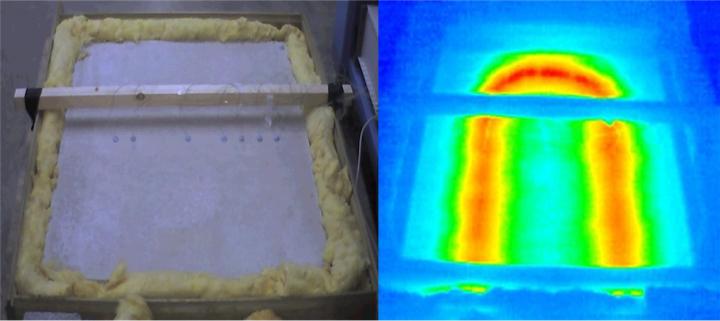
Firstly, they have studied the possibility of using industrial metal waste as a reinforcement in concrete or mortar, analysing mortars reinforced with brass fibres from electrical discharge machining. Secondly, and linked to this avenue of research aimed at reducing the amount of cement required, they have explored the use of lime mud waste from the paper industry, obtaining good results in terms of thermal conductivity and finding that the resulting material is adequate for use in radiant floor heating systems. And finally, they have used furnace slag as an aggregate: ‘the thermal conductivity of sand extracted from electric arc furnaces is low, making it a good option for insulation purposes,’ explains Dr Borinaga.

Although they are studying many different types of materials, what they are doing is basic research: ‘ours is the first step in researching these materials. Industrial by-products and waste are not particularly homogeneous, meaning that they vary greatly in accordance with their origin. Therefore, the first step is to analyse the properties bestowed by each specific type of waste. It is important to conduct these analyses with a large amount of waste with different origins, and to compare the results in order to determine whether or not the materials are suitable for use in manufacturing,’ he concludes.

###

Media Contact
Matxalen Sotillo
[email protected]

Original Source

https://www.ehu.eus/en/web/campusa-magazine/-/more-sustainable-mortars-and-concrete-with-optimal-thermal-and-mechanical-efficiency

Related Journal Article

http://dx.doi.org/10.1016/j.jobe.2021.102408

Tags: Civil EngineeringClimate ChangeIndustrial Engineering/ChemistryMechanical EngineeringNaturePollution/RemediationTechnology/Engineering/Computer ScienceUrbanization
Share12Tweet8Share2ShareShareShare2

Related Posts

Microenvironment Shapes Gold-Catalysed CO2 Electroreduction

Microenvironment Shapes Gold-Catalysed CO2 Electroreduction

December 11, 2025
Photoswitchable Olefins Enable Controlled Polymerization

Photoswitchable Olefins Enable Controlled Polymerization

December 11, 2025

Cation Hydration Entropy Controls Chloride Ion Diffusion

December 10, 2025

Iridium Catalysis Enables Piperidine Synthesis from Pyridines

December 3, 2025
Please login to join discussion

POPULAR NEWS

  • Scientists Uncover Chameleon’s Telephone-Cord-Like Optic Nerves, A Feature Missed by Aristotle and Newton

    Scientists Uncover Chameleon’s Telephone-Cord-Like Optic Nerves, A Feature Missed by Aristotle and Newton

    122 shares
    Share 49 Tweet 31
  • Nurses’ Views on Online Learning: Effects on Performance

    69 shares
    Share 28 Tweet 17
  • NSF funds machine-learning research at UNO and UNL to study energy requirements of walking in older adults

    70 shares
    Share 28 Tweet 18
  • MoCK2 Kinase Shapes Mitochondrial Dynamics in Rice Fungal Pathogen

    71 shares
    Share 28 Tweet 18

About

BIOENGINEER.ORG

We bring you the latest biotechnology news from best research centers and universities around the world. Check our website.

Follow us

Recent News

Long-Term Quality of Life After COVID-19 Recovery

Resilience Amid Challenges: Mothers of Autistic Children in Palestine

Gender Bias Shapes Telehealth Use in Obesity

Subscribe to Blog via Email

Enter your email address to subscribe to this blog and receive notifications of new posts by email.

Join 69 other subscribers
  • Contact Us

Bioengineer.org Ā© Copyright 2023 All Rights Reserved.

Welcome Back!

Login to your account below

Forgotten Password?

Retrieve your password

Please enter your username or email address to reset your password.

Log In
No Result
View All Result
  • Homepages
    • Home Page 1
    • Home Page 2
  • News
  • National
  • Business
  • Health
  • Lifestyle
  • Science

Bioengineer.org Ā© Copyright 2023 All Rights Reserved.