• HOME
  • NEWS
  • EXPLORE
    • CAREER
      • Companies
      • Jobs
    • EVENTS
    • iGEM
      • News
      • Team
    • PHOTOS
    • VIDEO
    • WIKI
  • BLOG
  • COMMUNITY
    • FACEBOOK
    • INSTAGRAM
    • TWITTER
Sunday, May 10, 2026
BIOENGINEER.ORG
No Result
View All Result
  • Login
  • HOME
  • NEWS
  • EXPLORE
    • CAREER
      • Companies
      • Jobs
        • Lecturer
        • PhD Studentship
        • Postdoc
        • Research Assistant
    • EVENTS
    • iGEM
      • News
      • Team
    • PHOTOS
    • VIDEO
    • WIKI
  • BLOG
  • COMMUNITY
    • FACEBOOK
    • INSTAGRAM
    • TWITTER
  • HOME
  • NEWS
  • EXPLORE
    • CAREER
      • Companies
      • Jobs
        • Lecturer
        • PhD Studentship
        • Postdoc
        • Research Assistant
    • EVENTS
    • iGEM
      • News
      • Team
    • PHOTOS
    • VIDEO
    • WIKI
  • BLOG
  • COMMUNITY
    • FACEBOOK
    • INSTAGRAM
    • TWITTER
No Result
View All Result
Bioengineer.org
No Result
View All Result
Home NEWS Science News Chemistry

Blood vessel formation in damaged tissues with mussel adhesive protein

Bioengineer by Bioengineer
April 12, 2021
in Chemistry
Reading Time: 3 mins read
0
IMAGE
Share on FacebookShare on TwitterShare on LinkedinShare on RedditShare on Telegram

IMAGE

Credit: POSTECH

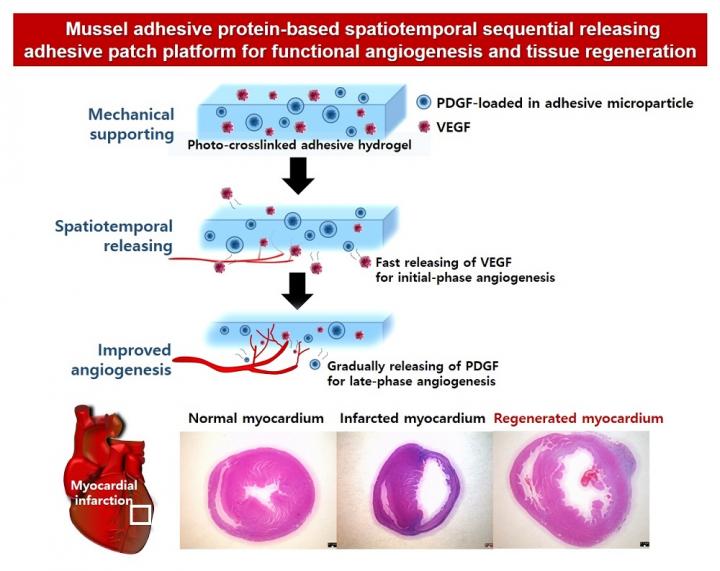
Blood vessels deliver nutrients and oxygen to each organ in our body. They are difficult to completely restore to their original conditions once damaged by myocardial infarction or severe ischemic diseases. This is because various angiogenic growth factors must be applied sequentially in order to restore the vascular structure. Recently, a research team at POSTECH has bioengineered a novel adhesive patch platform that can efficiently deliver blood vessel-forming growth factors spatiotemporally using mussel adhesive protein (MAP), a bio-adhesive material that is made from mussels harmless to humans.

A POSTECH research team led by Professor Hyung Joon Cha and Dr. Tae Yoon Park of the Department of Chemical Engineering has developed a drug-delivering adhesive patch using two formulations – coacervate-based microparticles and light activation-based crosslinked hydrogels – that can be mass-produced. The team verified their effectiveness in tissue regeneration including neovascularization using a rat model for myocardial infarction and excisional wound model incapable of self-healing.

The research team produced microparticles by instantaneously encapsulating and crosslinking platelet-derived growth factor (PDGF) required for the late-phase angiogenesis during the process of forming coacervate microdroplets formed by the electrostatic interaction of MAP and hyaluronic acid.

In addition, PDGF-loaded microparticles and the vascular endothelial growth factor (VEGF) required for initial-phase angiogenic factor are simultaneously encapsulated in a MAP-based crosslinked hydrogel, spatially separated and mounted the two factors easily and quickly.

This effective novel angiogenesis-inducing platform showed that PDGF was secreted and delivered 1.9 times later in time despite its smaller size than VEGF. In addition, the team confirmed that the platform allows crosslinking to occur instantaneously so that it can easily adhere even to uneven curved surfaces.

“We have developed a new platform that can efficiently deliver angiogenic factors spatiotemporally by using the formulation property of MAP, an original biomaterial,” remarked Professor Hyung Joon Cha who has long devoted himself to studying the MAP. “It is of great significance that we have confirmed the functional recovery beyond effective neovascularization by applying it to actual animal model of myocardial infarction and severely damaged skin model.”

“It will be successfully applicable to chronic and ischemic diseases in a similar environment.” He added eagerly, “This platform can play a key role in the neovascularization treatment market as it uses biocompatible biomaterials that are harmless to the human body.”

###

This MAP-based hydrogel and coacervate liquid microdroplets fabrication technology have undergone a technology transfer to Nature Gluetech Co., Ltd. and is currently being commercialized.

The finding of this study was published in Biomaterials, the most authoritative journal in the field of biomaterials. The study was conducted with the support from the health and medical technology development project supported by the Ministry of Health and Welfare and the Korea Institute for Health Industry Promotion, and as part of the Nano-New Materials Core Technology Development Program of the Ministry of Science and ICT and the National Research Foundation of Korea.

Media Contact
Jinyoung Huh
[email protected]

Original Source

https://postech.ac.kr/eng/blood-vessel-formation-in-damaged-tissues-with-mussel-adhesive-protein/#post-22471

Related Journal Article

http://dx.doi.org/10.1016/j.biomaterials.2021.120774

Tags: BiochemistryBiologyBiomechanics/BiophysicsBiotechnologyChemistry/Physics/Materials SciencesClinical TrialsMarine/Freshwater BiologyMedicine/HealthTechnology/Engineering/Computer Science
Share12Tweet8Share2ShareShareShare2

Related Posts

Miniature Sensor Uses Light to Detect Touch — Chemistry

Miniature Sensor Uses Light to Detect Touch

May 8, 2026
Iron Minerals Determine Whether Dissolved Organic Matter Fuels Microbes or Becomes Long-Term Carbon Storage — Chemistry

Iron Minerals Determine Whether Dissolved Organic Matter Fuels Microbes or Becomes Long-Term Carbon Storage

May 8, 2026

Kate Evans Appointed Associate Lab Director for Biological and Environmental Systems Science at ORNL

May 8, 2026

Advancing Multiscale Modeling and Overcoming Operational Challenges in Autothermal COâ‚‚-to-Methanol Reactors

May 8, 2026
Please login to join discussion

POPULAR NEWS

  • Research Indicates Potential Connection Between Prenatal Medication Exposure and Elevated Autism Risk

    840 shares
    Share 336 Tweet 210
  • New Study Reveals Plants Can Detect the Sound of Rain

    727 shares
    Share 290 Tweet 181
  • Scientists Investigate Possible Connection Between COVID-19 and Increased Lung Cancer Risk

    68 shares
    Share 27 Tweet 17
  • Salmonella Haem Blocks Macrophages, Boosts Infection

    61 shares
    Share 24 Tweet 15

About

We bring you the latest biotechnology news from best research centers and universities around the world. Check our website.

Follow us

Recent News

Evaluating Digoxin Use in Patients with Symptomatic Rheumatic Heart Disease

Evaluating the Effectiveness and Safety of Digitalis Glycosides in Treating Heart Failure

Urdu Fall Risk Questionnaire Adapted for Elderly

Subscribe to Blog via Email

Enter your email address to subscribe to this blog and receive notifications of new posts by email.

Join 82 other subscribers
  • Contact Us

Bioengineer.org © Copyright 2023 All Rights Reserved.

Welcome Back!

Login to your account below

Forgotten Password?

Retrieve your password

Please enter your username or email address to reset your password.

Log In
No Result
View All Result
  • Homepages
    • Home Page 1
    • Home Page 2
  • News
  • National
  • Business
  • Health
  • Lifestyle
  • Science

Bioengineer.org © Copyright 2023 All Rights Reserved.