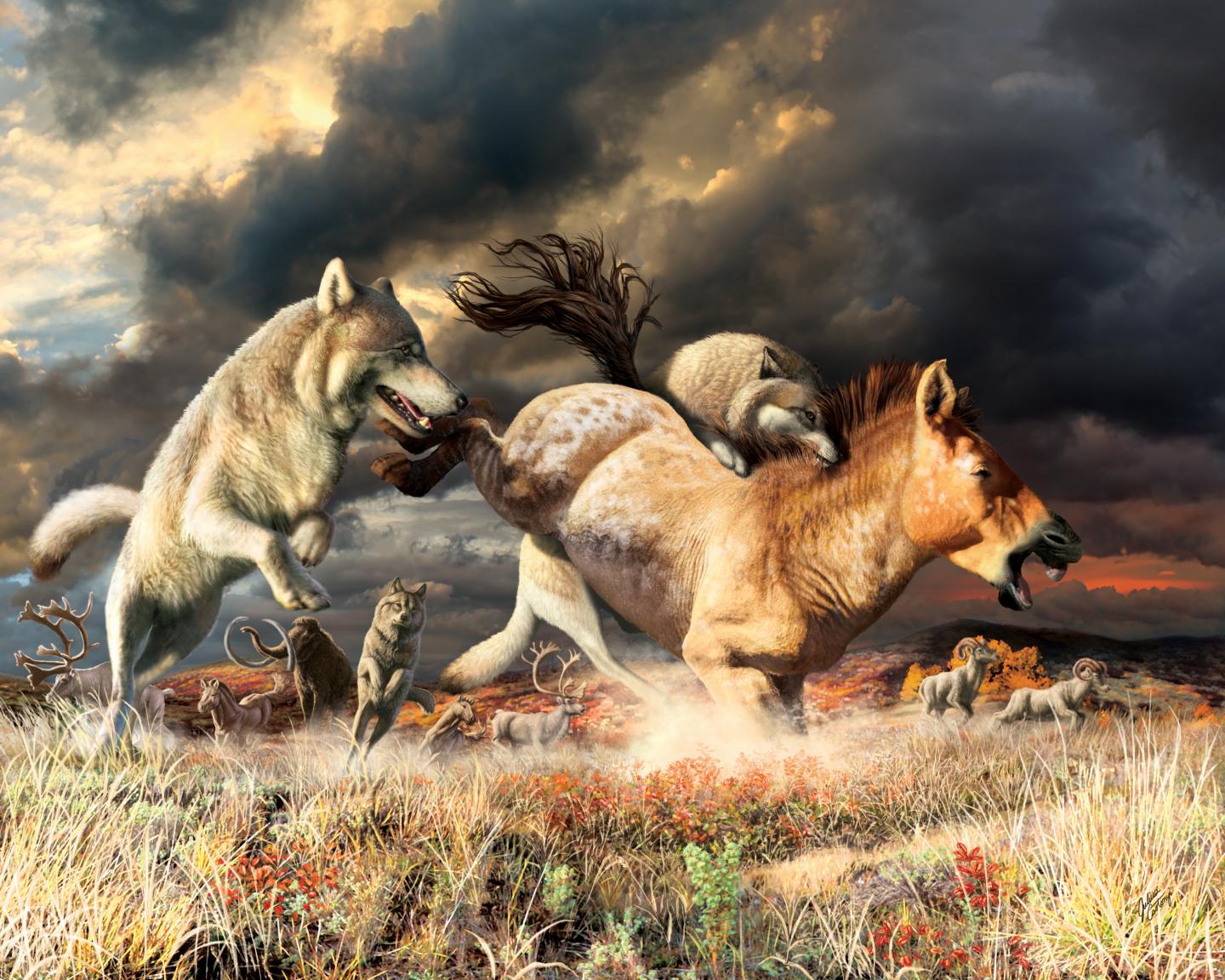
Credit: Julius Csotonyi
April12, 2021 – Gray wolves are among the largest predators to have survived the extinction at the end of the last ice age around11,700 years ago. Today, they can be found roaming Yukon’s boreal forest and tundra, with caribou and moose as their main sources of food.
A new study led by the Canadian Museum of Nature shows that wolves may have survived by adapting their diet over thousands of years—from a primary reliance on horses during the Pleistocene, to caribou and moose today. The results are published in the journal Palaeogeography, Palaeoclimatology, Palaeoecology.
The research team, led by museum palaeontologist Dr. Danielle Fraser and student Zoe Landry, analysed evidence preserved in teeth and bones from skulls of both ancient (50,000 to 26,000 years ago) and modern gray wolves. All the specimens were collected in Yukon, a region that once supported the Beringia mammoth-steppe ecosystem, and are curated in the museum’s national collections as well as those of the Yukon government.
“We can study the change in diet by examining wear patterns on the teeth and chemical traces in the wolf bones,” says Landry, the lead author who completed the work as a Carleton University student under Fraser’s supervision. “These can tell us a lot about how the animal ate, and what the animal was eating throughout its life, up until about a few weeks before it died.”
Landry and Fraser relied on established models that can determine an animal’s eating behaviour by examining microscopic wear patterns on its teeth. Scratch marks indicate the wolf would have been consuming flesh, while the presence of pits would suggest chewing and gnawing on bones, likely as a scavenger.
Analysis showed that scratch marks prevailed in both the ancient and modern wolf teeth, meaning that the wolves continued to survive as primary predators, hunting their prey.
What then were the gray wolves eating? The modern diet – caribou and moose – is well established. The diet of the ancient wolves was assessed by looking at the ratios of carbon and nitrogen isotopes extracted from collagen in the bones. Relative levels of the isotopes can be compared with established indicators for specific species. “The axiom, you are what you eat comes into play here,” says Landry.
Results showed that horses, which went extinct during the Pleistocene, accounted for about half of the gray wolf diet. About 15% came from caribou and Dall’s sheep, with some mammoth mixed in. All this at a time when the ancient wolves would have co-existed with other large predators such as scimitar cats and short-faced bears. The eventual extinction of these predators could have created more opportunity for the wolves to transition to new prey species.
“This is really a story of ice age survival and adaptation, and the building up of a species towards the modern form in terms of ecological adaptation,” notes Dr. Grant Zazula, study co-author, and Government of Yukon paleontologist who is an expert on the ice-age animals that populated Beringia.
The findings have implications for conservation today. “The gray wolves showed flexibility in adapting to a changing climate and a shift in habitat from a steppe ecosystem to boreal forest,” explains Fraser. “And their survival is closely linked to the survival of prey species that they are able to eat.”
Given the reliance of modern gray wolves on caribou, the study’s authors suggest that the preservation of caribou populations will be an important factor in maintaining a healthy wolf population.
###
This study was funded by an NSERC Discovery Grant awarded to Dr. Danielle Fraser. Isotope analysis was done by Dr. Sora Kim and Dr. Robin Trayler at the University of California, Merced. In all, the research team acquired data from 31 Pleistocene skulls as well as data from 17 modern skulls (most collected in the 1960s). All specimens are in the collections of the Canadian Museum of Nature and the Government of Yukon.
Information for media, including images:
Dan Smythe
Head, Media Relations
Canadian Museum of Nature
613-698-9253 (cell)
[email protected]
Media Contact
Daniel Smythe
[email protected]
Original Source
https:/
Related Journal Article
http://dx.