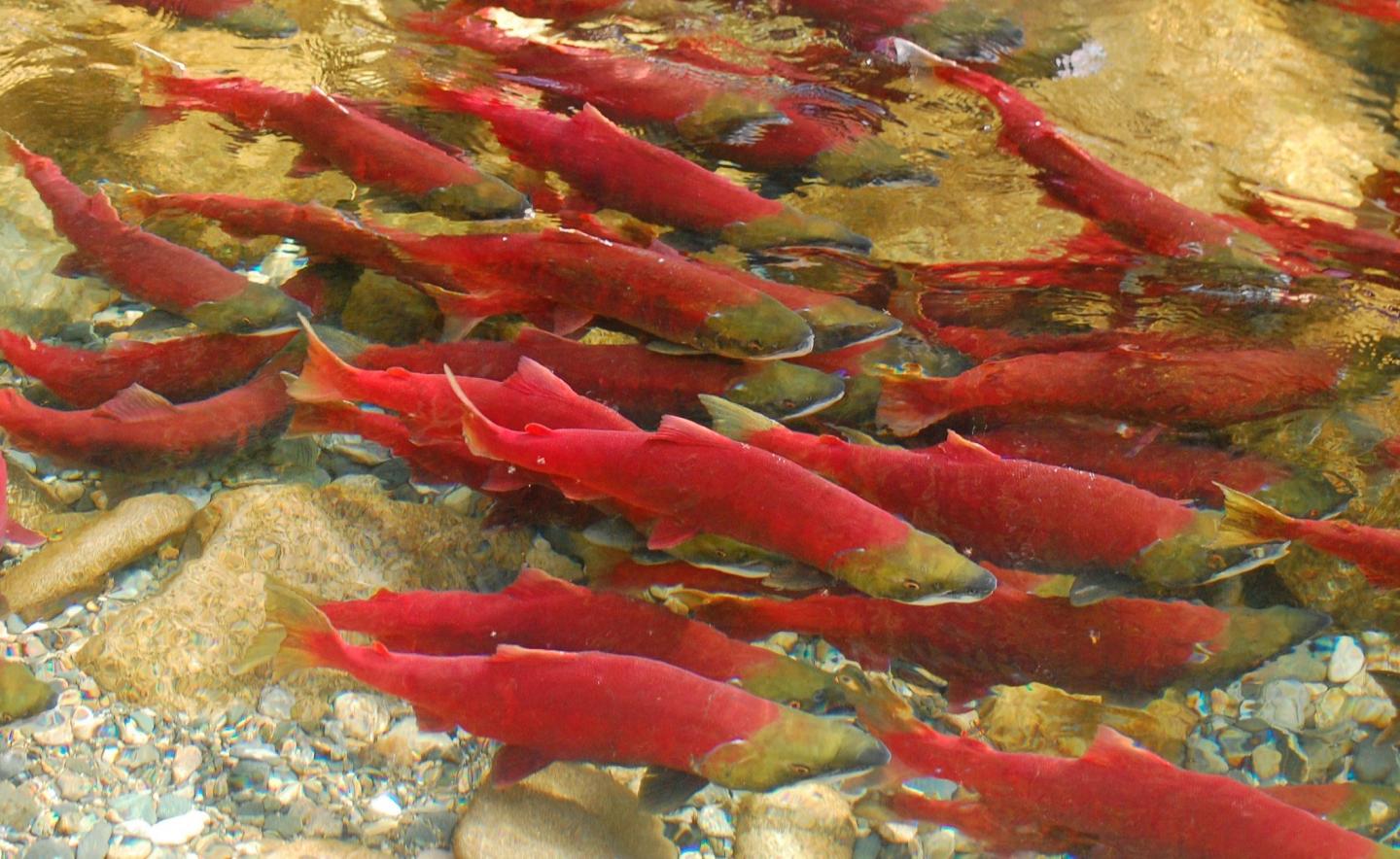
Credit: UBC
Female adult sockeye from the Fraser River are dying at significantly higher rates than their male counterparts on the journey back to their spawning grounds, finds new UBC research. For every male salmon that doesn’t make it to their natal stream, at least two, sometimes three female salmon die.
“This is causing skewed sex ratios in their spawning grounds, something that has been observed in recent years,” says lead researcher Dr. Scott Hinch, a professor in the faculty of forestry and head of the Pacific Salmon Ecology and Conservation Laboratory at UBC. “The implications on the health of Fraser River stocks are concerning, particularly as Pacific salmon populations in British Columbia have been declining over the past several decades.”
Hinch noted that records in the 1930s and even up to the early 1990s show that for most years, females outnumbered males on spawning grounds. The sex ratios started to change in the early 2000s towards relatively fewer females.
“A combination of environmental stressors could have triggered the shift,” he explains. “More females die relative to males when migration conditions are challenging. This happens when the water is too warm, or there is too much turbulence, or when the fish have been handled or released from capture. Stressful events have a larger impact on females.”
The trend of higher female mortality when environmental conditions are challenging also was identified in other Pacific salmon species including Coho and Chinook salmon, and in sockeye in other river systems.
Energy, heart function, stress and disease identified as factors
Hinch and his collaborators came up with their finding after reviewing 19 major studies on salmon, including tagging and tracking studies in the field, and laboratory studies. They are proposing four reasons why females are dying at higher rates than males in the studies they reviewed: depletion of energy reserves, reduced cardiac capacity, stress and disease.
“Females have higher heart rates and smaller hearts than males leading to reduced cardiac capacity. Because female gonads are so large compared to males, they have to divert way more blood to them especially as the eggs are developing and this requires even more oxygen supply from the heart, so it’s likely that when the migration is difficult, females are not able to get enough oxygen to swim.”
Sockeye and other Pacific salmon don’t feed during their river migration and the females, more so than the males, can also run out of stored energy reserves earlier. “Females are also more susceptible to stress, and to pathogens, so a combination of factors is likely causing their higher mortality.”
In 2019, the Committee on the Status of Endangered Wildlife in Canada (COSEWIC), an independent committee of wildlife experts and scientists, designated 24 salmon populations in southern B.C. as threatened or endangered, including several of the sockeye populations that Hinch and his colleagues studied.
“The conservation and management implications of our findings are significant,” says Hinch. “Pacific salmon stocks are important ecologically, but also culturally and as food security to First Nations, and for commercial and recreational fisheries. Salmon fishing in British Columbia supports more than 8,000 jobs and generates over $200 million in tax revenues annually, while commercial fisheries bring in up to $200 million a year. Recreational fishing contributes almost $1 billion in economic impact each year.”
Potential solutions
Hinch and his team are recommending actions like adjusting harvest rates to protect female salmon, and ensuring migration routes have fewer obstacles to ensure females are able to complete their migrations. This is a particularly large issue at present as a fishway is now being built at the site of the Fraser River Big Bar landslide, an area that has impeded spawning migrations for the past two years.
“A few years ago we studied the migration of sockeye salmon through the Seton River Dam and Fishway near Lillooet, B.C., and proposed that some small adjustments by BC Hydro to flows at this dam could improve salmon passage, which they did. Female salmon benefitted the most, showing us that basic research can be used to fine-tune our management actions to improve the survival of female salmon.”
Hinch and his team acknowledge that more research is needed to fully understand the mechanisms behind the different mortality rates in salmon. But they warn that as rivers continue to warm with climate change, we will see even higher rates of female mortality.
###
The study, “Exceptionally high mortality of migrating female salmon: a large-scale emerging trend and a conservation concern” was published recently in the Canadian Journal of Fisheries and Aquatic Sciences.
Multimedia assets: Dropbox https:/
Media Contact
Lou Corpuz-Bosshart
[email protected]
Original Source
https:/
Related Journal Article
http://dx.