New method for more accurately estimating the location of tectonic tremors in deep ocean faults could help to better understand earthquake rupture processes
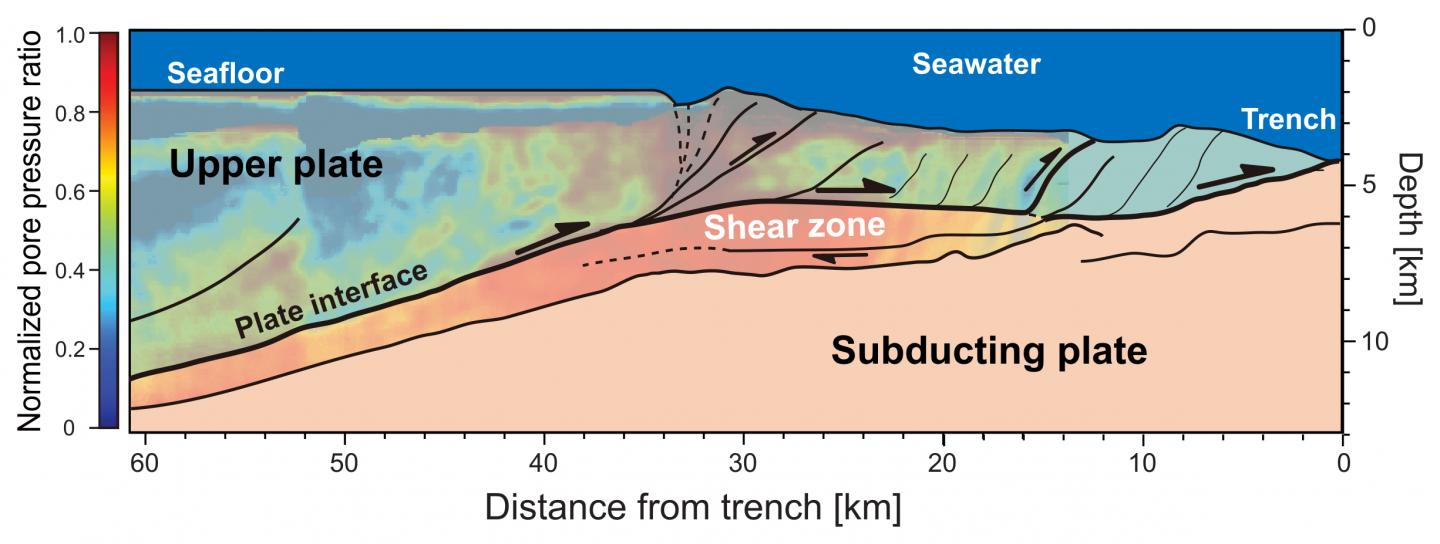
Credit: Takeshi Tsuji, Kyushu University
Researchers from Japan and Indonesia have pioneered a new method for more accurately estimating the source of weak ground vibrations in areas where one tectonic plate is sliding under another in the sea. Applying the approach to Japan’s Nankai Trough, the researchers were able to estimate previously unknown properties in the region, demonstrating the method’s promise to help probe properties needed for better monitoring and understanding larger earthquakes along this and other plate interfaces.
Episodes of small, often imperceptible seismic events known as tremors occur around the world and are particularly common in areas near volcanoes and subduction zones–regions where one of the massive plates forming Earth’s outer layers slides under another. Though they may be weak, studying these vibrations is important for estimating features of the associated tectonic plate boundaries and is necessary for detecting slipping among the plates that can be used to warn against larger earthquake events and tsunamis.
“Tremor episodes occur frequently in subduction zones, but their point of origin can be difficult to determine as they have no clear onset features like the sudden, strong shaking seen with ordinary earthquakes,” explains Takeshi Tsuji, leader of the study’s research team from Kyushu University’s International Institute for Carbon-Neutral Energy Research (I2CNER).
“Current techniques to identify their source rely on waveform readings from nearby seismic stations together with a modelling system, but complex geological structures can greatly influence the results, leading to inaccurate travel times.”
The I2CNER team developed the new methodology to take into account some of the complexities of subduction zones such as the Nankai Trough and estimate more accurate travel times from source to station. The novel approach involves a model that does not rely on a constant waveform and also considers the relationships between tremors detected at all possible pairs of monitoring stations.
“Applying this method to the Nankai Trough, we found that most tremors occurred in areas of high fluid pressure called the shear zone on the plate boundary,” says study lead author Andri Hendriyana.
“The thickness of the shear zone was found to be a major controlling factor for the tremor epicentre, with the tremor sequence initiating at regions where fluid pressures within the rocks are the greatest.”
Having better determined the locations of several tremors, the research could also more accurately estimate the speed of tremor propagation. Using this information, the team was then able to estimate how easily liquids can move through the deep fault. Known as permeability, this property is important for evaluating earthquake rupture processes and had never before been reported for the deep plate interface of the Nankai Trough.
“Accurately determining tremor source and related geophysical properties is crucial in the monitoring and modelling of larger earthquakes along the plate interface,” comments Tsuji. “Our method can also be applied in other regions where tremor location estimation is difficult because of a complex geography to better obtain this vital information.”
###
For more information about this research, see “Influence of structure and pore pressure of plate interface on tectonic tremor in the Nankai subduction zone, Japan,” Andri Hendriyana and Takeshi Tsuji, Earth and Planetary Science Letters (2021).
https:/
Media Contact
William J. Potscavage Jr.
[email protected]
Original Source
https:/
Related Journal Article
http://dx.