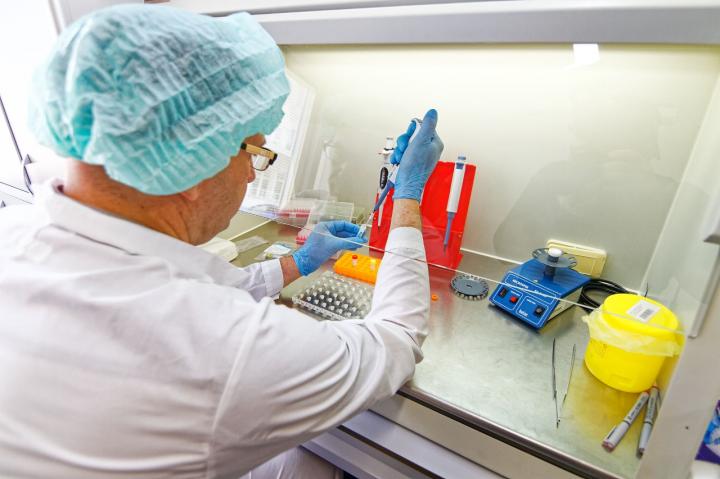
Credit: FEFU press office
Scientists from Far Eastern Federal University (FEFU) together with Russian and German colleagues, continue studying antitumor compounds synthesized based on bioactive molecules isolated from a sea sponge. One of them fights cancer cells resistant to standard chemotherapy, and at the same time has an interesting dual mechanism of action. A related article appears in Marine Drugs.
Scientists have tested the biological effect of the marine alkaloid 3,10-dibromofascaplysin on various prostate cancer cells, including those resistant to standard docetaxel-based chemotherapy. The compound was first isolated from the sea sponge Fascaplysinopsis reticulata and subsequently chemically synthesized in FEFU. The substance forces tumor cells to die via a programmed cell death mechanism. This process is called “apoptosis” and is considered the most favorable mode of action of anticancer drugs.
“The examined compound, while killing cancer cells, even ones resistant to standard chemotherapy, simultaneously activates an enzyme (so-called «kinase») protecting these tumor cells. However, it can’t be considered as a “good” or “bad” effect. This is just a mechanism of action, an understanding of which suggests us to apply 3,10-dibromofascaplysin together with inhibitors of these enzymes,” says Dr. Sergey Dyshlovoy, from the Laboratory of biologically active substances of FEFU School of Natural Sciences, senior researcher in the laboratory of the pharmacology of National Scientific Centre of Marine Biology (Vladivostok, Russia).
According to the scientist, the synthesized compound in addition to its own activity, works well in combination with several already approved anticancer drugs, enhancing their antitumor effect.
Next, scientists are planning to examine how 3,10-dibromofascaplysin affects non-cancer cells. They already run a related project supported by the Russian Foundation for Basic Research, aiming to report the outcomes during 2021.
“Fascaplysins are rather toxic to non-cancer cells. In our laboratory, we are trying to modify the structure of these compounds in order to reduce their cytotoxic effect on normal cells, while maintaining the necessary antitumor effect. The goal is to create a substance for targeted therapy, with a minimum of side effects for healthy cells of the body,” says Dr. Maxim Zhidkov, Head of Department of Organic Chemistry, FEFU School of Natural Sciences.
Commented on the time needed for the development of the on-the-shelf drug, scientists speak about the horizon of 10-15 years, given the necessity for long preliminary and further clinical trials.
###
In the study took part specialists from the Far Eastern Federal University, A.V. Zhirmunsky National Scientific Center of Marine Biology (RAS, Vladivostok), Martini Clinic (Germany), University Medical Center Hamburg-Eppendorf (Germany), V.N. Orekhovich Research Institute of Biomedical Chemistry (Russian Academy of Sciences), V.A. Engelhardt Institute of Molecular Biology (RAS, Moscow).
The World Ocean is one of the priority research run in the FEFU. University scientists conduct research on bioactive molecules of marine origin, develop engineering solutions for Arctic ice platforms (exploration and production of minerals), underwater robotics, under-ice communications, etc.
Media Contact
Alexander Zverev
[email protected]
Related Journal Article
http://dx.