• HOME
  • NEWS
  • EXPLORE
    • CAREER
      • Companies
      • Jobs
    • EVENTS
    • iGEM
      • News
      • Team
    • PHOTOS
    • VIDEO
    • WIKI
  • BLOG
  • COMMUNITY
    • FACEBOOK
    • INSTAGRAM
    • TWITTER
Sunday, February 8, 2026
BIOENGINEER.ORG
No Result
View All Result
  • Login
  • HOME
  • NEWS
  • EXPLORE
    • CAREER
      • Companies
      • Jobs
        • Lecturer
        • PhD Studentship
        • Postdoc
        • Research Assistant
    • EVENTS
    • iGEM
      • News
      • Team
    • PHOTOS
    • VIDEO
    • WIKI
  • BLOG
  • COMMUNITY
    • FACEBOOK
    • INSTAGRAM
    • TWITTER
  • HOME
  • NEWS
  • EXPLORE
    • CAREER
      • Companies
      • Jobs
        • Lecturer
        • PhD Studentship
        • Postdoc
        • Research Assistant
    • EVENTS
    • iGEM
      • News
      • Team
    • PHOTOS
    • VIDEO
    • WIKI
  • BLOG
  • COMMUNITY
    • FACEBOOK
    • INSTAGRAM
    • TWITTER
No Result
View All Result
Bioengineer.org
No Result
View All Result
Home NEWS Science News Chemistry

The magic angle of twisted graphene

Bioengineer by Bioengineer
February 23, 2021
in Chemistry
Reading Time: 2 mins read
0
IMAGE
Share on FacebookShare on TwitterShare on LinkedinShare on RedditShare on Telegram

IMAGE

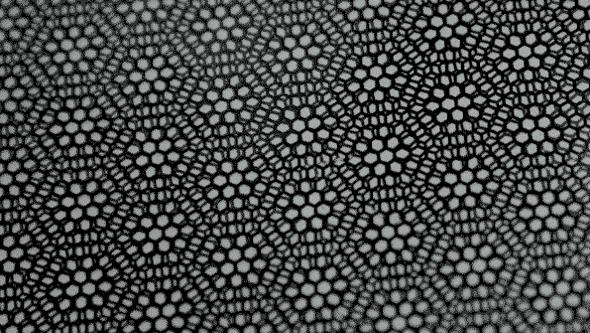
Credit: JC Charlier UCLouvain

Graphene, a two-dimensional material composed exclusively of carbon, has revealed extraordinary properties, including thermal and electrical conductivity, transparency, and flexibility. When combined, these properties become particularly interesting in the age of touch screens and flexible electronics! ‘Unlike 3D materials, graphene has a height reduced to the ultimate dimension of the atom. It’s therefore a carbon atom plane,’ explains Prof. Jean-Christophe Charlier, a specialist in nanoscopic physics at the Institute of Condensed Matter and Nanosciences of UCLouvain.

In a study published in Nature, the scientist and his team dissected the behaviour of electrons when two layers of graphene superimposed at an angle of 1.1 degrees (the so-called ‘magic angle’) produce a moiré effect. Well known to photographers, painters and fashion specialists, this optical effect consists of a figure composed of dark and light domains resulting from the superposition of two gratings. ‘When two layers of graphene are superimposed with this magic angle, they give rise to superconductivity. They therefore conduct electricity without any resistance,’ Prof. Charlier says. This property is more than useful for transporting electricity without loss of energy. ‘We’ve shown that the two graphene planes twisted in this way interact and lead to a restructuring of the atoms into domains where electrons are trapped and localised in space.’ However, by definition, electrons tend to move away from one other, repelled by their respective negative charges. ‘To limit their interactions, the electrons can organise themselves by aligning their spin, which gives them magnetic properties, or by forming an insulator, or by pairing up to produce superconductivity.’ It’s the last that occurs in the case of bilayer graphene twisted at the magic angle. In addition, the scientists have shown that phonons, atom particles responsible for vibrations in solid materials, are also trapped in the domains formed by the twisted graphene.

The synthesis of new 2D materials and the observation of the extraordinary properties which can be derived from them have led to a twistronics craze driven by the idea of one day being able to create structures with the desired properties ‘brick by brick’, or to extrapolate knowledge acquired on simple materials, such as graphene, to more complex materials, allowing for better control or performance of superconducting systems in everyday life. Examples include the superconducting coils in Japanese magnetic levitation trains (Maglev), which levitate above the rails, or the superconducting magnet in magnetic resonance imaging (MRI) equipment.

###

Media Contact
Jean-Christophe Charlier
[email protected]

Original Source

https://uclouvain.be/fr/chercher/actualites/l-angle-magique-du-graphene-bicouche.html

Related Journal Article

http://dx.doi.org/10.1038/s41586-021-03252-5

Tags: Chemistry/Physics/Materials SciencesElectromagneticsMaterialsNanotechnology/MicromachinesSuperconductors/Semiconductors
Share12Tweet8Share2ShareShareShare2

Related Posts

blank

Breakthrough in Environmental Cleanup: Scientists Develop Solar-Activated Biochar for Faster Remediation

February 7, 2026
blank

Cutting Costs: Making Hydrogen Fuel Cells More Affordable

February 6, 2026

Scientists Develop Hand-Held “Levitating” Time Crystals

February 6, 2026

Observing a Key Green-Energy Catalyst Dissolve Atom by Atom

February 6, 2026
Please login to join discussion

POPULAR NEWS

  • Robotic Ureteral Reconstruction: A Novel Approach

    Robotic Ureteral Reconstruction: A Novel Approach

    82 shares
    Share 33 Tweet 21
  • Digital Privacy: Health Data Control in Incarceration

    63 shares
    Share 25 Tweet 16
  • Breakthrough in RNA Research Accelerates Medical Innovations Timeline

    53 shares
    Share 21 Tweet 13
  • Mapping Tertiary Lymphoid Structures for Kidney Cancer Biomarkers

    50 shares
    Share 20 Tweet 13

About

We bring you the latest biotechnology news from best research centers and universities around the world. Check our website.

Follow us

Recent News

Evaluating a Self-Care App for Chest Trauma Patients

Anesthesia Method’s Impact on Elderly Hip Fracture Recovery

Menopause Care: Insights from Workforce Review and Consultation

Subscribe to Blog via Email

Enter your email address to subscribe to this blog and receive notifications of new posts by email.

Join 73 other subscribers
  • Contact Us

Bioengineer.org © Copyright 2023 All Rights Reserved.

Welcome Back!

Login to your account below

Forgotten Password?

Retrieve your password

Please enter your username or email address to reset your password.

Log In
No Result
View All Result
  • Homepages
    • Home Page 1
    • Home Page 2
  • News
  • National
  • Business
  • Health
  • Lifestyle
  • Science

Bioengineer.org © Copyright 2023 All Rights Reserved.