Perovskite LEDs with the world’s highest efficiency (EQE = 23.4%) — Seoul National University and University of Pennsylvania
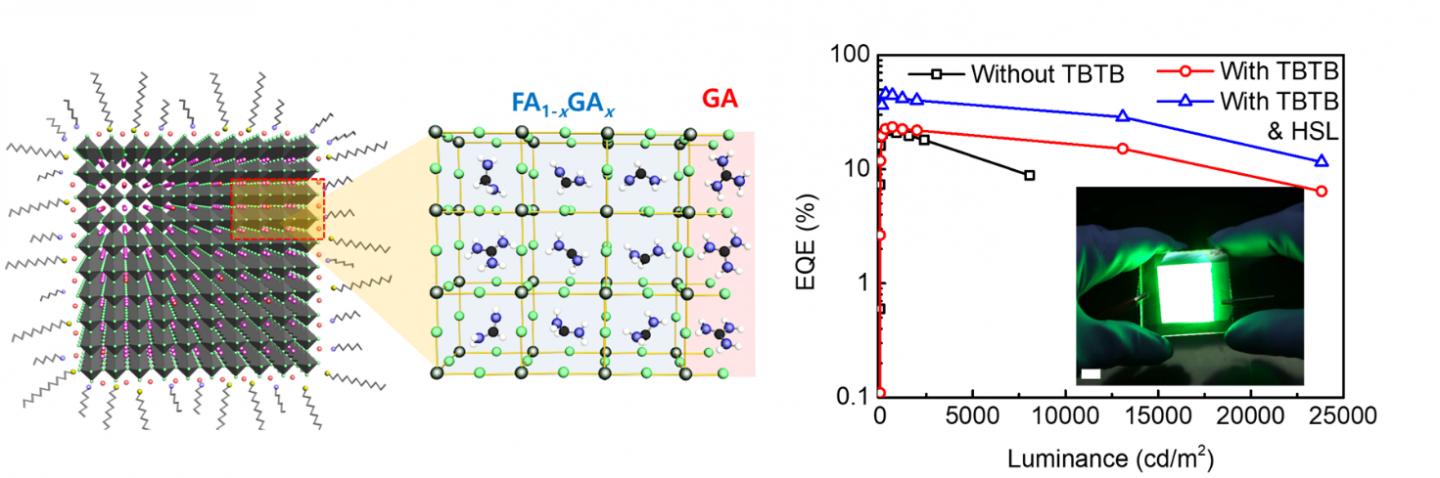
Credit: seoul national university
Research team at Seoul National University (Prof. Tae-Woo Lee) and University of Pennsylvania (Prof. Andrew M. Rappe) developed perovskite light-emitting diodes (PeLEDs) with an external quantum efficiency (EQE) of 23.4%. The research results were published in Nature Photonics, which is the world-renowned international academic journal, on January 4th (Title: Comprehensive defect suppression in perovskite nanocrystals for high-efficiency light-emitting diodes).
Metal halide perovskites have very narrow spectral emission, excellent color purity, low material cost, and wide and easy color-tunability. Based on these advantages, perovskites are considered as a promising high color purity light emitter which can replace the conventional organic and inorganic quantum dot (QD) light emitters in displays and solid-state lighting technologies. Especially, perovskite is the only one emitter which can meet the standard of REC.2020. Therefore, perovskite is expected to contribute to the future ultra-high-definition television (UHD-TV) technology.
Since professor Tae-Woo Lee reported the PeLEDs with EQE of 8.53% which was comparable to that of phosphorescent organic light-emitting diode (LED) in Science in 2015, electroluminescence efficiencies of PeLEDs have been dramatically increased. After the Science paper, professor Tae-Woo Lee has lead the research fields of PeLEDs and recently achieved a EQE of 23.4% which was published in Nature Photonics. This EQE value is the highest efficiency in PeLEDs to date and even surpasses the highest EQE in InP-based green-emitting QD-LEDs (EQE = 13.6%). This improvement of EQE in PeLEDs is much faster than that in QD-LEDs which took 20 years to achieve EQE of 20% since it was first reported. These highlight the possibility of a commercialization of the perovskite emitters in industrial displays and solid-state lighting technologies.
Perovskites have severe problems to emit light at room temperature; small exciton binding energy induces direct dissociation of charge carriers and results in low luminescence efficiencies. To overcome this intrinsic problem, researchers have devoted to synthesizing colloidal perovskite nanocrystals which have a size of several nanometers (1 billionth of a meter). In such a small dimension, charge carriers can be spatially confined and can have high binding energy. However, due to the small size and concomitant high surface-to-volume ratio, perovskite nanocrystals have large surface defects. Furthermore, surface organic ligands are easily detached from the nanocrystal surfaces due to the dynamic binding nature, which induces many defects on the nanocrystal surfaces. Therefore, new strategy to effectively passivate the defects should be needed.
To solve these problems, Seoul National University research team led by Professor Tae-Woo Lee proposed a comprehensive strategy which introduces guanidinium organic cations into the conventional formamidinium-based perovskite nanocrystals. The introduced guanidinium cations controlled the defects both inside the nanocrystals and on the surfaces, and simultaneously confined the charge carriers more effectively inside the nanocrystals. As a result, perovskite nanocrystals achieve very high photoluminescence quantum efficiency (PLQE>90%) in both films and solutions. In addition, research team removed residual defects on nanocrystal surfaces by using a halide-based defect passivation agent, 1,3,5-tris(bromomethyl)-2,4,6-triethylbenzene (TBTB). With these comprehensive strategies, the research team demonstrated PeLEDs with the world’s highest EQE (23.4%) and current efficiency (108 cd A-1). This is the highest device efficiency in PeLEDs to date and even surpasses the highest efficiency in InP-based green emitting QD-LEDs (EQE = 13.6%).
A collaborative research team at University of Pennsylvania, led by Professor Andrew M Rappe, investigated a detailed defect suppression mechanism through the density functional theory (DFT) calculation. The collaborative research team investigated the mechanism that guanidinium can be incorporated into the nanocrystals in small concentrations (~10%), above which guanidinium migrates to the surface outermost layer of nanocrystals. Furthermore, the collaborative research team studied how this guanidinium doping passivates the defects both inside the nanocrystals and on the surfaces. In addition, collaborative research team investigated the principle that halide-based TBTB material passivates the residual defects on the surfaces.
Prof. Tae-Woo Lee said, “We have proposed a comprehensive strategies to passivate the defects and increase the radiative recombination in the perovskite nanocrystals for demonstrating extremely efficient PeLEDs”. “We expect that our work contributes to the commercialization of PeLEDs, as well as suggests a way to increase the luminescence efficiency of the PeLEDs.” said Tae-Woo.
###
This work was funded by the National Research Foundation of Korea (NRF) grant funded by the Korea government.
Media Contact
Tae-woo Lee
[email protected]