• HOME
  • NEWS
  • EXPLORE
    • CAREER
      • Companies
      • Jobs
    • EVENTS
    • iGEM
      • News
      • Team
    • PHOTOS
    • VIDEO
    • WIKI
  • BLOG
  • COMMUNITY
    • FACEBOOK
    • INSTAGRAM
    • TWITTER
Saturday, February 7, 2026
BIOENGINEER.ORG
No Result
View All Result
  • Login
  • HOME
  • NEWS
  • EXPLORE
    • CAREER
      • Companies
      • Jobs
        • Lecturer
        • PhD Studentship
        • Postdoc
        • Research Assistant
    • EVENTS
    • iGEM
      • News
      • Team
    • PHOTOS
    • VIDEO
    • WIKI
  • BLOG
  • COMMUNITY
    • FACEBOOK
    • INSTAGRAM
    • TWITTER
  • HOME
  • NEWS
  • EXPLORE
    • CAREER
      • Companies
      • Jobs
        • Lecturer
        • PhD Studentship
        • Postdoc
        • Research Assistant
    • EVENTS
    • iGEM
      • News
      • Team
    • PHOTOS
    • VIDEO
    • WIKI
  • BLOG
  • COMMUNITY
    • FACEBOOK
    • INSTAGRAM
    • TWITTER
No Result
View All Result
Bioengineer.org
No Result
View All Result
Home NEWS Science News Biology

Study identifies a nonhuman primate model that mimics severe COVID-19 similar to humans

Bioengineer by Bioengineer
January 19, 2021
in Biology
Reading Time: 2 mins read
0
IMAGE
Share on FacebookShare on TwitterShare on LinkedinShare on RedditShare on Telegram

New research published in The American Journal of Pathology suggests that aged African green monkeys may be suitable models for the study of severe forms of COVID-19
IMAGE

Credit: The American Journal of Pathology

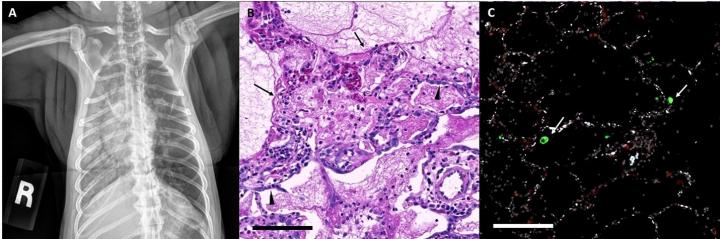
Philadelphia, January 19, 2021 – Aged, wild-caught African green monkeys exposed to the SARS-CoV-2 virus developed acute respiratory distress syndrome (ARDS) with clinical symptoms similar to those observed in the most serious human cases of COVID-19, report researchers in The American Journal of Pathology, published by Elsevier. This is the first study to show that African green monkeys can develop severe clinical disease after SARS-CoV-2 infection, suggesting that they may be useful models for the study of COVID-19 in humans.

“Animal models greatly enhance our understanding of diseases. The lack of an animal model for severe manifestations of COVID-19 has hampered our understanding of this form of the disease,” explained lead investigator Robert V. Blair, DVM, PhD, Dip ACVP, Tulane National Primate Research Center, Covington, LA, USA. “If aged green monkeys prove to be a consistent model of severe COVID-19, studying the disease pathobiology in them would improve our understanding of the disease and allow testing treatment options.”

The researchers exposed four aged rhesus macaques and four aged African green monkeys to SARS-CoV-2. Older animals (13-16 years of age) were specifically chosen to see if they would develop the severe form of the disease that is observed more frequently in elderly individuals. All of the monkeys developed a spectrum of disease from mild to severe COVID-19. A day after routine screening found no remarkable symptoms, two of the African green monkeys developed rapid breathing that quickly progressed to severe respiratory distress. Radiographic studies found the two African green monkeys had widespread opacities in the lungs, in stark contrast to images taken the day before, highlighting the rapid development of the disease. Such opacities are a hallmark of ARDS in humans.

The African green monkeys that progressed to severe disease had notable increases in plasma cytokines that are compatible with cytokine storm, which is thought to underlie the development of ARDS in some patients. All four African green monkeys had elevated levels of interferon gamma; the two that had progressed to ARDS had the highest plasma concentration. Plasma cytokines were not increased in the rhesus macaques. Dr. Blair suggested that elevated interferon gamma could be explored as a potential predictive biomarker for advanced disease in patients and a possible therapeutic target.

Dr. Blair said, “Our data suggest that both rhesus monkeys and African green monkeys are capable of modeling mild manifestations of SARS-CoV-2 infection, and aged African green monkeys may additionally be capable of modeling severe disease manifestations, including ARDS.”

###

Media Contact
Eileen Leahy
[email protected]

Original Source

https://www.elsevier.com/about/press-releases/research-and-journals/study-identifies-a-nonhuman-primate-model-that-mimics-severe-covid-19-similar-to-humans

Related Journal Article

http://dx.doi.org/10.1016/j.ajpath.2020.10.016

Tags: Infectious/Emerging DiseasesMedicine/HealthVirologyZoology/Veterinary Science
Share12Tweet8Share2ShareShareShare2

Related Posts

Florida Cane Toad: Complex Spread and Selective Evolution

Florida Cane Toad: Complex Spread and Selective Evolution

February 7, 2026
New Study Uncovers Mechanism Behind Burn Pit Particulate Matter–Induced Lung Inflammation

New Study Uncovers Mechanism Behind Burn Pit Particulate Matter–Induced Lung Inflammation

February 6, 2026

DeepBlastoid: Advancing Automated and Efficient Evaluation of Human Blastoids with Deep Learning

February 6, 2026

Navigating the Gut: The Role of Formic Acid in the Microbiome

February 6, 2026
Please login to join discussion

POPULAR NEWS

  • Robotic Ureteral Reconstruction: A Novel Approach

    Robotic Ureteral Reconstruction: A Novel Approach

    82 shares
    Share 33 Tweet 21
  • Digital Privacy: Health Data Control in Incarceration

    63 shares
    Share 25 Tweet 16
  • Study Reveals Lipid Accumulation in ME/CFS Cells

    57 shares
    Share 23 Tweet 14
  • Breakthrough in RNA Research Accelerates Medical Innovations Timeline

    53 shares
    Share 21 Tweet 13

About

We bring you the latest biotechnology news from best research centers and universities around the world. Check our website.

Follow us

Recent News

TPMT Expression Predictions Linked to Azathioprine Side Effects

Improving Dementia Care with Enhanced Activity Kits

Decoding Prostate Cancer Origins via snFLARE-seq, mxFRIZNGRND

Subscribe to Blog via Email

Enter your email address to subscribe to this blog and receive notifications of new posts by email.

Join 73 other subscribers
  • Contact Us

Bioengineer.org © Copyright 2023 All Rights Reserved.

Welcome Back!

Login to your account below

Forgotten Password?

Retrieve your password

Please enter your username or email address to reset your password.

Log In
No Result
View All Result
  • Homepages
    • Home Page 1
    • Home Page 2
  • News
  • National
  • Business
  • Health
  • Lifestyle
  • Science

Bioengineer.org © Copyright 2023 All Rights Reserved.