Credit: Tokyo Tech
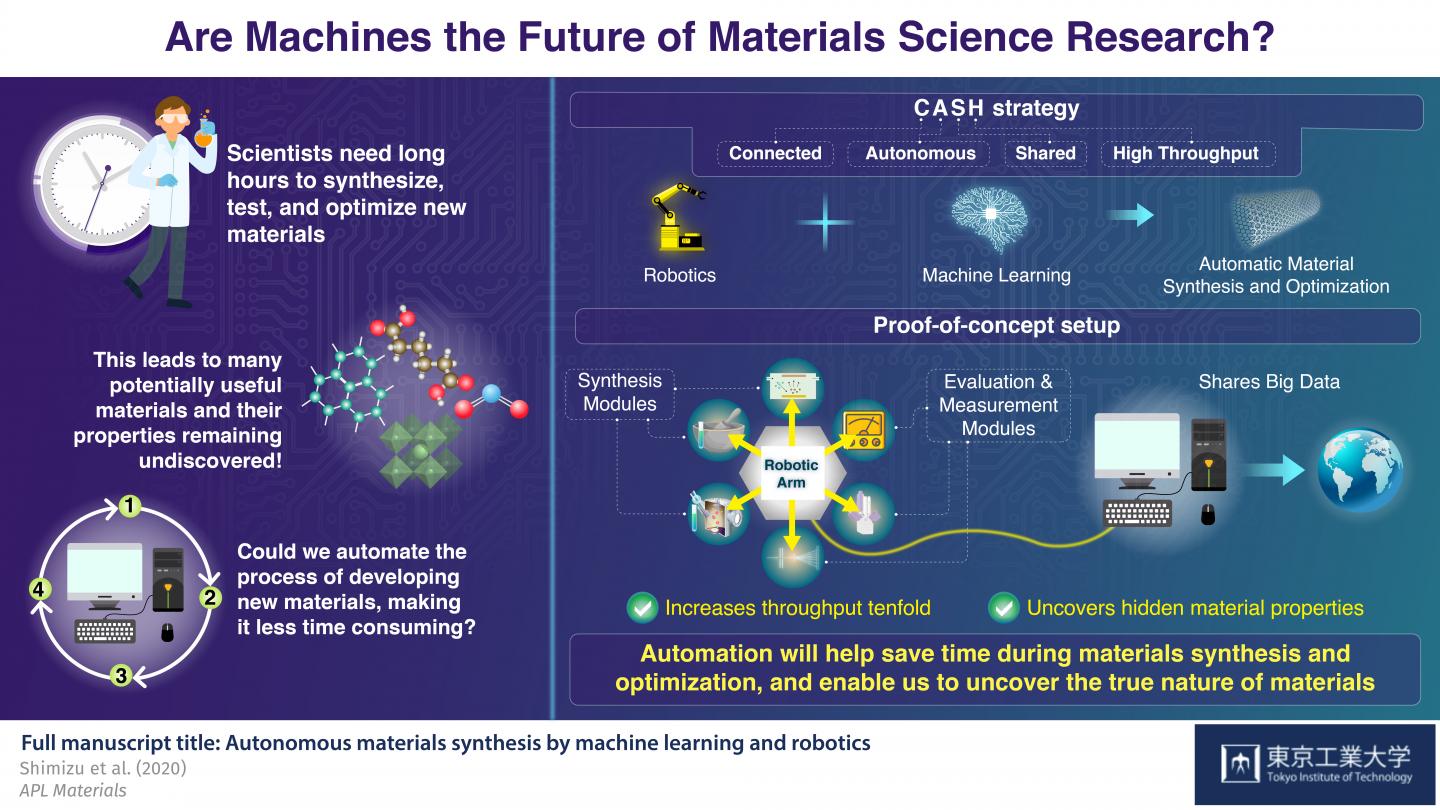
At the heart of many past scientific breakthroughs lies the discovery of novel materials. However, the cycle of synthesizing, testing, and optimizing new materials routinely takes scientists long hours of hard work. Because of this, lots of potentially useful materials with exotic properties remain undiscovered. But what if we could automate the entire novel material development process using robotics and artificial intelligence, making it much faster?
In a recent study published at APL Material, scientists from Tokyo Institute of Technology (Tokyo Tech), Japan, led by Associate Professor Ryota Shimizu and Professor Taro Hitosugi, devised a strategy that could make fully autonomous materials research a reality. Their work is centered around the revolutionary idea of laboratory equipment being ‘CASH’ (Connected, Autonomous, Shared, High-throughput). With a CASH setup in a materials laboratory, researchers need only decide which material properties they want to optimize and feed the system the necessary ingredients; the automatic system then takes control and repeatedly prepares and tests new compounds until the best one is found. Using machine learning algorithms, the system can employ previous knowledge to decide how synthesis conditions should be changed to approach the desired outcome in each cycle.
To demonstrate that CASH is a feasible strategy in solid-state materials research, Associate Prof Shimizu and team created a proof-of-concept system comprising a robotic arm surrounded by several modules. Their setup was geared toward minimizing the electrical resistance of a titanium dioxide thin film by adjusting the deposition conditions. Therefore, the modules are a sputter deposition apparatus and a device for measuring resistance. The robotic arm transferred the samples from module to module as needed, and the system autonomously predicted the synthesis parameters for the next iteration based on previous data. For the prediction, they used the Bayesian optimization algorithm.
Amazingly, their CASH setup managed to produce and test about twelve samples per day, a tenfold increase in throughput compared to what scientists can manually achieve in a conventional laboratory. In addition to this significant increase in speed, one of the main advantages of the CASH strategy is the possibility of creating huge shared databases describing how material properties vary according to synthesis conditions. In this regard, Prof Hitosugi remarks: “Today, databases of substances and their properties remain incomplete. With the CASH approach, we could easily complete them and then discover hidden material properties, leading to the discovery of new laws of physics and resulting in insights through statistical analysis.”
The research team believes that the CASH approach will bring about a revolution in materials science. Databases generated quickly and effortlessly by CASH systems will be combined into big data and scientists will use advanced algorithms to process them and extract human-understandable expressions. However, as Prof Hitosugi notes, machine learning and robotics alone cannot find insights nor discover concepts in physics and chemistry. “The training of future materials scientists must evolve; they will need to understand what machine learning can solve and set the problem accordingly. The strength of human researchers lies in creating concepts or identifying problems in society. Combining those strengths with machine learning and robotics is very important,” he says.
Overall, this perspective article highlights the tremendous benefits that automation could bring to materials science. If the weight of repetitive tasks is lifted off the shoulders of researchers, they will be able to focus more on uncovering the secrets of the material world for the benefit of humanity.
###
Media Contact
Kazuhide Hasegawa
[email protected]
Original Source
https:/
Related Journal Article
http://dx.