As the global energy landscape strives toward sustainability, hydrogen stands out as a pivotal clean fuel with immense potential to decarbonize multiple sectors. However, the widespread adoption of hydrogen energy hinges critically on efficient and cost-effective purification technologies. Traditional polymer membranes used for gas separations have long faced a fundamental trade-off: achieving high permeability often comes at the expense of selectivity, and vice versa. Meanwhile, crystalline porous materials (CPMs) such as metal-organic frameworks (MOFs) and hydrogen-bonded organic frameworks (HOFs) offer promising alternatives due to their tunable pore architectures and exceptional separation capabilities. Despite this potential, fabricating large-scale, defect-free membranes from these materials remains a formidable challenge.
A research team led by Professors Daofeng Sun and Zixi Kang from China University of Petroleum (East China) has unveiled a novel strategy that elegantly addresses these hurdles. Their groundbreaking approach, recently published in the journal Nano Research, marries the precision of MOFs with the solution-processability of HOFs to engineer an all-nanoporous composite (ANC) membrane tailored for hydrogen purification. This innovation centers on a deceptively simple yet highly effective “bricks-placing and mortar-pouring” strategy that yields membranes with unparalleled structural order and performance.
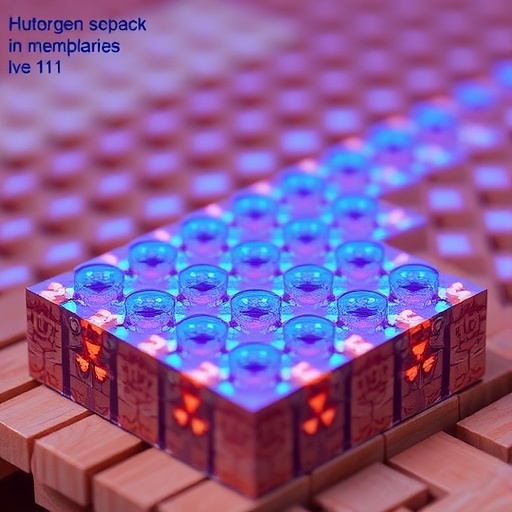
In this innovative paradigm, MOF nanosheets serve as the “bricks,” meticulously stacked to create an ordered scaffold. The “mortar” consists of the HOF monomer solution, which is then poured in to fill the interstitial spaces between the MOF layers. Upon crystallization, the HOF forms a continuous, defect-free matrix that binds the MOF bricks into a robust composite membrane. This construction mimics the hierarchical architecture of traditional masonry but operates at the nanoscale, achieving a composite material with hybrid characteristics.
The critical element underpinning this approach is hetero-nucleation engineering—a process by which the surfaces of MOF nanosheets preferentially induce the nucleation and growth of HOF crystals. By acting as hetero-nucleation sites, the MOFs facilitate the controlled, site-specific crystallization of the HOF matrix, circumventing the common problem of homogeneous nucleation that often leads to defects and compromised membrane integrity. Experimental systematic tuning of parameters such as HOF monomer concentration and solvent evaporation temperature allowed the researchers to finely balance nucleation driving forces, molecular attachment rates, and nutrient supply to optimize membrane formation.
The resulting MOF/HOF composite membranes display exceptional gas separation performance metrics that stand out in the field. The best-performing ANC membrane exhibited a staggering 562% increment in hydrogen permeance compared to pristine HOF membranes, alongside a remarkable 241% improvement in hydrogen/methane selectivity. Even more striking is the membrane’s pressure-responsive behavior, with hydrogen permeance surging from 3,233 GPU at 1.2 bar to 9,842 GPU at 2.0 bar while maintaining a high selectivity value of approximately 30. This unique characteristic holds tremendous promise for industrial applications where operating pressures can vary widely.
These performance enhancements derive from the synergistic coupling of the MOF’s high-surface-area, two-dimensional nanosheet architecture with the dense, interconnected HOF matrix. The hetero-nucleation mechanism ensures the intimate integration of the two components, resulting in an architecture that maximizes accessible nanopores for rapid gas transport while maintaining the molecular sieving necessary for selective hydrogen separation. By leveraging the solution-processability of HOFs, the process also enables facile membrane scale-up and customization.
This research represents a paradigm shift in the design and fabrication of composite membranes for gas separations. It establishes a versatile hetero-nucleation engineering framework that can be extended to other crystalline porous materials, boding well for the development of advanced membranes tailored for diverse energy and environmental challenges. The mortar-and-brick hybrid architecture exemplifies an innovative blueprint for integrating the mechanical robustness of MOFs with the adaptable chemistry of HOFs to overcome longstanding fabrication bottlenecks.
Beyond demonstrating exceptional hydrogen purification capabilities, the study elucidates fundamental principles related to nucleation control and membrane morphology that can serve as guidelines for future explorations into multi-component membrane systems. By precisely managing the interplay between heterogeneous and homogeneous nucleation processes, the researchers highlight pathways to fabricate membranes with customized porosity, thickness, and defect levels dictated by molecular interactions at the nanoscale.
The project assembled expertise from multiple disciplines, with contributors including Caiyan Zhang, Haoyu Xu, Chunchen Liu, Baolei Huang, Lu Qiao, Liting Yu, Sheng Yang, and Lili Fan from the Shandong Key Laboratory of Intelligent Energy Materials and the School of Materials Science and Engineering, China University of Petroleum (East China). Their collaborative efforts underscore the growing importance of interdisciplinary research in addressing grand energy challenges.
Funding support for this research was provided through prestigious national and provincial programs, including the National Key Research and Development Program of China, the National Natural Science Foundation of China, and the Natural Science Foundation of Shandong Province. These investments highlight the strategic priority given to clean energy technologies and innovative materials science.
The findings reported in Nano Research not only elevate the prospects for high-performance, scalable hydrogen separation membranes but also kindle broader interest in hetero-nucleation-driven composite material fabrication. As global energy systems accelerate their transition to sustainable fuels, advances like this “mortar-and-brick” membrane technology may play a decisive role in enabling the hydrogen economy of the future, minimizing energy losses and maximizing purity for a wide array of downstream applications.
Subject of Research: High-performance hydrogen purification membranes using metal-organic framework/hydrogen-bonded organic framework (MOF/HOF) composite membranes and hetero-nucleation engineering.
Article Title: Scientists Build High-Performance Hydrogen Separation Membranes with “Mortar-and-Brick” Design
News Publication Date: 23-Jan-2026
Web References:
DOI: 10.26599/NR.2025.94908080
Journal Link: Nano Research
Image Credits: Nano Research, Tsinghua University Press
Keywords
Hydrogen purification, metal-organic frameworks, hydrogen-bonded organic frameworks, hetero-nucleation engineering, composite membranes, gas separation, permeability-selectivity trade-off, nanoporous materials, membrane fabrication, clean energy, nano architecture, solution processing.
Tags: advanced gas separation materialsChina University of Petroleum membrane researchhigh-efficiency hydrogen separation membraneshydrogen purification technologieshydrogen-bonded organic frameworks applicationsmetal-organic frameworks for gas separationmortar-and-brick membrane designnanoporous composite membranesovercoming polymer membrane trade-offsscalable membrane fabrication techniquessustainable hydrogen energy solutionstunable pore architectures in membranes