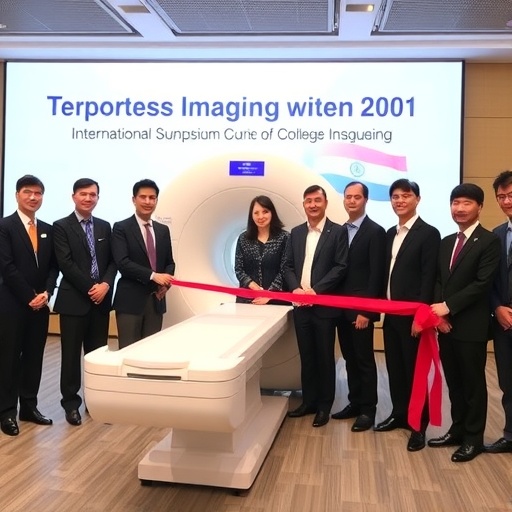
Korea University’s College of Medicine has marked a significant milestone with the inauguration of the MRI Precision Imaging Research Center at the Korea University Mediscience Park. Officially opened on April 14, this center represents a landmark in domestic medical research facilities as the first MRI center wholly devoted to medical investigations within Korea’s academic medical institutions. The event not only celebrated this achievement but also underscored a renewed commitment to advancing the field of brain imaging through international collaboration and technological innovation.
The MRI Precision Imaging Research Center is poised to become a pivotal node in Korea University Mediscience Park’s scientific ecosystem, joining a cluster of cutting-edge institutions. Among these are the Vaccine Innovation Center, known as Korea University’s pioneering private medical facility; the Biosafety Center, the country’s most expansive private medical enterprise; the Korea University College of Medicine-UNIST Joint Research Institute; and the Department of Biomedical Informatics, distinguished by its large faculty body. Collectively, these institutions embody Korea University’s robust dedication to pioneering medical science and translational research.
At the heart of the new MRI Center is a state-of-the-art 3 Tesla (3T) MRI scanner, a high-field imaging system known for its superior signal-to-noise ratio and spatial resolution compared to lower field strengths. The deployment of this advanced tool signals Korea University’s commitment to pushing the boundaries of neuroimaging research. This ultra-sensitive scanner enables researchers to capture exceptionally detailed images of brain structure and function, facilitating breakthroughs in diagnosing and understanding complex neurological diseases.
The opening ceremony emphasized the substantial investments made by Korea University’s College of Medicine to realize this facility. Detailed presentations showcased the design and technological features of the MRI scanning environment, engineered to optimize patient comfort and data integrity. The facility’s infrastructure adheres to rigorous standards ensuring electromagnetic shielding, vibration reduction, and environmental controls, all critical factors that influence the precision and reproducibility of MRI data acquisition.
Augmenting the inauguration was an international symposium that convened leading experts in the field of MRI and brain imaging from multiple disciplines. Distinguished guests included eminent scholars from the University of Nottingham’s School of Medicine, a globally recognized hub for MRI research. This cross-border academic congregation underscored the importance of collaborative efforts in accelerating progress in the advanced imaging field, particularly in neuropsychiatric and neurodegenerative disorders.
The symposium’s keynote address was presented by Professor Dorothee P. Auer of the University of Nottingham, newly appointed as a visiting professor at Korea University. Her lecture highlighted recent innovations in functional and structural MRI techniques implemented in psychiatric research. Additionally, Professor Marcus Kaiser, renowned for his work on the human connectome, delivered a special lecture on neuromodulation technologies and their integration with precision imaging modalities to decode neural circuitry dynamics.
Several domestic experts contributed to the symposium by sharing insights into the operational expertise and cutting-edge research methods developed at home. Director Kim Sung-ki of the Brain Science Imaging Research Group at the Institute for Basic Science (IBS) detailed advanced MRI protocols and methodological optimizations that have propelled IBS’s imaging capabilities to the forefront of global research. His talk offered strategic perspectives on elevating research infrastructure to maximize scientific yield.
Professor Lee Jong-hwan from Korea University’s Department of Brain & Cognitive Engineering illustrated the power of convergent brain imaging approaches that combine MRI with computational neuroscience techniques. This multidisciplinary integration facilitates the extraction of meaningful biomarkers from complex imaging data, fostering deeper understanding of cognitive processes and pathologies. Beyond this, a cadre of interdisciplinary research was showcased by professors from fields such as psychology, psychiatry, neurology, and radiology, illustrating the center’s broad impact on healthcare and fundamental brain science.
The collaboration between Korea University and the University of Nottingham, initiated in 2018, was reaffirmed during the event as a cornerstone of international cooperative research. This partnership has already yielded significant publications focusing on neuropsychiatry, rehabilitation, and neurology, delving into advanced MRI applications. The joint endeavor has also propelled the development of novel diagnostic approaches that integrate multimodal imaging data, enhancing early detection and personalized therapeutic strategies.
In his closing remarks, Dean Pyun Sung-bom articulated a strategic vision for Korea University’s College of Medicine to ascend as a global research nexus through the capabilities endowed by the MRI Precision Imaging Research Center. He emphasized the transformative potential of international partnerships, particularly the synergy with the University of Nottingham, to catalyze groundbreaking research and foster innovations that transcend geographical barriers.
The inauguration of the MRI Precision Imaging Research Center thus represents more than just a new facility; it signals a paradigm shift in Korea’s medical research landscape. Equipped with cutting-edge imaging technology and supported by a global network of expertise, the center is set to drive forward the frontier of precision neuroimaging, offering profound implications for medical science, diagnostics, and clinical practice worldwide.
Korea University’s investment and strategic collaborations in this center illustrate an ambitious trajectory aimed at unlocking the complexities of the human brain. Through enhanced imaging resolution and compatible interdisciplinary research, the center will contribute invaluable insights into brain development, neurological disorders, and psychiatric conditions, fostering the development of precise, individualized interventions.
As brain imaging continues to evolve rapidly, the MRI Precision Imaging Research Center stands as a beacon of innovation, integrating advanced MRI technology, computational analysis, and collaborative research. This holistic approach promises to yield transformative healthcare outcomes and establish Korea University as a leading international center in medical imaging research.
In summary, Korea University’s launch of the MRI Precision Imaging Research Center signifies an extraordinary leap in medical imaging research and international scientific cooperation. By combining top-tier technology with global expert collaboration, the center is uniquely positioned to contribute to critical advancements in neuroscience and beyond, heralding a new era of precision medicine.
Subject of Research: Not applicable
Image Credits: KU Medicine
Keywords: Magnetic resonance imaging, Image processing, Research methods, Medical research facilities, Laboratories
Tags: 3 Tesla MRI scanner technologyadvanced brain imaging research Koreabiomedical informatics in medical researchbiosafety center private medical research Koreacutting-edge MRI medical investigationshigh-field MRI for neurological studiesinternational medical symposium KoreaKorea University College of Medicine research collaborationKorea University Mediscience Park institutionsKorea University MRI Precision Imaging Research Centertranslational medical science Koreavaccine innovation center Korea University