• HOME
  • NEWS
  • EXPLORE
    • CAREER
      • Companies
      • Jobs
    • EVENTS
    • iGEM
      • News
      • Team
    • PHOTOS
    • VIDEO
    • WIKI
  • BLOG
  • COMMUNITY
    • FACEBOOK
    • INSTAGRAM
    • TWITTER
Monday, May 11, 2026
BIOENGINEER.ORG
No Result
View All Result
  • Login
  • HOME
  • NEWS
  • EXPLORE
    • CAREER
      • Companies
      • Jobs
        • Lecturer
        • PhD Studentship
        • Postdoc
        • Research Assistant
    • EVENTS
    • iGEM
      • News
      • Team
    • PHOTOS
    • VIDEO
    • WIKI
  • BLOG
  • COMMUNITY
    • FACEBOOK
    • INSTAGRAM
    • TWITTER
  • HOME
  • NEWS
  • EXPLORE
    • CAREER
      • Companies
      • Jobs
        • Lecturer
        • PhD Studentship
        • Postdoc
        • Research Assistant
    • EVENTS
    • iGEM
      • News
      • Team
    • PHOTOS
    • VIDEO
    • WIKI
  • BLOG
  • COMMUNITY
    • FACEBOOK
    • INSTAGRAM
    • TWITTER
No Result
View All Result
Bioengineer.org
No Result
View All Result
Home NEWS Science News Chemistry

USask physicist teams up with U.K. partners in world-first program of quantum technologies

Bioengineer by Bioengineer
November 10, 2020
in Chemistry
Reading Time: 3 mins read
0
IMAGE
Share on FacebookShare on TwitterShare on LinkedinShare on RedditShare on Telegram

IMAGE

Credit: USask

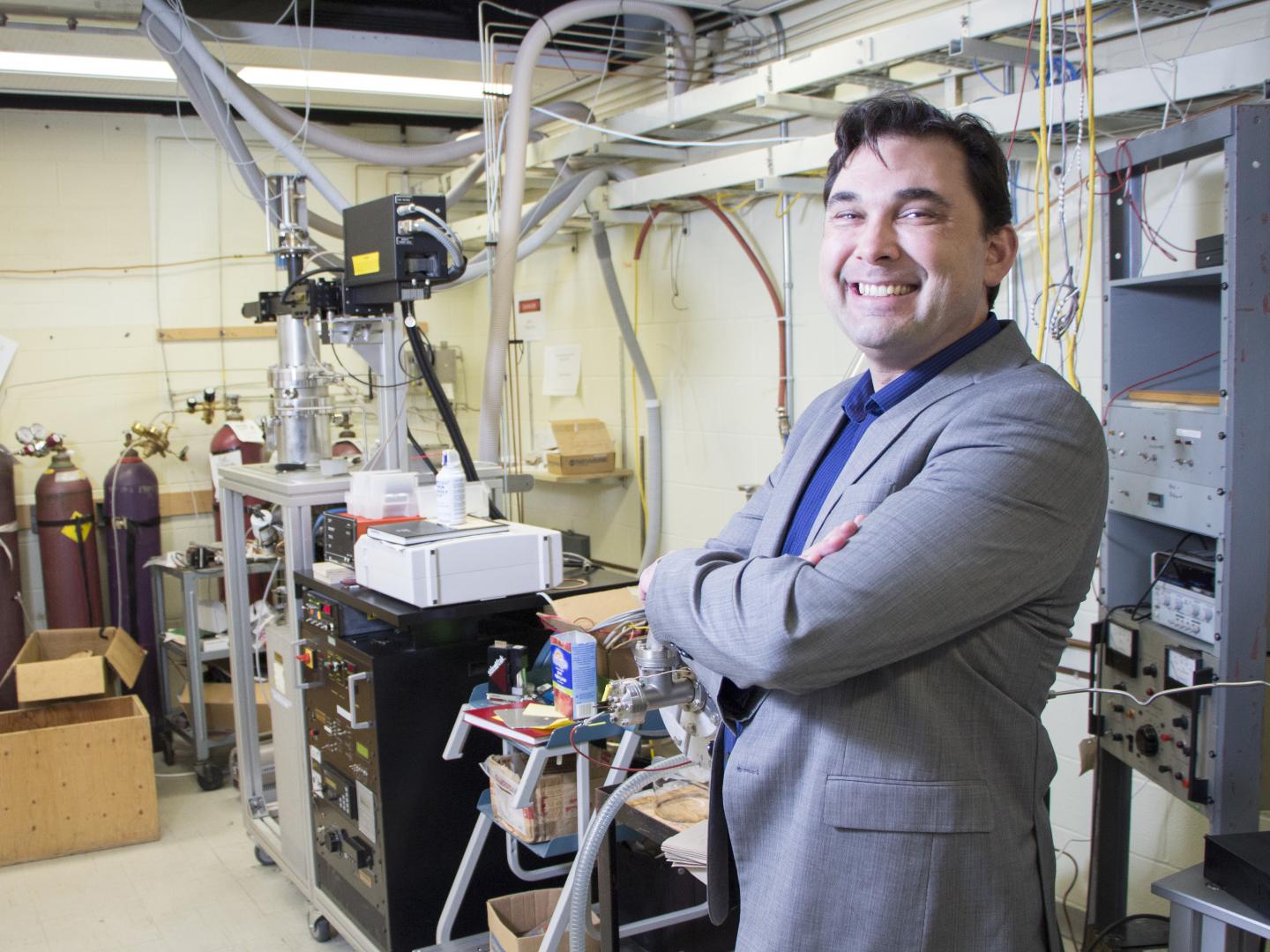
As part of a new U.K.-Canada collaboration, a University of Saskatchewan quantum physics team will develop a highly sensitive and precise sensor for measuring magnetic fields, a technology of potential benefit for geological prospecting, medicine, and quantum computers.

USask physicist Michael Bradley is one of eight winners of the U.K.-Canada Quantum Technologies Competition aimed at accelerating promising quantum technologies for real-world applications in areas such as health care, secure communications, and financial services.

Bradley’s quantum sensor or “magnetometer” for detecting magnetic fields would be more compact, cheaper and easier for geophysical companies to use in taking measurements of ore bodies in remote environments than the bulky liquid-helium-cooled devices currently available. As well, the measurements can be taken without the bulky cryogenic cooling apparatus needed for other techniques.

Bradley’s technique relies on the wavelike quantum mechanical properties of electrons to make higher precision measurements than are possible using classical approaches. The technology has been demonstrated in the lab, but there is no commercial product on the market.

“We aim to design, build and demonstrate a quantum magnetometer that will be a powerful way to measure small magnetic fields,” said Bradley. “In three years, we want to be able to place in the hands of geophysicists a Rubik’s Cube-sized box containing this new measurement tool for precisely detecting the magnetic field signatures of various rock formations.”

The competition is run jointly by the U.K. Research and Innovation (UKRI) and Natural Sciences and Engineering Research Council of Canada (NSERC). Bradley’s $90,000 project involves academic partner University of Nottingham (Prof. Mark Fromhold) and industrial partners M-Squared Lasers Limited in the U.K. and Saskatoon-based Dias Geophysical Ltd. in Canada.

At the core of the compact magnetometer is diamond. That’s because some diamonds have a naturally occurring atomic impurity (a nitrogen-vacancy centre) in which energy levels of trapped electrons are extremely sensitive to a nearby magnetic field. An optical signal from the electrons excited by the magnetic field is detected by a laser. In their lab, Bradley’s team has demonstrated the capability to grow high-quality synthetic diamond chips for use in the new instrument.

Another potential application of the new technology could be in neuroscience, Bradley said. For instance, helmets studded with the diamond magnetometers could be used to precisely monitor brain activity. The technology might also be developed for doctors to detect certain bacteria that contain magnetic iron oxide crystals.

The new magnetometer would also provide improved sensor technology for environmental monitoring and could have applications in developing quantum computers which would be much faster at processing than even the largest standard ones.

Bradley is a member of the USask Centre for Quantum Topology and its Applications which involves researchers from mathematics, physics, computing and chemistry collaborating on work related to quantum materials.

###

The U.K.-Canada competition follows a 2017 agreement between the two nations to share quantum expertise through academic and business collaborations. More information on the initiative is available here:
https://www.nserc-crsng.gc.ca/Media-Media/NewsDetail-DetailNouvelles_eng.asp?ID=1195 and https://www.nserc-crsng.gc.ca/NSERC-CRSNG/FundingDecisions-DecisionsFinancement/2020/UKRI_eng.asp

Media Contact
Victoria Dinh
[email protected]

Original Source

https://news.usask.ca/articles/research/2020/usask-physicist-teams-up-with-u.k.-partners-in-world-first-program-of-quantum-technologies.php

Tags: Biomedical/Environmental/Chemical EngineeringDiagnosticsElectrical Engineering/ElectronicsElectromagneticsGeology/SoilGeophysicsMedicine/HealthResearch/DevelopmentTechnology TransferTechnology/Engineering/Computer Science
Share12Tweet8Share2ShareShareShare2

Related Posts

Miniature Sensor Uses Light to Detect Touch — Chemistry

Miniature Sensor Uses Light to Detect Touch

May 8, 2026
Iron Minerals Determine Whether Dissolved Organic Matter Fuels Microbes or Becomes Long-Term Carbon Storage — Chemistry

Iron Minerals Determine Whether Dissolved Organic Matter Fuels Microbes or Becomes Long-Term Carbon Storage

May 8, 2026

Kate Evans Appointed Associate Lab Director for Biological and Environmental Systems Science at ORNL

May 8, 2026

Advancing Multiscale Modeling and Overcoming Operational Challenges in Autothermal COâ‚‚-to-Methanol Reactors

May 8, 2026
Please login to join discussion

POPULAR NEWS

  • Research Indicates Potential Connection Between Prenatal Medication Exposure and Elevated Autism Risk

    841 shares
    Share 336 Tweet 210
  • New Study Reveals Plants Can Detect the Sound of Rain

    728 shares
    Share 290 Tweet 182
  • Salmonella Haem Blocks Macrophages, Boosts Infection

    62 shares
    Share 25 Tweet 16
  • Breastmilk Balances E. coli and Beneficial Bacteria in Infant Gut Microbiomes

    57 shares
    Share 23 Tweet 14

About

We bring you the latest biotechnology news from best research centers and universities around the world. Check our website.

Follow us

Recent News

HIV-1 Strains Reveal Varied Paths to Antibody Escape

Rapid Nanopore Genomics Tracks Malaria Across Africa

Global City Growth Decouples from Fossil Fuels

Subscribe to Blog via Email

Enter your email address to subscribe to this blog and receive notifications of new posts by email.

Join 82 other subscribers
  • Contact Us

Bioengineer.org © Copyright 2023 All Rights Reserved.

Welcome Back!

Login to your account below

Forgotten Password?

Retrieve your password

Please enter your username or email address to reset your password.

Log In
No Result
View All Result
  • Homepages
    • Home Page 1
    • Home Page 2
  • News
  • National
  • Business
  • Health
  • Lifestyle
  • Science

Bioengineer.org © Copyright 2023 All Rights Reserved.