New work could enable scientists to engineer the metabolism of organisms to be more resilient and productive in a range of environments
Credit: Illustration courtesy of Arthur Grossman and Emanuel Sanz-Luque.
Palo Alto, CA– In a changing climate, understanding how organisms respond to stress conditions is increasingly important. New work led by Carnegie’s Arthur Grossman and Emanuel Sanz-Luque could enable scientists to engineer the metabolism of organisms to be more resilient and productive in a range of environments.
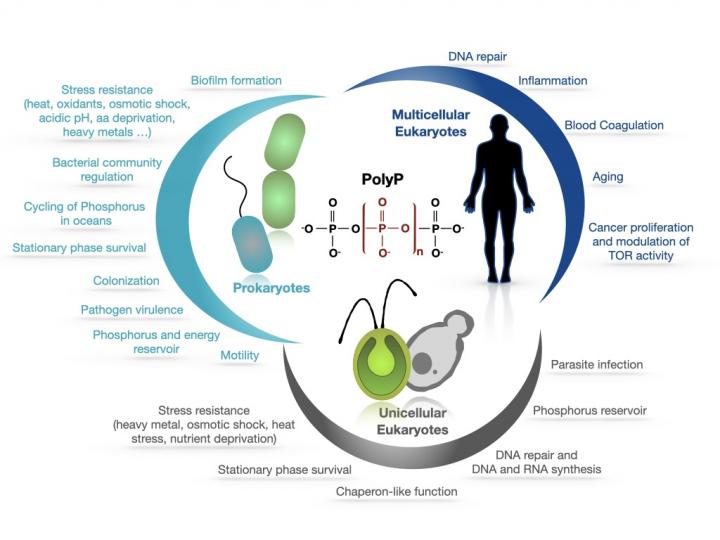
Their research focuses on polyphosphate, an energy-rich polymer of tens to hundreds phosphate groups which is conserved in all kingdoms of life and is integral to many cellular activities, including an organism’s ability to respond to changing environmental conditions.
“The ways in which polyphosphate synthesis and mobilization can be integrated into a myriad of biological processes in a range of photosynthetic and non-photosynthetic organisms and various cell types has been difficult to unravel,” Grossman said. “Polyphosphate plays a critical role in responding to environmental stresses, including high temperatures, exposure to toxic metals and, of particular interest to us, nutrient deprivation.”
The research team–which also included Carnegie’s Shai Saroussi, Weichao Huang, and Nicholas Akkawi–investigated how the photosynthetic alga Chlamydomonas reinhardtii copes with a sparsity of nutrients. Their findings were recently published in Science Advances.
The team revealed that polyphosphate synthesis is deeply integrated with cellular metabolism, leveraging this relationship to shape the alga’s ability to adapt to challenges in its surroundings.
Using advanced techniques, the researchers showed that the synthesis of polyphosphate is crucial for maintaining the optimal energy balance, enabling cellular physiological processes. When nutrient availability is low, polyphosphate synthesis is necessary for the alga to adjust its cellular metabolism and survive the adverse conditions. It does this by impacting the biochemical processes occurring in the cell’s power centers–mitochondria which perform respiration and chloroplasts which perform photosynthesis.
If a cell’s ability to synthesize polyphosphate is impaired, it is unable to accomplish normal electron transport in the mitochondria and chloroplasts–central to the functions of these key organelles–compromising cellular regulation, fitness, and survival.
“It is possible that the role of polyphosphate synthesis and mobilization in regulating the energetic functions of the cell under nutrient-limited conditions results in the creation of ‘checkpoint’ molecules within chloroplast and mitochondria that guide changes in the genes expressed in response to the environmental conditions,” said lead author Sanz-Luque.
This knowledge could potentially be harnessed to improve the resilience of other photosynthetic organisms and make them better able to survive the stress of a changing climate.
Together Carnegie’s Emanuel Sanz-Luque, Devaki Bhaya, and Arthur Grossman also published a comprehensive review in Frontiers in Plant Science detailing the ways in which polyphosphate integrate into the metabolic networks and regulatory processes in a variety of photosynthetic organisms.
###
This work was supported by the the European Union’s Horizon 2020 research and innovation program under the Marie Sklodwska-Curie grant 751039, the ‘Alfonso Martín Escudero Foundation, and the U.S. Department of Energy.
Media Contact
Arthur Grossman
[email protected]
Related Journal Article
http://dx.