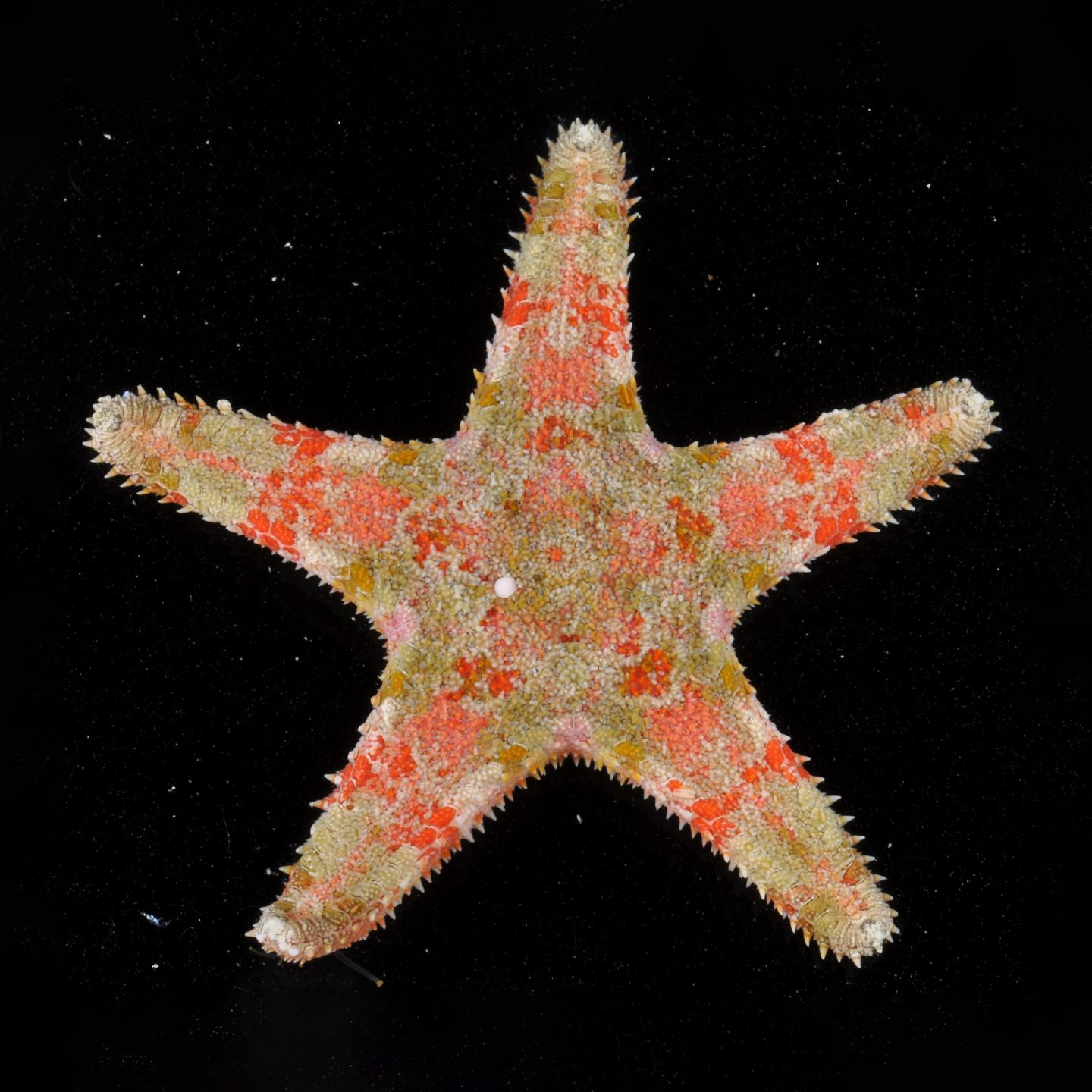
Credit: Michael Boyle
For decades, biologists have captured tiny sea star larvae in their nets that did not match the adults of any known species. A Smithsonian team recently discovered what these larvae grow up to be and how a special superpower may help them move around the world. Their results are published online in the Biological Bulletin.
“Thirty years ago, people noticed that these asteroid starfish larvae could clone themselves, and they wondered what the adult form was,” said staff scientist Rachel Collin at the Smithsonian Tropical Research Institute (STRI). “They assumed that because the larvae were in the Caribbean the adults must also be from the Caribbean.”
Scientists monitor larvae because the larvae can be more sensitive to physical conditions than the adults and larval dispersal has a large influence on the distribution of adult fishes and invertebrates. Collin’s team uses a technique called DNA barcoding to identify plankton. They determine the DNA sequence of an organism, then look for matches with a sequence from a known animal in a database.
“This mystery species was one of the most common in our samples from the Caribbean coast of Panama,” Collin said. “We knew from people’s studies that the DNA matched sequences from similar larvae across the Caribbean and it matched unidentified juvenile starfish caught in the Gulf of Mexico–but no one had found a match to any known adult organism in the Caribbean. So we decided to see if the DNA matched anything in the global ‘Barcode of Life’ data base.”
“That’s when we got a match with Valvaster striatus, a starfish that was thought to be found only in the Indo West Pacific,” Collin said. “The is the first-ever report of this species in the Atlantic Ocean. We could not have identifed it if Gustav Paulay from the University of Florida didn’t have DNA sequences from invertebrates on the other side of the world.”
But why are the larvae common in the Caribbean if adult Valvaster starfish have never been found here? Are the adult starfish hidden inside Caribbean reefs, or are the larvae arriving from the other side of the world?
V. striatus is widespread but rare in the western Pacific. The few reports from collectors and the confirmed photos on iNaturalist range from the Indian Ocean to Guam and Hawaii. These starfish live deep in the reef matrix, only coming out at night. So, it is possible that there are adults in the Caribbean that have never been seen. But the other possibility, that the ability to clone themselves may allow them to spread around the world, is also intriguing.
“It’s possible that the ability of the larvae to clone themselves is not just a clever way to stay forever young,” Collin said. “There’s a natural barrier that keeps organisms from the western Pacific and the Indian ocean from crossing the Atlantic to the Caribbean. After they make it around the tip of Africa, they are met by a cold current that presumably kills tropical species.”
“Just how cloning could help them get through the barrier is still not known, but it’s intriguing that another sea star species from the Indo West Pacific that was collected for the first time in the Caribbean in the 1980s also has cloning larvae,” Collin said.
###
This study would not have been possible without collecting permits from Panama’s MiAmbiente and ARAP, molecular analysis in the Laboratories of Analytical Biology at the Smithsonian’s National Museum of Natural History in Washington, D.C. and funds from the Smithsonian, Paul Peck, an anonymous donor, the Gordon and Betty Moore Foundation and the Sloan Foundation.
Collin, R., Venera-Pontón, D.E., Paulay, G., Boyle, M.J. 2020. World travelers: DNA Barcoding unmasks the origin of cloning Asteroid larvae from the Caribbean. Bio Bull. Doi:10.1086/710796
Media Contact
Elisabeth king
[email protected]
Original Source
https:/
Related Journal Article
http://dx.