• HOME
  • NEWS
  • EXPLORE
    • CAREER
      • Companies
      • Jobs
    • EVENTS
    • iGEM
      • News
      • Team
    • PHOTOS
    • VIDEO
    • WIKI
  • BLOG
  • COMMUNITY
    • FACEBOOK
    • INSTAGRAM
    • TWITTER
Sunday, May 10, 2026
BIOENGINEER.ORG
No Result
View All Result
  • Login
  • HOME
  • NEWS
  • EXPLORE
    • CAREER
      • Companies
      • Jobs
        • Lecturer
        • PhD Studentship
        • Postdoc
        • Research Assistant
    • EVENTS
    • iGEM
      • News
      • Team
    • PHOTOS
    • VIDEO
    • WIKI
  • BLOG
  • COMMUNITY
    • FACEBOOK
    • INSTAGRAM
    • TWITTER
  • HOME
  • NEWS
  • EXPLORE
    • CAREER
      • Companies
      • Jobs
        • Lecturer
        • PhD Studentship
        • Postdoc
        • Research Assistant
    • EVENTS
    • iGEM
      • News
      • Team
    • PHOTOS
    • VIDEO
    • WIKI
  • BLOG
  • COMMUNITY
    • FACEBOOK
    • INSTAGRAM
    • TWITTER
No Result
View All Result
Bioengineer.org
No Result
View All Result
Home NEWS Science News Chemistry

Japan’s geologic history in question after discovery of metamorphic rock microdiamonds

Bioengineer by Bioengineer
September 4, 2020
in Chemistry
Reading Time: 2 mins read
0
IMAGE
Share on FacebookShare on TwitterShare on LinkedinShare on RedditShare on Telegram

IMAGE

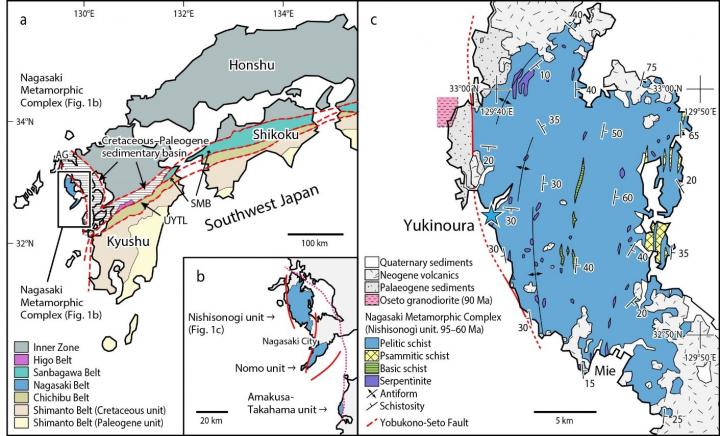
a: Geological zone in western Japan. The blue-green part is the Sanbagawa belt that crosses mainland Japan. The Nishisonogi metamorphic rock was thought to belong to the same geological formation…
view more 

A collaboration of researchers based in Kumamoto University, Japan have discovered microdiamonds in the Nishisonogi metamorphic rock formation in Nagasaki Prefecture, Japan. Microdiamonds in metamorphic rocks are important minerals because they form in continental collision zones and show that the crust has penetrated deeper than 120 km below the surface. This is the second area in the world, after the Italian Alps, that shows microdiamonds can form in metamorphic rock through subduction of oceanic plates.

In recent years, microdiamonds have received a great deal of attention because they have been discovered in metamorphic rocks around the world and it has become clear that they are formed in collisions between continents. It was thought that Japan would not produce such microdiamonds because it is not a continental collision zone, but an oceanic plate subduction zone. However, the first microdiamonds from metamorphic rocks in Japan were found in the Nishisonogi metamorphic rock formation in the west coast of Nagasaki Prefecture.

The area where the microdiamonds were discovered is an approximately 100-million-year-old Cretaceous metamorphic rock formation. On the west coast of Saikai City in Nagasaki Prefecture, blocks of pelitic and basic schist are scattered amongst serpentinite that was created from mantle material. Such rocks are called a serpentinite mélange and indicate that they have risen from deep in the subduction zone. Researchers found microdiamonds here, in the serpentinite mélange. Their formation conditions have been estimated to be a temperature of about 450 °C and a pressure of about 2.8 GPa, which makes them the coldest diamonds ever formed. It has been thought that the Nishisonogi metamorphic rock was formed under a pressure of about 1 GPa, but it is now clear that they were ultrahigh-pressure metamorphic rocks that rose after subducting to 120 km–a very unexpected discovery.

“The discovery of microdiamonds from Japan’s first metamorphic rocks will rewrite Japan’s geological history,” said Professor Tadao Nishiyama, the leader of this study. “Until now, the Nagasaki metamorphic rocks were said to belong to a low-temperature, high-pressure-type metamorphic rock belt, the “Sanbagawa Belt,” which crosses the Japanese mainland. It has become clear, however, that they are independently-formed ultrahigh-pressure metamorphic rocks. I expect that there will be many discussions about what kind of plate movement created this formation.”

###

This research was posted online in Scientific Reports on 15 July 2020.

Source: Nishiyama, T., Ohfuji, H., Fukuba, K., Terauchi, M., Nishi, U., Harada, K., … Arai, S. (2020). Microdiamond in a low-grade metapelite from a Cretaceous subduction complex, western Kyushu, Japan. Scientific Reports, 10(1). doi:10.1038/s41598-020-68599-7

Media Contact
J. Sanderson, N. Fukuda
[email protected]

Related Journal Article

http://dx.doi.org/10.1038/s41598-020-68599-7

Tags: Earth ScienceGeographyGeology/SoilGeophysicsGeophysics/GravityPlate Tectonics
Share13Tweet8Share2ShareShareShare2

Related Posts

Miniature Sensor Uses Light to Detect Touch — Chemistry

Miniature Sensor Uses Light to Detect Touch

May 8, 2026
Iron Minerals Determine Whether Dissolved Organic Matter Fuels Microbes or Becomes Long-Term Carbon Storage — Chemistry

Iron Minerals Determine Whether Dissolved Organic Matter Fuels Microbes or Becomes Long-Term Carbon Storage

May 8, 2026

Kate Evans Appointed Associate Lab Director for Biological and Environmental Systems Science at ORNL

May 8, 2026

Advancing Multiscale Modeling and Overcoming Operational Challenges in Autothermal CO₂-to-Methanol Reactors

May 8, 2026
Please login to join discussion

POPULAR NEWS

  • Research Indicates Potential Connection Between Prenatal Medication Exposure and Elevated Autism Risk

    840 shares
    Share 336 Tweet 210
  • New Study Reveals Plants Can Detect the Sound of Rain

    727 shares
    Share 290 Tweet 181
  • Scientists Investigate Possible Connection Between COVID-19 and Increased Lung Cancer Risk

    68 shares
    Share 27 Tweet 17
  • Salmonella Haem Blocks Macrophages, Boosts Infection

    61 shares
    Share 24 Tweet 15

About

We bring you the latest biotechnology news from best research centers and universities around the world. Check our website.

Follow us

Recent News

Evaluating Digoxin Use in Patients with Symptomatic Rheumatic Heart Disease

Evaluating the Effectiveness and Safety of Digitalis Glycosides in Treating Heart Failure

Urdu Fall Risk Questionnaire Adapted for Elderly

Subscribe to Blog via Email

Success! An email was just sent to confirm your subscription. Please find the email now and click 'Confirm' to start subscribing.

Join 82 other subscribers
  • Contact Us

Bioengineer.org © Copyright 2023 All Rights Reserved.

Welcome Back!

Login to your account below

Forgotten Password?

Retrieve your password

Please enter your username or email address to reset your password.

Log In
No Result
View All Result
  • Homepages
    • Home Page 1
    • Home Page 2
  • News
  • National
  • Business
  • Health
  • Lifestyle
  • Science

Bioengineer.org © Copyright 2023 All Rights Reserved.