• HOME
  • NEWS
  • EXPLORE
    • CAREER
      • Companies
      • Jobs
    • EVENTS
    • iGEM
      • News
      • Team
    • PHOTOS
    • VIDEO
    • WIKI
  • BLOG
  • COMMUNITY
    • FACEBOOK
    • INSTAGRAM
    • TWITTER
Saturday, February 7, 2026
BIOENGINEER.ORG
No Result
View All Result
  • Login
  • HOME
  • NEWS
  • EXPLORE
    • CAREER
      • Companies
      • Jobs
        • Lecturer
        • PhD Studentship
        • Postdoc
        • Research Assistant
    • EVENTS
    • iGEM
      • News
      • Team
    • PHOTOS
    • VIDEO
    • WIKI
  • BLOG
  • COMMUNITY
    • FACEBOOK
    • INSTAGRAM
    • TWITTER
  • HOME
  • NEWS
  • EXPLORE
    • CAREER
      • Companies
      • Jobs
        • Lecturer
        • PhD Studentship
        • Postdoc
        • Research Assistant
    • EVENTS
    • iGEM
      • News
      • Team
    • PHOTOS
    • VIDEO
    • WIKI
  • BLOG
  • COMMUNITY
    • FACEBOOK
    • INSTAGRAM
    • TWITTER
No Result
View All Result
Bioengineer.org
No Result
View All Result
Home NEWS Science News Biology

Fossil trees on Peru’s Central Andean Plateau tell a tale of dramatic environmental change

Bioengineer by Bioengineer
August 28, 2020
in Biology
Reading Time: 3 mins read
0
IMAGE
Share on FacebookShare on TwitterShare on LinkedinShare on RedditShare on Telegram

IMAGE

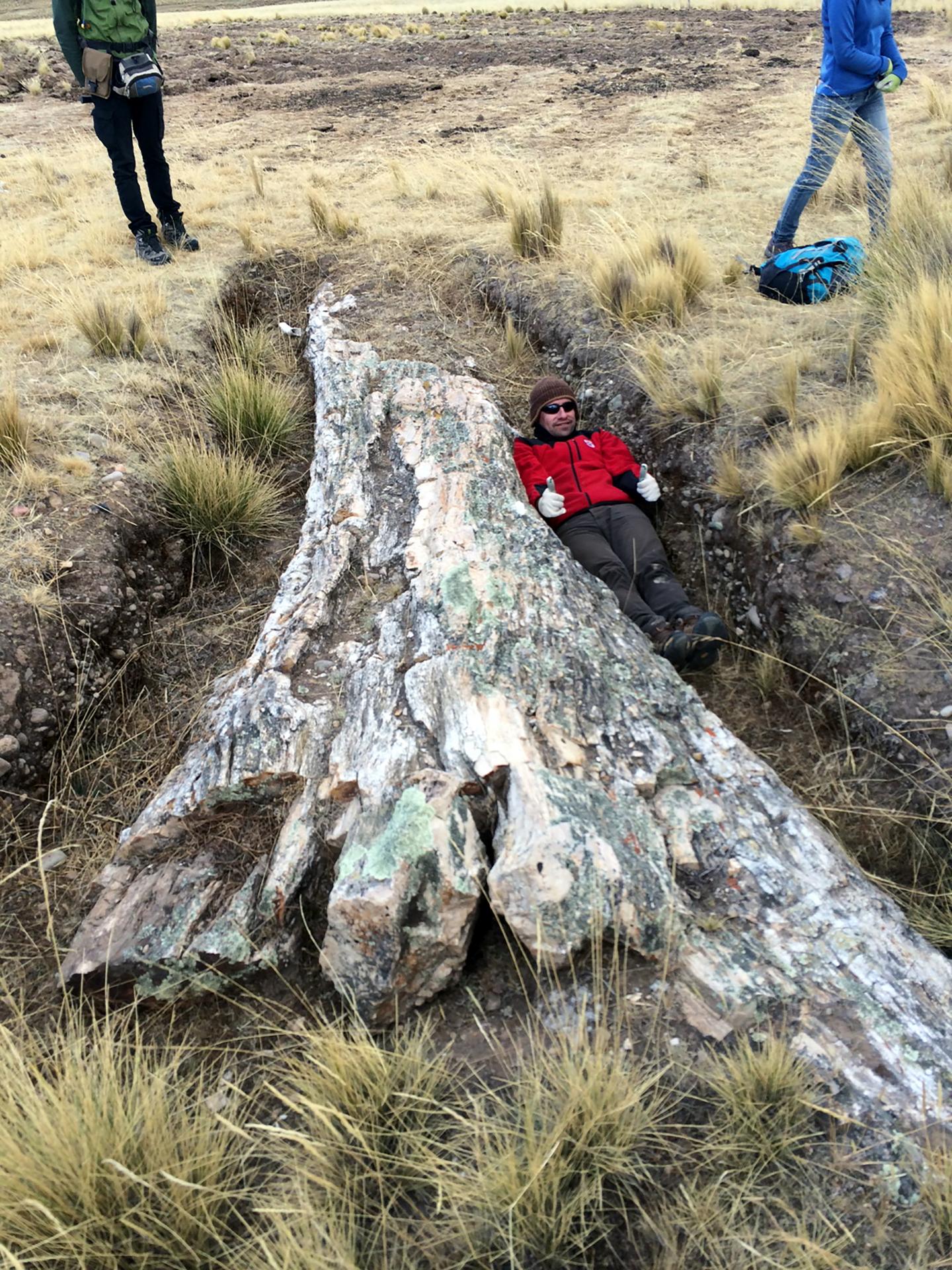
Credit: Carlos Jaramillo, Smithsonian Tropical Research Institute

On an expedition to the Central Andean Plateau, researchers from the Smithsonian Tropical Research Institute (STRI) and colleagues were astounded to find a huge fossil-tree buried in the cold, grassy plain. The plant fossil record from this high-altitude site in southern Peru contains dramatic reminders that the environment in the Andes mountains changed drastically during the past 10 million years, but not in the ways that climate models of the past suggest. Findings from the expedition are presented in the journal Science Advances.

“This tree and the hundreds of fossil wood, leaf and pollen samples we collected on the expedition, reveal that when these plants were alive the ecosystem was more humid–even more humid than climate models of the past predicted,” said Camila Martinez, a fellow at STRI, who recently finished her doctorate at Cornell University. “There is probably no comparable modern ecosystem, because temperatures were higher when these fossils were deposited 10 million years ago.”

The anatomy of the petrified (permineralized) wood the researchers found is very much like wood anatomy in low-elevation tropical forests today. Indeed, the altitude then was probably only 2,000 meters above sea level.

But that ecosystem did not last for long. Today, the arid, intermountain plateau lies at 4,000 meters above sea level.

Five million year-old fossils from the same sites confirmed that the Puna ecosystem that now dominates the Andes’ high mountain plateaus had been born: the younger pollen samples were mostly from grasses and herbs, rather than from trees. Leaf material was from ferns, herbs and shrubs, indicating that the plateau had already risen to its current altitude.

“The fossil record in the region tells us two things: both the altitude and the vegetation changed dramatically over a relatively short period of time, supporting a hypothesis that suggests the tectonic uplift of this region occurred in rapid pulses,” said Carlos Jaramillo, STRI staff scientist and project leader.

“Andean uplift played an important role in shaping the climate of South America, but the relationship between the rise of the Andes, local climates and vegetation is still not well understood,” Martinez said. “By the end of this century, changes in temperature and atmospheric carbon dioxide concentrations will again approximate the conditions 10 million years ago. Understanding the discrepancies between climate models and data based on the fossil record help us to elucidate the driving forces controlling the current climate of the Altiplano, and, ultimately, the climate across the South American continent.

###

Author affiliations include: STRI; Cornell University; CNRS, EPHE, IRD, Montpellier; Universidad Nacional Autónoma de México; Museo de Historia Natural, Lima, Peru; University of Rochester, Rochester, New York; and the Florida Institute of Technology.

Reference: Martinez, C., Jaramillo, C., Correa-Metrio, A, et al. 2020. Neogene precipitation, vegetation and elevation history of the Central Andean Plateau. Science Advances, 6: eaaz4724 Doi:10.1126/sciadv.aaz4724. https://advances.sciencemag.org/lookup/doi/10.1126/sciadv.aaz4724

Media Contact
Beth King
[email protected]

Related Journal Article

http://dx.doi.org/10.1126/sciadv.aaz4724

Tags: Atmospheric ScienceBiodiversityBiologyClimate ChangeEarth ScienceEvolutionGeology/SoilPaleontologyPlant Sciences
Share13Tweet8Share2ShareShareShare2

Related Posts

Florida Cane Toad: Complex Spread and Selective Evolution

Florida Cane Toad: Complex Spread and Selective Evolution

February 7, 2026
New Study Uncovers Mechanism Behind Burn Pit Particulate Matter–Induced Lung Inflammation

New Study Uncovers Mechanism Behind Burn Pit Particulate Matter–Induced Lung Inflammation

February 6, 2026

DeepBlastoid: Advancing Automated and Efficient Evaluation of Human Blastoids with Deep Learning

February 6, 2026

Navigating the Gut: The Role of Formic Acid in the Microbiome

February 6, 2026
Please login to join discussion

POPULAR NEWS

  • Robotic Ureteral Reconstruction: A Novel Approach

    Robotic Ureteral Reconstruction: A Novel Approach

    82 shares
    Share 33 Tweet 21
  • Digital Privacy: Health Data Control in Incarceration

    63 shares
    Share 25 Tweet 16
  • Study Reveals Lipid Accumulation in ME/CFS Cells

    57 shares
    Share 23 Tweet 14
  • Breakthrough in RNA Research Accelerates Medical Innovations Timeline

    53 shares
    Share 21 Tweet 13

About

We bring you the latest biotechnology news from best research centers and universities around the world. Check our website.

Follow us

Recent News

Digital Health Perspectives from Baltic Sea Experts

Florida Cane Toad: Complex Spread and Selective Evolution

Exploring Decision-Making in Dementia Caregivers’ Mobility

Subscribe to Blog via Email

Enter your email address to subscribe to this blog and receive notifications of new posts by email.

Join 73 other subscribers
  • Contact Us

Bioengineer.org © Copyright 2023 All Rights Reserved.

Welcome Back!

Login to your account below

Forgotten Password?

Retrieve your password

Please enter your username or email address to reset your password.

Log In
No Result
View All Result
  • Homepages
    • Home Page 1
    • Home Page 2
  • News
  • National
  • Business
  • Health
  • Lifestyle
  • Science

Bioengineer.org © Copyright 2023 All Rights Reserved.