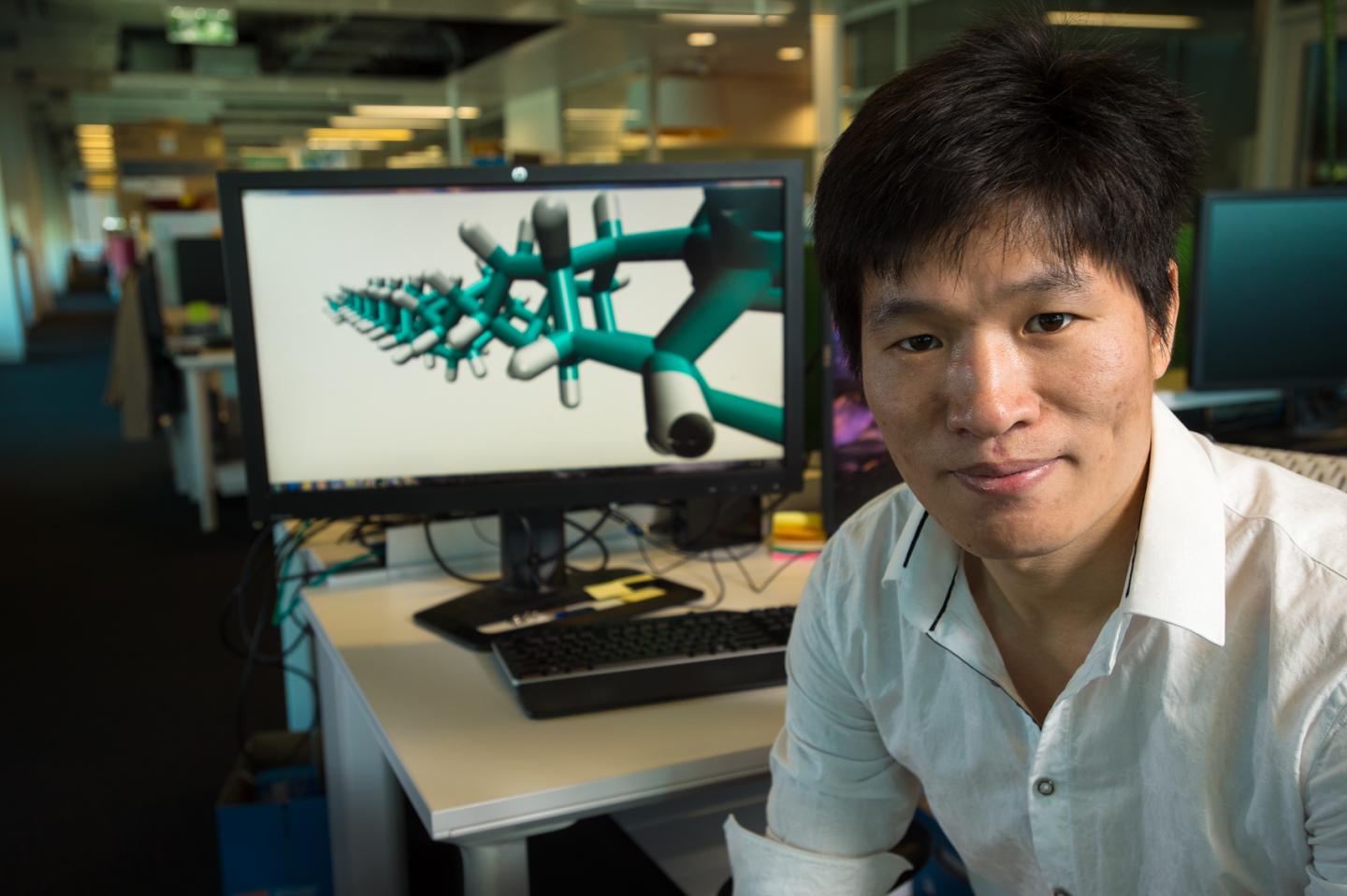
Credit: QUT
QUT researchers have proposed the design of a new carbon nanostructure made from diamond nanothreads that could one day be used for mechanical energy storage, wearable technologies, and biomedical applications.
Dr Haifei Zhan, from the QUT Centre for Materials Science, and his colleagues successfully modelled the mechanical energy storage and release capabilities of a diamond nanothread (DNT) bundle – a collection of ultrathin one-dimensional carbon threads that store energy when twisted or stretched.
“Similar to a compressed coil or children’s wind-up toy, energy can be released as the twisted bundle unravels,” Dr Zhan said.
“If you can make a system to control the power supplied by the nanothread bundle it would be a safer and more stable energy storage solution for many applications.”
The new carbon structure could be a potential micro-scale power supply for anything from implanted biomedical sensing systems monitoring heart and brain functions, to small robotics and electronics.
“Unlike chemical storage such as lithium ion batteries, which use electro-chemical reactions to store and release energy, a mechanical energy system itself would carry much lower risk by comparison,” Dr Zhan said.
“At high temperatures chemical storage systems can explode or can become non-responsive at low temperatures. These can also leak upon failure, causing chemical pollution.
“Mechanical energy storage systems don’t have these risks so make them more suited to potential applications within the human body.
“Carbon nanothread bundles could be made into twist-spun yarn-based artificial muscles that respond to electrical, chemical or photonic excitations.
“Previous research has shown such a structure made with carbon nanotubes could lift 50,000 times its own weight.”
Dr Zhan’s team found the nanothread bundle’s energy density – how much energy it could store for its mass – was 1.76 MJ per kilogram, which was 4-5 orders higher than a conventional steel spring, and up to 3 times compared to Li-ion batteries.
“Energy dense materials are very important to many applications, which is why we are always looking for lightweight materials that still perform well.
“The benefits for aerospace applications are obvious. If we can reduce the weight of a system, we can significantly reduce its fuel requirements and costs.”
The application of carbon nanothread bundles as an energy source could be endless, according to Dr Zhan.
“The nanothread bundles could be used in next-generation power transmission lines, aerospace electronics, and field emission, batteries, intelligent textiles and structural composites such as building materials.
Research findings were published by Nature Communications in the paper: ‘Ultra-high Density Mechanical Energy Storage with Carbon Nanothread Bundle’, and form the basis of Dr Zhan’s ARC Discovery project – ‘A Novel Multilevel Modelling Framework to Design Diamond Nanothread Bundles’.
Dr Zhan and his team are now planning production of an experimental nanoscale mechanical energy system as proof of concept.
Dr Zhan said the research team would spend the next two to three years building the control mechanism for the system to store energy – the system which controls twisting and stretching of the nanothread bundle.
###
Dr Zhan is from the School of Mechanical, Medical and Process Engineering. This research was funded through the ARC Discovery program and was a collaboration between the QUT Centre for Materials Science, Agency for Science, Technology and Research in Singapore, and the National University of Singapore.
Rod Chester, QUT Media, 07 3138 9449 or 0401 140 985 or [email protected]
Media Contact
Rod Chester
[email protected]
Original Source
https:/
Related Journal Article
http://dx.