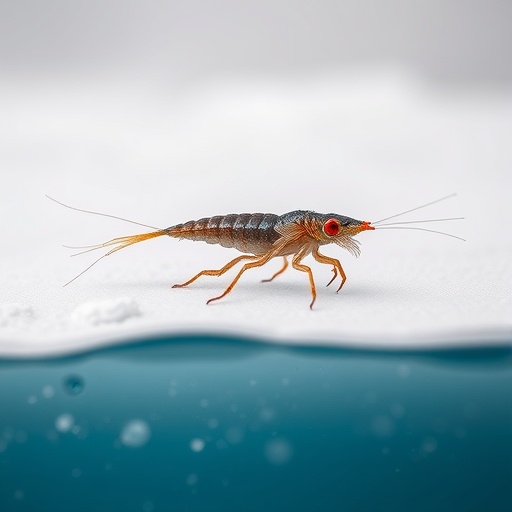
In the vast and enigmatic waters of the Southern Ocean, Antarctic krill (Euphausia superba) serve as a foundational species, sustaining an intricate web of marine life that hinges upon their presence. Recent research has shed new light on a pressing environmental crisis, revealing how the daily vertical migration patterns of these tiny crustaceans intersect with complex oceanographic conditions to modulate their exposure to pervasive microplastic pollution. This study, conducted by Gallagher and Manno and published in Scientific Reports in 2026, offers a sophisticated analysis of how the physical and biological dynamics of the Antarctic marine ecosystem influence the ingestion and accumulation of microplastics in krill populations.
Antarctic krill are known for their extensive diel vertical migrations, moving hundreds of meters through the water column each day in response to changing light conditions. These migrations are not merely mechanical; they are vital behavioral adaptations that promote access to food resources, predator avoidance, and reproduction. However, this vertical movement exposes krill to a stratified marine environment, where microplastic particles are unevenly distributed due to complex physical processes such as currents, temperature gradients, and salinity layers. Gallagher and Manno’s work cogently explores how these spatial heterogeneities in microplastic concentrations influence the extent of krill’s plastic ingestion.
The research meticulously integrates field sampling with state-of-the-art oceanographic modeling. By tracking krill swarms alongside precise measurements of microplastic density across vertical strata, the team was able to uncover patterns of microplastic hotspots concordant with oceanographic features such as thermoclines and pycnoclines. These oceanographic boundaries create microenvironments where microplastics accumulate or disperse, thus dictating the probability of encounter by vertically migrating krill. This multidimensional approach marks a significant advancement over prior studies that largely focused on surface waters or relied solely on laboratory exposure experiments.
One of the study’s critical insights pertains to the timing and depth of krill migration and its synchronization with the ocean’s physical structure. Early evening ascents to surface waters correspond with maximal ingestion rates of microplastics, coinciding with peak particle concentrations driven by surface convergence zones and localized eddies. Conversely, during night-time descent into deeper, colder waters, particles might be less abundant but potentially more compacted in dense layers due to downwelling currents. These dynamics highlight that krill’s risk of microplastic exposure is not constant but varies markedly over their daily vertical journey.
Gallagher and Manno emphasize that the physiological implications for krill ingesting microplastics are multifaceted. Microplastics can obstruct digestive tracts, alter feeding behavior, and leach toxic chemicals, which may cumulatively undermine krill health and population viability. Given krill’s pivotal role as a primary food source for whales, seals, penguins, and a variety of fish species, disruptions to their population dynamics reverberate throughout the Antarctic food web. This research underscores the urgent need for a deeper understanding of microplastic pollution’s cascading ecological impacts in polar regions.
Moreover, the study introduces novel quantifications of microplastic concentration gradients within the mixed layer and below the surface mixed layer in the Southern Ocean. These gradients are critical to modeling accurate exposure risk scenarios, as microplastics exhibit diverse transport pathways influenced by Antarctic Circumpolar Current jets, frontal systems, and episodic storm-driven mixing. Understanding these physical drivers is essential for predicting future trends under climate change, which is expected to alter stratification patterns and ocean circulation regimes significantly.
The research also addresses methodological challenges inherent to studying microplastic distribution in extreme polar environments, noting the scarce data due to logistical constraints and sampling biases. By coupling direct sampling with remote sensing and numerical models, Gallagher and Manno bridge these gaps, providing a robust framework for interdisciplinary marine pollution research. Their approach offers a blueprint for future monitoring programs and policy interventions aimed at mitigating microplastic contamination in fragile polar ecosystems.
Importantly, the study situates microplastic pollution within broader environmental stressors, including ocean acidification and warming, which collectively exacerbate risks to krill populations. The compound effects of habitat alteration and contaminant exposure might manifest as reduced reproductive success or impaired larval development, thereby threatening krill’s population resilience. The authors advocate for integrative research agendas that concurrently evaluate multiple stressors to predict and manage ecosystem responses under shifting environmental baselines.
The findings hold critical implications for conservation strategies targeting the Antarctic marine environment. By delineating precise spatial and temporal hotspots of microplastic ingestion risk, this research enables the targeting of mitigation efforts, such as restrictions on plastic discharge and enhanced waste management in adjacent human activities including fishing and tourism. Furthermore, the study provides empirical evidence supporting international regulatory measures under frameworks like the Commission for the Conservation of Antarctic Marine Living Resources (CCAMLR).
Gallagher and Manno’s research also opens new avenues for exploring the biogeochemical cycling of microplastics within polar oceans. Krill act not only as consumers but as vectors, redistributing microplastics vertically and horizontally through their fecal pellet production and movement patterns. This biophysical interaction creates feedback loops that potentially amplify microplastic dispersion or sequestration in deep ocean layers, a phenomenon increasingly scrutinized for its implications on global plastic budgets and ocean health.
The integration of behavioral ecology and physical oceanography in this study exemplifies the interdisciplinary nature required to unravel the complexities of microplastic pollution in marine systems. It challenges researchers to consider organismal behavior as a dynamic modulator of exposure risk rather than treating species as passive recipients of pollution. This refined perspective could reshape ecological risk assessments and environmental modelling moving forward.
In a broader context, the paper highlights the Southern Ocean as a sentinel region where emerging environmental threats converge. The pristine nature of Antarctic waters has historically shielded marine communities from anthropogenic contaminants; however, escalating global plastic production and maritime activity are eroding this refuge. Gallagher and Manno’s contribution serves as a wake-up call, stressing that even remote ecosystems are not immune from the infiltration and ramifications of microplastics.
Finally, the research underscores the critical importance of sustained, large-scale monitoring integrating biological, chemical, and physical dimensions to fully capture the scope of pollution impacts in polar marine ecosystems. It calls for enhanced international cooperation and funding commitments to support long-term observational networks capable of detecting subtle shifts induced by microplastics and related pollutants. Such sustained scientific effort is indispensable to safeguard the health and productivity of Antarctic krill populations and, by extension, the global oceans they underpin.
As microplastic pollution intensifies globally, few studies have addressed how key species’ behavior interacts with the physical environment to heighten exposure risks in such an integrative manner. Gallagher and Manno’s pioneering work not only maps a pathway for future research but also elevates the conversation about the far-reaching consequences of human-made pollutants on the most remote corners of our planet. Their findings resonate far beyond the frigid Southern Ocean, underscoring a universal truth: that marine conservation requires a nuanced understanding of the intertwined fabric of behavior, oceanography, and pollutant dynamics.
Subject of Research: Antarctic krill, microplastic pollution, vertical migration, oceanography
Article Title: Interactions between vertical migration and local oceanography drive microplastic exposure for Antarctic krill
Article References:
Gallagher, K.L., Manno, C. Interactions between vertical migration and local oceanography drive microplastic exposure for Antarctic krill. Sci Rep (2026). https://doi.org/10.1038/s41598-026-50531-0
Image Credits: AI Generated
Tags: Antarctic krill vertical migrationdiel vertical migration behaviorkrill ecological rolekrill microplastic ingestionkrill predator-prey dynamics and pollutionmarine ecosystem plastic exposuremicroplastic distribution in ocean layersmicroplastic pollution in Southern Oceanoceanographic influence on microplasticsphysical oceanography and plasticsplastic accumulation in marine speciesSouthern Ocean marine pollution