• HOME
  • NEWS
  • EXPLORE
    • CAREER
      • Companies
      • Jobs
    • EVENTS
    • iGEM
      • News
      • Team
    • PHOTOS
    • VIDEO
    • WIKI
  • BLOG
  • COMMUNITY
    • FACEBOOK
    • INSTAGRAM
    • TWITTER
Saturday, February 7, 2026
BIOENGINEER.ORG
No Result
View All Result
  • Login
  • HOME
  • NEWS
  • EXPLORE
    • CAREER
      • Companies
      • Jobs
        • Lecturer
        • PhD Studentship
        • Postdoc
        • Research Assistant
    • EVENTS
    • iGEM
      • News
      • Team
    • PHOTOS
    • VIDEO
    • WIKI
  • BLOG
  • COMMUNITY
    • FACEBOOK
    • INSTAGRAM
    • TWITTER
  • HOME
  • NEWS
  • EXPLORE
    • CAREER
      • Companies
      • Jobs
        • Lecturer
        • PhD Studentship
        • Postdoc
        • Research Assistant
    • EVENTS
    • iGEM
      • News
      • Team
    • PHOTOS
    • VIDEO
    • WIKI
  • BLOG
  • COMMUNITY
    • FACEBOOK
    • INSTAGRAM
    • TWITTER
No Result
View All Result
Bioengineer.org
No Result
View All Result
Home NEWS Science News Chemistry

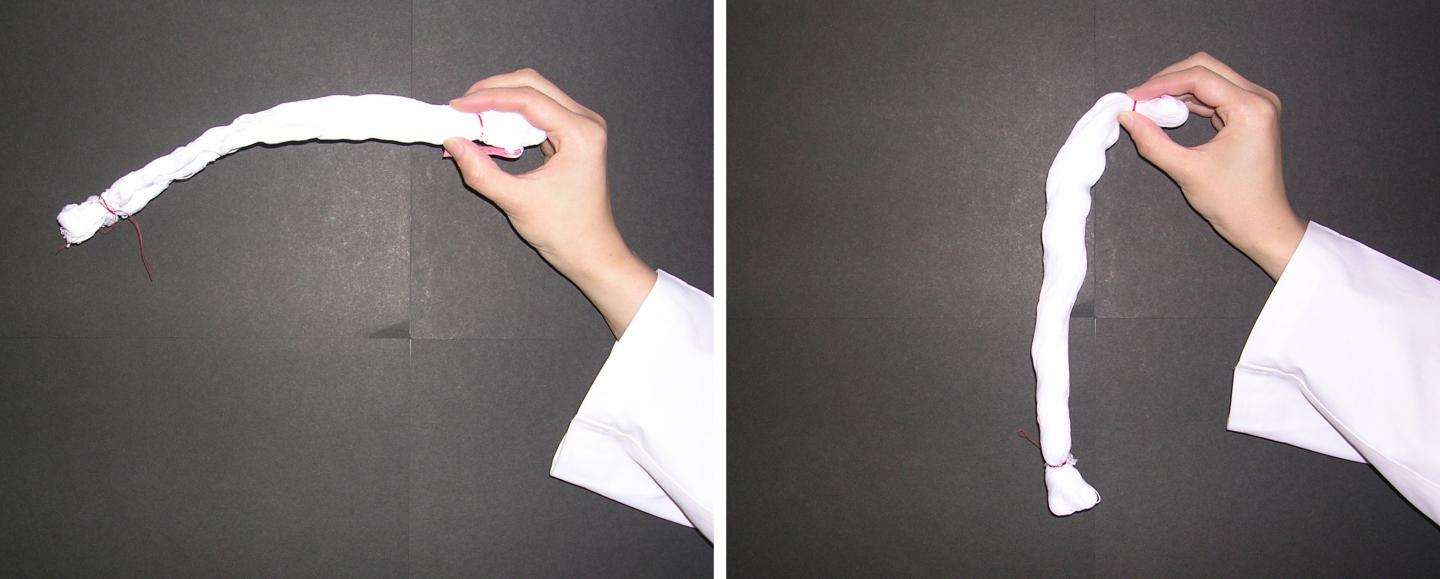
Why does your cotton towel get stiff after natural drying?

Bioengineer by Bioengineer
March 27, 2020
in Chemistry
Reading Time: 2 mins read
0
IMAGE
Share on FacebookShare on TwitterShare on LinkedinShare on RedditShare on Telegram

IMAGE

Credit: J. Surfact Deterg (2016), 19, 183

The remaining “bound water” on cotton surfaces cross-link single fibers of cotton, causing hardening after natural drying, according to a new study conducted by Kao Corporation and Hokkaido University. This provides new insight into unique water behaviors on material surfaces and helps us develop better cleaning technologies.

Cotton towels often become stiff when washed without fabric softener and naturally dried, but the mechanism behind it has remained a mystery. In previous studies, the research groups at Kao Corporation suggested the involvement of bound water — a special type of water that exhibits unique properties on the surface of materials — for the hardening. The group proposed a theoretical model in which the bound water that remains on the surface of cotton causes cross-linking between single fibers through a process called capillary adhesion.

In the current study published in The Journal of Physical Chemistry C, the research group reports direct observations of the bound water on cotton surfaces, providing strong evidence for Kao’s model. Joined by Ken-ichiro Murata of Hokkaido University, the group employed special analytical techniques called atomic force microscopy (AFM) and AFM-based infrared spectroscopy (AFM-IR) to investigate the bound water on cotton surfaces at the molecular level.

The AFM observations indicated the existence of a viscous substance on the cotton surface that is not cellulose, the major component of cotton. This strongly suggested viscous bound water is present there causing capillary adhesion — a phenomenon in which liquid sandwiched between solid surfaces causes adhesion of them. In the following experiments, the AFM-IR spectra of naturally dried cotton surfaces showed two-peaks that indicate the existence of water. On the other hand, no peaks were observed after completely removing water on the cotton surface. Furthermore, the spectra, showing two clear peaks, suggested that the bound water takes two different states at the air-water interface and the water-cotton interface, respectively.

“The experiments clarified that bound water is evident on cotton surfaces and contributes to certain dynamic properties such as stiffness mediated by capillary adhesion. Also, the bound water itself manifested a unique hydrogen bonding state different from that of ordinary water,” said Ken-ichiro Murata of Hokkaido University. Takako Igarashi of Kao Corporation added, “It has been thought that fabric softeners reduce friction between cotton fibers. However, our results showing the involvement of bound water in the hardening of cotton provide new insight into how fabric softeners work and can help us develop better agents, formulations and systems.”

###

Media Contact
Naoki Namba
[email protected]
81-117-062-185

Original Source

https://www.global.hokudai.ac.jp/blog/why-does-your-cotton-towel-get-stiff-after-natural-drying/

Related Journal Article

http://dx.doi.org/10.1021/acs.jpcc.0c00423

Tags: Atomic/Molecular/Particle PhysicsBiomedical/Environmental/Chemical EngineeringChemistry/Physics/Materials SciencesIndustrial Engineering/ChemistryMaterialsPolymer Chemistry
Share12Tweet8Share2ShareShareShare2

Related Posts

blank

Breakthrough in Environmental Cleanup: Scientists Develop Solar-Activated Biochar for Faster Remediation

February 7, 2026
blank

Cutting Costs: Making Hydrogen Fuel Cells More Affordable

February 6, 2026

Scientists Develop Hand-Held “Levitating” Time Crystals

February 6, 2026

Observing a Key Green-Energy Catalyst Dissolve Atom by Atom

February 6, 2026
Please login to join discussion

POPULAR NEWS

  • Robotic Ureteral Reconstruction: A Novel Approach

    Robotic Ureteral Reconstruction: A Novel Approach

    82 shares
    Share 33 Tweet 21
  • Digital Privacy: Health Data Control in Incarceration

    63 shares
    Share 25 Tweet 16
  • Study Reveals Lipid Accumulation in ME/CFS Cells

    57 shares
    Share 23 Tweet 14
  • Breakthrough in RNA Research Accelerates Medical Innovations Timeline

    53 shares
    Share 21 Tweet 13

About

We bring you the latest biotechnology news from best research centers and universities around the world. Check our website.

Follow us

Recent News

Digital Health Perspectives from Baltic Sea Experts

Florida Cane Toad: Complex Spread and Selective Evolution

Exploring Decision-Making in Dementia Caregivers’ Mobility

Subscribe to Blog via Email

Enter your email address to subscribe to this blog and receive notifications of new posts by email.

Join 73 other subscribers
  • Contact Us

Bioengineer.org © Copyright 2023 All Rights Reserved.

Welcome Back!

Login to your account below

Forgotten Password?

Retrieve your password

Please enter your username or email address to reset your password.

Log In
No Result
View All Result
  • Homepages
    • Home Page 1
    • Home Page 2
  • News
  • National
  • Business
  • Health
  • Lifestyle
  • Science

Bioengineer.org © Copyright 2023 All Rights Reserved.