• HOME
  • NEWS
  • EXPLORE
    • CAREER
      • Companies
      • Jobs
    • EVENTS
    • iGEM
      • News
      • Team
    • PHOTOS
    • VIDEO
    • WIKI
  • BLOG
  • COMMUNITY
    • FACEBOOK
    • INSTAGRAM
    • TWITTER
Tuesday, January 13, 2026
BIOENGINEER.ORG
No Result
View All Result
  • Login
  • HOME
  • NEWS
  • EXPLORE
    • CAREER
      • Companies
      • Jobs
        • Lecturer
        • PhD Studentship
        • Postdoc
        • Research Assistant
    • EVENTS
    • iGEM
      • News
      • Team
    • PHOTOS
    • VIDEO
    • WIKI
  • BLOG
  • COMMUNITY
    • FACEBOOK
    • INSTAGRAM
    • TWITTER
  • HOME
  • NEWS
  • EXPLORE
    • CAREER
      • Companies
      • Jobs
        • Lecturer
        • PhD Studentship
        • Postdoc
        • Research Assistant
    • EVENTS
    • iGEM
      • News
      • Team
    • PHOTOS
    • VIDEO
    • WIKI
  • BLOG
  • COMMUNITY
    • FACEBOOK
    • INSTAGRAM
    • TWITTER
No Result
View All Result
Bioengineer.org
No Result
View All Result
Home NEWS Science News Chemistry

Holographic cosmological model and thermodynamics on the horizon of the universe

Bioengineer by Bioengineer
March 26, 2020
in Chemistry
Reading Time: 2 mins read
0
IMAGE
Share on FacebookShare on TwitterShare on LinkedinShare on RedditShare on Telegram

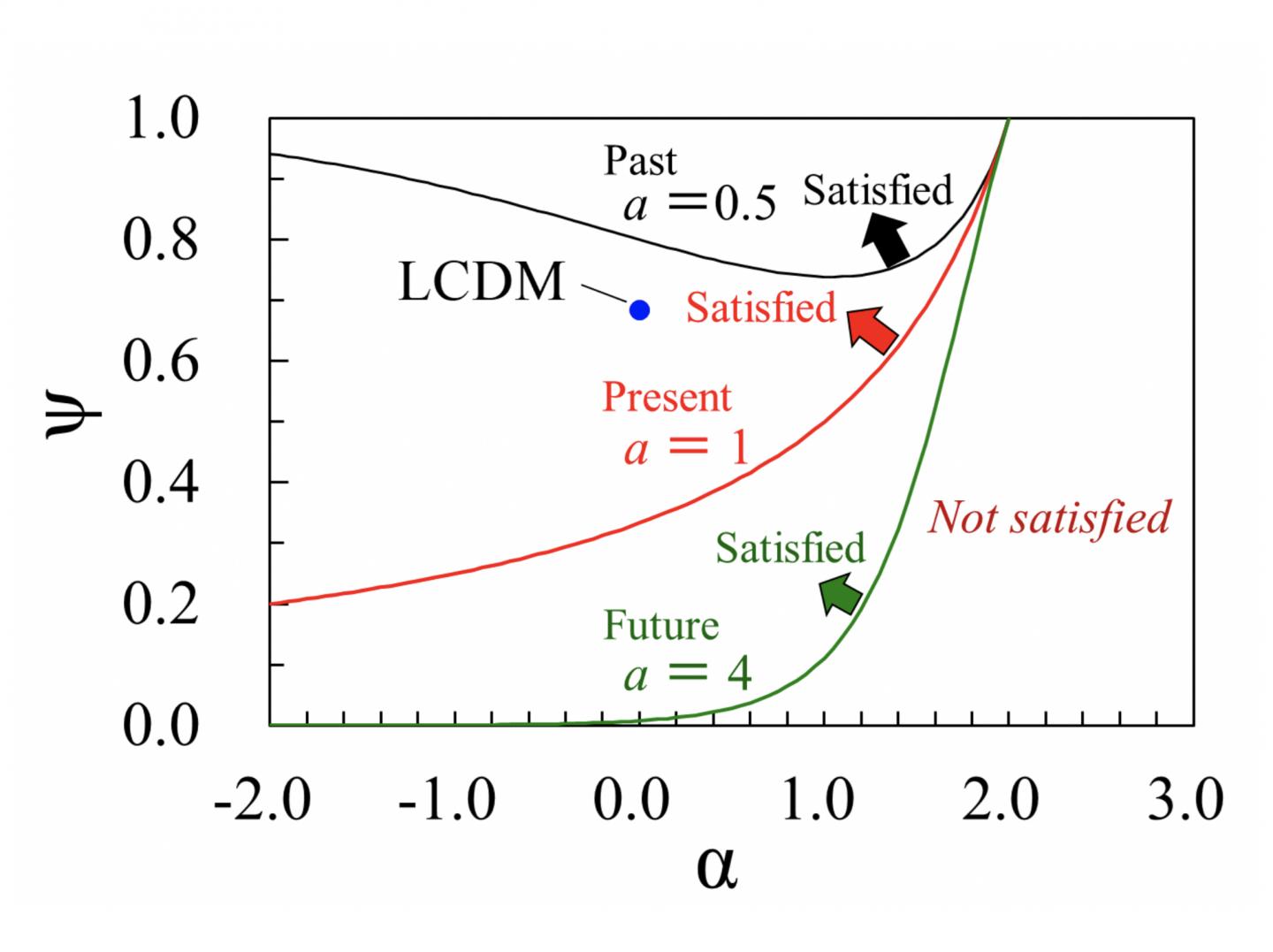
A Kanazawa University researcher proposes a novel cosmological model to study thermodynamics on the horizon of the universe
IMAGE

Credit: Kanazawa University


Kanazawa, Japan – The expansion of the Universe has occupied the minds of astronomers and astrophysicists for decades. Among the cosmological models that have been suggested over the years, Lambda cold dark matter (LCDM) models are the simplest models that can provide elegant explanations of the properties of the Universe, e.g., the accelerated expansion of the late Universe and structural formations. However, the LCDM model suffers from several theoretical difficulties, such as the cosmological constant problem. To resolve these difficulties, alternative thermodynamic scenarios have recently been proposed that extend the concept of black hole thermodynamics.

“Previous research implies that a certain type of universe will behave like an ordinary macroscopic system. The expansion of the Universe is considered likely to be related to thermodynamics on its horizon, based on the holographic principle,” explains the study’s author, Kanazawa University’s Nobuyoshi Komatsu.

“I considered a cosmological model with a power-law term, assuming application of the holographic equipartition law. The power-law term is proportional to Hα, where H is the Hubble parameter and α is considered to be a free parameter (α may be related to the entanglement of the quantum fields close to the horizon).”

“I used the proposed model to study the thermodynamic properties on the horizon of the Universe, focusing on the evolutions of the Bekenstein-Hawking entropy. I found that the model satisfies the second law of thermodynamics on the horizon,” says Associate Professor Komatsu.

“In addition, I used the model to examine the relaxation-like processes that occur before the last stage of the evolution of the Universe and thus enable study of the maximization of the entropy.”

“Figure 1 shows the boundaries for maximization of the entropy in the (α, ψ) plane. Here, ψ represents a type of density parameter for the effective dark energy. The upper side of each boundary corresponds to the region that satisfies the conditions for maximization of the entropy. For example, the point for the fine-tuned LCDM model is found to satisfy the conditions for maximization of the entropy at the present time. In addition, the region close to this point also satisfies the conditions for maximization of the entropy, both at the present time and in the future. Cosmological models in this region are likely to be favored from a thermodynamics viewpoint,” says Associate Professor Komatsu.

In addition to the reported results of the study, it is hoped that the developed model will serve to enable discussion and analysis of the wide range of currently available cosmological models from a thermodynamics perspective.

###

Media Contact
Tomoya Sato
[email protected]
81-762-645-076

Related Journal Article

http://dx.doi.org/10.1103/PhysRevD.100.123545

Tags: AstronomyAstrophysicsSpace/Planetary Science
Share12Tweet8Share2ShareShareShare2

Related Posts

blank

Thermal [2+2] Cycloaddition Builds Gem-Difluoro Bicycloalkanes

January 13, 2026
blank

Cobalt-Catalyzed Thioester Coupling via Siloxycarbene

January 12, 2026

Advancing Alkene Chemistry: Homologative Difunctionalization Breakthrough

January 8, 2026

Biocompatible Ligand Enables Safe In-Cell Protein Arylation

January 8, 2026
Please login to join discussion

POPULAR NEWS

  • Enhancing Spiritual Care Education in Nursing Programs

    154 shares
    Share 62 Tweet 39
  • PTSD, Depression, Anxiety in Childhood Cancer Survivors, Parents

    147 shares
    Share 59 Tweet 37
  • Robotic Ureteral Reconstruction: A Novel Approach

    72 shares
    Share 29 Tweet 18
  • Study Reveals Lipid Accumulation in ME/CFS Cells

    52 shares
    Share 21 Tweet 13

About

We bring you the latest biotechnology news from best research centers and universities around the world. Check our website.

Follow us

Recent News

Optimizing Pleurotus djamor Polysaccharides for Health Benefits

Global Sarcocystis Infection in Pigs: Trends and Predictions

Osimertinib ± Savolitinib in MET-EGFR NSCLC Trial

Subscribe to Blog via Email

Enter your email address to subscribe to this blog and receive notifications of new posts by email.

Join 71 other subscribers
  • Contact Us

Bioengineer.org © Copyright 2023 All Rights Reserved.

Welcome Back!

Login to your account below

Forgotten Password?

Retrieve your password

Please enter your username or email address to reset your password.

Log In
No Result
View All Result
  • Homepages
    • Home Page 1
    • Home Page 2
  • News
  • National
  • Business
  • Health
  • Lifestyle
  • Science

Bioengineer.org © Copyright 2023 All Rights Reserved.