Credit: Martin Stevens
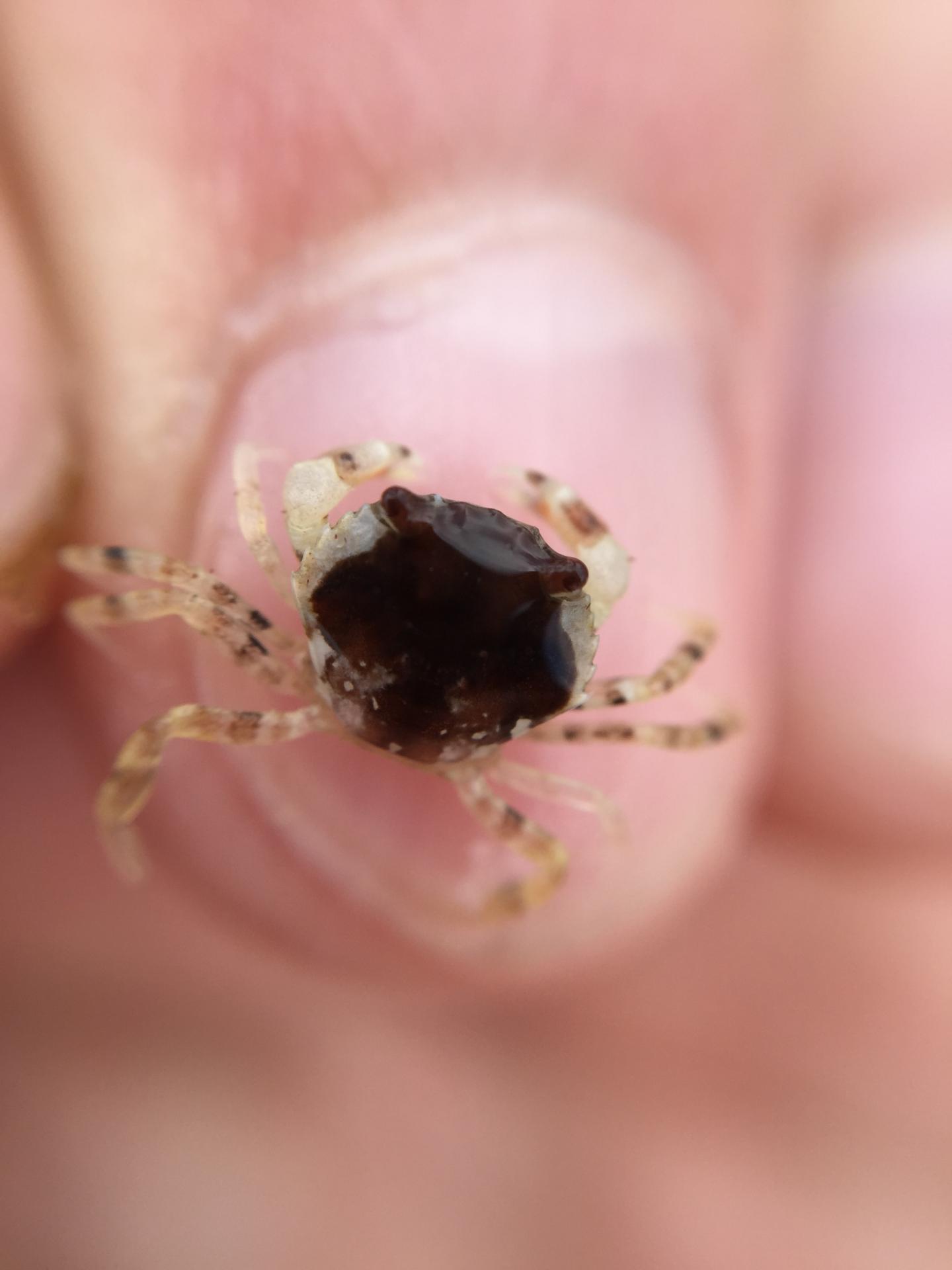
The ocean is getting too loud even for crabs. Normally, shore crabs (Carcinus maenas) can slowly change their shell color to blend in with the rocky shores in which they live, but recent findings show that prolonged exposure to the sounds of ships weakens their camouflaging powers and leaves them more open to attack. The work, appearing March 9 in the journal Current Biology, illustrates how man-made undersea noise can turn common shore crabs into sitting ducks for potential predators.
“Prior work had shown that ship noise can be stressful for shore crabs, so in this study, we wanted to address how that stress might affect behaviors they rely on for survival,” says first author Emily Carter, a graduate from the University of Exeter. Unlike frogs or bats, who use sound to communicate or hunt, crabs don’t primarily use sound to interact with each other. However, this study demonstrates that noise pollution can still affect important shore crab survival behaviors like the ability to camouflage and quickly respond to danger.
Carter placed dark-shelled juvenile shore crabs into white tanks. Within the tanks, crabs were exposed to the underwater sounds of a cruise ship, container ship, and oil tanker. As a control, other crabs listened to natural water sounds–played either quietly, or loud at a similar amplitude to the ship noise. Over 8 weeks, the crabs exposed to ship noise lightened their color to match their tanks only half as much as those which heard ambient water alone (both quiet and loud). Carter believes this reduced change in color demonstrates the unique effect of ship noise pollution on crab camouflage.
“Color change in shore crabs is a slow, energetically costly process that’s controlled by hormones that activate specialized pigment cells across their shell,” says Carter. “Stress consumes energy and disrupts hormone balance, so we believe that the stress caused by ship noise either drains the crabs of the energy required to change color properly or disrupts the balance of hormones necessary to make that change.” The crabs also grew and molted much more slowly, showing that ship noise impacts multiple aspects of shore crab physiology.
What’s more is that when crabs were subjected to a simulated shore bird attack, those that heard ship noise didn’t run and hide as they would normally. “About half of the crabs exposed to ship noise did not respond to the attack at all, and the ones that did were slow to hide themselves,” says Carter. “Similar to how people have trouble concentrating when stressed, the nature of their response indicates that they couldn’t process what was happening, as if that awareness and decision-making ability just wasn’t there.”
In noise pollution research, the sounds of ships and other forms of man-made noise are typically studied for their effects on animals who directly use sound. Here, Carter, co-author Tom Tregenza, professor of evolutionary ecology at the University of Exeter, and senior author Martin Stevens, professor of sensory and evolutionary ecology at the University of Exeter, show that the noise pollution field should also consider behaviors based on their importance to survival rather than whether they have a direct link with noise.
“This work shows how processes like color change, which are not directly linked to acoustics, can still be affected by noise and how even animals like crabs are impacted by noise pollution–not just species that actively use sound, such as many fish or mammals,” says Stevens.
To expand upon this research, Stevens’ lab is investigating how multiple stressors, including that of noise pollution and warming oceans, could work synergistically to disrupt the coloration and behavior of marine organisms.
###
Current Biology, Carter et al.: “Ship noise inhibits colour change, camouflage, and anti-predator behaviour in shore crabs” https://www.cell.com/current-biology/fulltext/S0960-9822(20)30014-2
Current Biology (@CurrentBiology), published by Cell Press, is a bimonthly journal that features papers across all areas of biology. Current Biology strives to foster communication across fields of biology, both by publishing important findings of general interest and through highly accessible front matter for non-specialists. Visit: http://www.
Media Contact
Jordan A. Greer
[email protected]
617-417-7053
Related Journal Article
http://dx.