Human trials tipped within two years
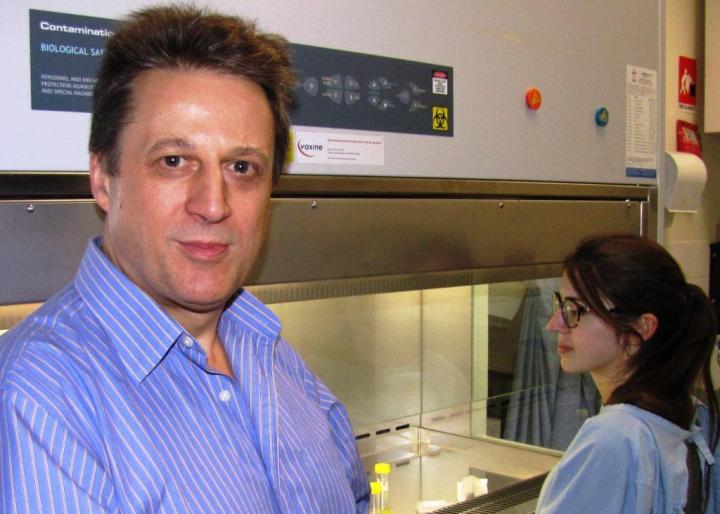
Credit: Flinders University
A preventive treatment for dementia may proceed to clinical trials after successful animal testing.
The US-led research is looking to develop effective immunotherapy via a new vaccine to remove ‘brain plaque’ and tau protein aggregates linked to Alzheimer’s disease.
Recent success in bigenic mice models supports progression to human trials in years to come, the researchers say.
A new paper in the journal Alzheimer’s Research & Therapy paves the way for more work in 2020, with medical researchers at the Institute for Molecular Medicine and University of California, Irvine (UCI) working with a successful vaccine formulated on adjuvant developed by Flinders University Professor Nikolai Petrovsky in South Australia.
The latest research aims to come up with a new treatment to remove accumulated beta-amyloid (Aβ) plaques and neurofibrillary tangles composed of hyperphosphorylated tau, which together lead to neurodegeneration and cognitive decline in Alzheimer’s disease.
Alzheimer’s disease (AD) is the leading cause of age-related dementia, affecting about 5.7 million people in the US. Major challenges in AD include the lack of effective treatments, reliable biomarkers, or preventive strategies.
Professor of the Institute for Molecular Medicine Anahit Ghochikyan and colleagues, Associate Professors Hvat Davtyan and Mathew Blurton-Jones from UCI, and other co-authors tested the universal MultiTEP platform-based vaccines formulated in the adjuvant developed at Professor Petrovsky’s Australian lab.
The possible new therapies were tested in bigenic mice with mix Aβ and tau pathologies.
“Taken together, these findings warrant further development of this dual vaccination strategy based on the MultiTEP technology for ultimate testing in human Alzheimer’s disease,” the lead authors Professor Ghochikyan and Blurton-Jones conclude.
Professor Petrovsky says the Advax adjuvant method is a pivotal system to help take the combination MultiTEP-based Aβ/tau vaccines therapy, as well as separate vaccines targeting these pathological molecules, to clinical trials – perhaps within two years.
“Our approach is looking to cover all bases and get past previous roadblocks in finding a therapy to slow the accumulation of Aβ/tau molecules and delay AD progression in a the rising number of people around the world,” says Professor Petrovsky, who will work in the US for the next three months.
Several promising drug candidates have failed in clinical trials so the search for new preventions or therapies continues.
A recent report on human monoclonal antibody, aducanumab, showed that high dose of this antibody reduced clinical decline in patients with early AD as measured by primary and secondary endpoints.
However, it is obvious that it could not be used as a preventive measure in healthy subjects due to the need for frequent (monthly) administration of high concentrations of immunotherapeutic.
Professor Ghochikyan says there is a pressing need to keep searching for new preventive vaccine to delay AD and slow down progression of this devastating disease.
The new combined vaccination approach could potentially be used to induce strong immune responses to both of the hallmark pathologies of AD in a broad population base of vaccinated subjects with high MHC (major histocompatibility complex) class II gene polymorphisms, the new paper concludes.
###
The latest article, ‘Testing a MultiTEP-based combination vaccine to reduce Aβ and tau pathology in Tau22/5xFAD bigenic mice’ (2019) by H Davtyan, A Hovakimyan, SK Shabestari, T Antonyan, MA Coburn, K Zagorski, G Chailyan, I Petrushina, O Svystun, E Danhash, N Petrovsky, DH Cribbs, MG Agadjanvan, M Blurton-Jones and A Ghochikyan, has been published in Alzheimer’s Research & Therapy (BMC, Springer Nature). DOI: 10.1186/s13195-019-0556-2
Also see ‘A MultiTEP platform-based epitope vaccine targeting the phosphatase activating domain (PAD) of tau: therapeutic efficacy in PS19 mice’ (2019) in Scientific Reports
The research is funded by various R01 grants from the National Institutes for Health in the USA.
Media Contact
Nikolai Petrovsky
[email protected]
61-413-131-635
Related Journal Article
http://dx.