Credit: Bill Barnhart, University of Iowa
A University of Iowa-led study has found that a series of Southern California earthquakes last summer increased stress on the Garlock Fault, a major earthquake fault line that has been dormant for at least a century.
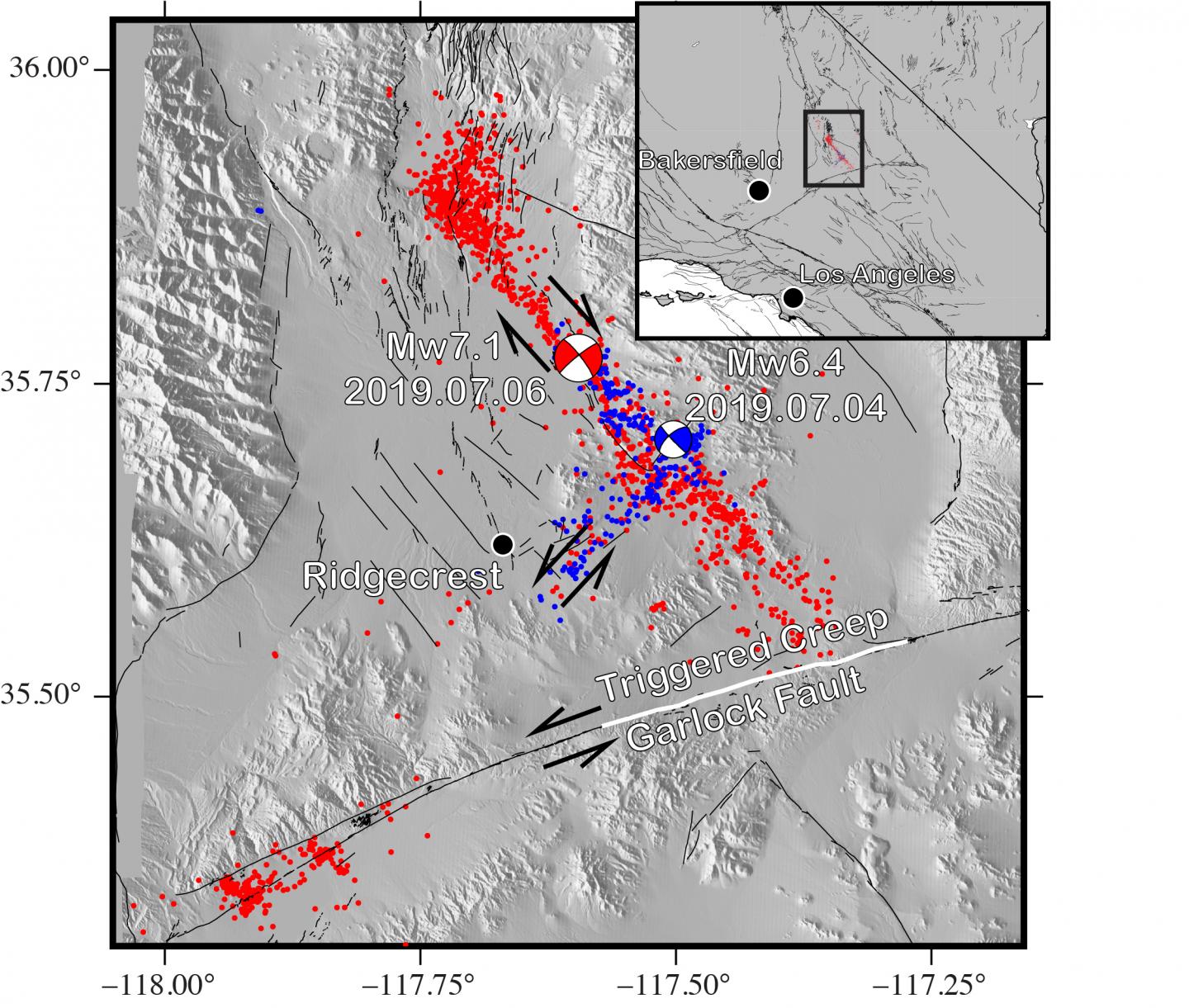
The researchers used satellite imagery and seismic instruments to map the effects of the Ridgecrest earthquakes, a sequence that began with a magnitude 6.4 foreshock in the Mojave Desert on July 4 before a magnitude 7.1 earthquake that struck the next day. In all, there were more than 100,000 aftershocks stemming from the twin earthquakes.
The analysis by Bill Barnhart, a geodesist at Iowa, and researchers at the U.S. Geological Survey showed the Ridgecrest earthquakes and aftershocks caused “aseismic creep” along a 12- to 16-mile section of the Garlock Fault, which runs east to west for 185 miles from the San Andreas Fault to Death Valley, and perpendicular to the Ridgecrest earthquake region.
“The aseismic creep tells us the Garlock Fault is sensitive to stress changes, and that stresses increased across only a limited area of the fault,” says Barnhart, assistant professor in the UI Department of Earth and Environmental Sciences and corresponding author on the study, published in the journal Geophysical Research Letters.
“So, if–and that’s a big if–this area were to slip in a future earthquake, we are showing where that might happen,” he adds.
The Ridgecrest earthquakes and aftershocks led to ruptures on the surface and below ground right up to the Garlock Fault. Other than the one stressed section on the Garlock Fault identified by the research team, the remaining 165 or so miles of the fault actually shows decreased stress from the Ridgecrest seismic activity.
“This is good news,” Barnhart says.
Aseismic creep is slip on a fault that does not produce the shaking or seismic waves associated with earthquakes. Creep on the Garlock Fault following the Ridgecrest earthquakes was shallow, occurring from the surface to around 300 feet below ground.
The Garlock Fault has not produced large earthquakes since instrument-keeping began–at least a century–but is considered a potential seismic risk to Southern California.
“The Garlock Fault has been quiet for a long time,” Barnhart says. “But there’s geologic evidence that there have been large earthquakes on it. It’s a major fault line.”
Barnhart’s team says the stressed section could be capable of producing an earthquake between a magnitude 6.7 to a magnitude 7.0 if it ruptured.
“It would be an earthquake of the magnitude of the Ridgecrest sequence,” Barnhart says. “That means it would be big. You’d feel some swaying in Los Angeles, but it wouldn’t be a magnitude 7.8 that could be more damaging.”
Aseismic creep triggered on faults by nearby earthquakes in Southern California are relatively common, and do not necessarily lead to earthquakes, Barnhart says.
Another analysis of the Ridgecrest earthquakes, published this month in the journal Science, reached the same general conclusions about the effects of the Ridgecrest temblors. Barnhart’s study, though, identifies a longer stretch of the Garlock Fault that has slipped, and gives a physical explanation for why the slip happened.
###
The study, “The July 2019 Ridgecrest California earthquake sequence: Kinematics of slip and stressing in cross-fault ruptures,” was published online on Oct. 15. Contributing authors are Ryan Gold from the USGS Geologic Hazards Center and Gavin Hayes from the USGS National Earthquake Information Center.
The USGS and the Southern California Earthquake Center funded the research.
Media Contact
Richard Lewis
[email protected]
319-384-0012
Related Journal Article
http://dx.