• HOME
  • NEWS
  • EXPLORE
    • CAREER
      • Companies
      • Jobs
    • EVENTS
    • iGEM
      • News
      • Team
    • PHOTOS
    • VIDEO
    • WIKI
  • BLOG
  • COMMUNITY
    • FACEBOOK
    • INSTAGRAM
    • TWITTER
Wednesday, December 17, 2025
BIOENGINEER.ORG
No Result
View All Result
  • Login
  • HOME
  • NEWS
  • EXPLORE
    • CAREER
      • Companies
      • Jobs
        • Lecturer
        • PhD Studentship
        • Postdoc
        • Research Assistant
    • EVENTS
    • iGEM
      • News
      • Team
    • PHOTOS
    • VIDEO
    • WIKI
  • BLOG
  • COMMUNITY
    • FACEBOOK
    • INSTAGRAM
    • TWITTER
  • HOME
  • NEWS
  • EXPLORE
    • CAREER
      • Companies
      • Jobs
        • Lecturer
        • PhD Studentship
        • Postdoc
        • Research Assistant
    • EVENTS
    • iGEM
      • News
      • Team
    • PHOTOS
    • VIDEO
    • WIKI
  • BLOG
  • COMMUNITY
    • FACEBOOK
    • INSTAGRAM
    • TWITTER
No Result
View All Result
Bioengineer.org
No Result
View All Result
Home NEWS Science News

NASA sees heavy rainfall occurring in strengthening Tropical Storm Mario

Bioengineer by Bioengineer
September 18, 2019
in Science News
Reading Time: 2 mins read
0
IMAGE
Share on FacebookShare on TwitterShare on LinkedinShare on RedditShare on Telegram

IMAGE

Credit: NASA/JAXA/NRL

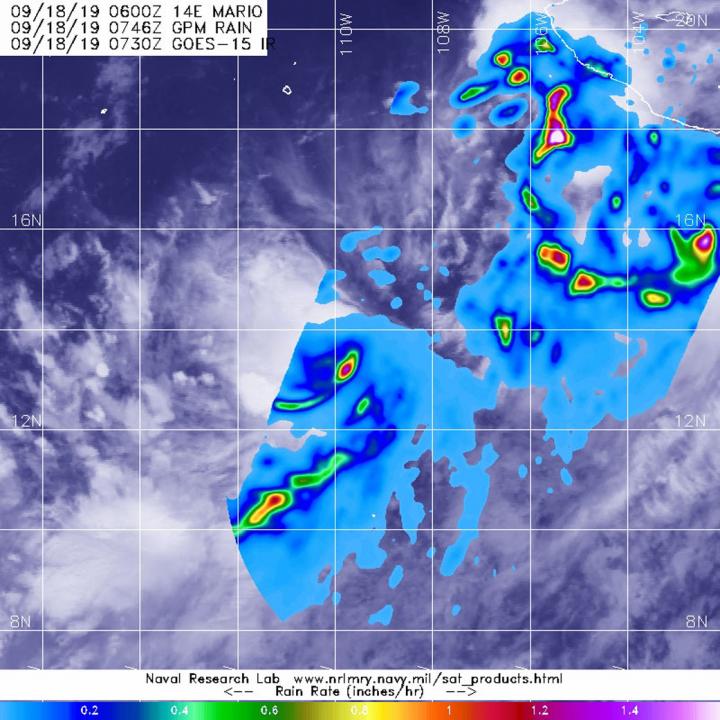
When the Global Precipitation Measurement mission or GPM core satellite passed over the Eastern Pacific Ocean, it flew over the eastern side of Tropical Storm Mario and measured rainfall.

The GPM’s core satellite passed over Mario on Sept. 18 at 3:46 a.m. EDT (0746 UTC). GPM found the heaviest rainfall in the southeastern side of the storm falling at a rate of over 36 mm (about 1.4 inch) per hour. Lighter rainfall rated were measured throughout the rest of the east and southern quadrants and band of thunderstorms south of center. Forecasters at NOAA’s National Hurricane Center or NHC incorporate the rainfall data into their forecasts

Mario formed on Sept. 17 as Tropical Depression 14E and six hours later at 6 p.m. EDT, it became a tropical storm.

At 11 a.m. EDT (1500 UTC), NHC forecasters said the center of Tropical Storm Mario was located near latitude 14.5 degrees north and longitude 111.0 degrees west. Mario is far from land, so there are no coastal warnings or watches in effect. Mario is centered about 585 miles (940 km) south of the southern tip of Baja California, Mexico.

Mario is moving toward the northwest near 12 mph (19 kph). This motion is expected to continue through tonight, with a decrease in forward speed beginning on Thursday. Mario is expected to become nearly stationary from early Friday through early Saturday.

Maximum sustained winds have increased to near 65 mph (100 kph) with higher gusts. The estimated minimum central pressure is 996 millibars.

Mario is forecast to become a hurricane by Thursday, Sept. 19.

Hurricanes are the most powerful weather event on Earth. NASA’s expertise in space and scientific exploration contributes to essential services provided to the American people by other federal agencies, such as hurricane weather forecasting.

###

GPM is a joint mission between NASA and the Japan Aerospace Exploration Agency, JAXA.

For updated forecasts, visit: http://www.nhc.noaa.gov

Rob Gutro

NASA’s Goddard Space Flight Center, Greenbelt, Md.

Media Contact
Rob Gutro
[email protected]

Original Source

https://blogs.nasa.gov/hurricanes/2019/09/18/mario-eastern-pacific-ocean/

Tags: Atmospheric ChemistryAtmospheric ScienceClimate ChangeClimate ScienceEarth ScienceMeteorologyTechnology/Engineering/Computer ScienceTemperature-Dependent PhenomenaWeather/Storms
Share13Tweet8Share2ShareShareShare2

Related Posts

ER Stress Triggers Cell Death in Tumor Environment

December 17, 2025
blank

Data-Driven Insights: Enhancing Moroccan Soccer Performance

December 17, 2025

TMS-EEG Reveals Brain Changes in Parkinson’s Mild Cognitive Impairment

December 17, 2025

Denosumab Slows Knee Osteoarthritis by Blocking Inflammation

December 17, 2025
Please login to join discussion

POPULAR NEWS

  • Nurses’ Views on Online Learning: Effects on Performance

    Nurses’ Views on Online Learning: Effects on Performance

    70 shares
    Share 28 Tweet 18
  • NSF funds machine-learning research at UNO and UNL to study energy requirements of walking in older adults

    70 shares
    Share 28 Tweet 18
  • MoCK2 Kinase Shapes Mitochondrial Dynamics in Rice Fungal Pathogen

    72 shares
    Share 29 Tweet 18
  • Unraveling Levofloxacin’s Impact on Brain Function

    52 shares
    Share 21 Tweet 13

About

We bring you the latest biotechnology news from best research centers and universities around the world. Check our website.

Follow us

Recent News

ER Stress Triggers Cell Death in Tumor Environment

Data-Driven Insights: Enhancing Moroccan Soccer Performance

TMS-EEG Reveals Brain Changes in Parkinson’s Mild Cognitive Impairment

Subscribe to Blog via Email

Enter your email address to subscribe to this blog and receive notifications of new posts by email.

Join 70 other subscribers
  • Contact Us

Bioengineer.org © Copyright 2023 All Rights Reserved.

Welcome Back!

Login to your account below

Forgotten Password?

Retrieve your password

Please enter your username or email address to reset your password.

Log In
No Result
View All Result
  • Homepages
    • Home Page 1
    • Home Page 2
  • News
  • National
  • Business
  • Health
  • Lifestyle
  • Science

Bioengineer.org © Copyright 2023 All Rights Reserved.