• HOME
  • NEWS
  • EXPLORE
    • CAREER
      • Companies
      • Jobs
    • EVENTS
    • iGEM
      • News
      • Team
    • PHOTOS
    • VIDEO
    • WIKI
  • BLOG
  • COMMUNITY
    • FACEBOOK
    • INSTAGRAM
    • TWITTER
Saturday, July 4, 2026
BIOENGINEER.ORG
No Result
View All Result
  • Login
  • HOME
  • NEWS
  • EXPLORE
    • CAREER
      • Companies
      • Jobs
        • Lecturer
        • PhD Studentship
        • Postdoc
        • Research Assistant
    • EVENTS
    • iGEM
      • News
      • Team
    • PHOTOS
    • VIDEO
    • WIKI
  • BLOG
  • COMMUNITY
    • FACEBOOK
    • INSTAGRAM
    • TWITTER
  • HOME
  • NEWS
  • EXPLORE
    • CAREER
      • Companies
      • Jobs
        • Lecturer
        • PhD Studentship
        • Postdoc
        • Research Assistant
    • EVENTS
    • iGEM
      • News
      • Team
    • PHOTOS
    • VIDEO
    • WIKI
  • BLOG
  • COMMUNITY
    • FACEBOOK
    • INSTAGRAM
    • TWITTER
No Result
View All Result
Bioengineer.org
No Result
View All Result
Home NEWS Science News Chemistry

Stopping inflammation in its tracks: A leap forward for new anti-inflammatory drugs

Bioengineer by Bioengineer
May 13, 2019
in Chemistry
Reading Time: 2 mins read
0
IMAGE
Share on FacebookShare on TwitterShare on LinkedinShare on RedditShare on Telegram

IMAGE

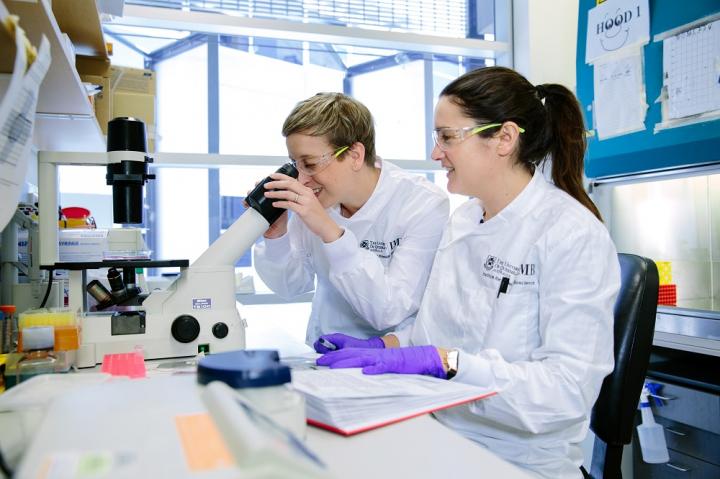
Credit: University of Queensland

Treatments for chronic inflammatory diseases are one step closer as University of Queensland researchers discover a way to stop inflammation in its tracks.

Associate Professor Kate Schroder and Dr Rebecca Coll from UQ’s Institute for Molecular Bioscience and Professor Avril Robertson from UQ’s School of Chemistry and Molecular Biosciences led the study, which will inform the design of new drugs to stop the formation of a protein complex, called the inflammasome, which drives inflammation.

Dr Coll, who is now a Lecturer at the Wellcome-Wolfson Institute for Experimental Medicine at Queen’s University Belfast, said the inflammasome was important in protecting our bodies from infection, but is also a key driver of unhealthy inflammation.

“Inflammation helps our bodies heal following infection, but when the inflammasome is not switched off, inflammation becomes damaging.

“Uncontrolled inflammation results in chronic diseases, such as Parkinson’s disease, Alzheimer’s disease and respiratory diseases such as asthma,” she said.

Associate Professor Schroder said the team’s exciting discovery gave new insight into how to stop inflammation at the molecular level.

“We previously identified a small molecule, MCC950, that inhibits the inflammasome to block inflammation in disease but, until now, we did not understand how it worked,” she said.

“We discovered that MCC950 binds directly to the inflammasome and inactivates it, turning off inflammation.

“Now that we understand how a small molecule can inhibit the inflammasome, we are very excited about the potential of inflammasome inhibitors as anti-inflammatory drugs.

Professor Robertson said “UQ start-up Inflazome Ltd, which is developing targeted therapies for inflammatory diseases, had announced its plans to commence clinical trials of their inflammasome inhibitors in 2019, and other companies are competing in this space.

“We are keen to see results of these trials and hope that our discovery can lead to the efficient design of new molecules as anti-inflammatory drugs of the future,” she said.

###

The research was published in the scientific journal Nature Chemical Biology and supported by the National Health and Medical Research Council of Australia and the Australian Research Council.

Media Contact
Jane Ilsley
[email protected]

Related Journal Article

http://dx.doi.org/10.1038/s41589-019-0277-7

Tags: Cell BiologyMedicine/HealthMolecular BiologyPharmaceutical Science
Share12Tweet8Share2ShareShareShare2

Related Posts

Intelligent Microgrid Management Promises Lower Household Energy Bills and Reduced Diesel Emissions — Chemistry

Intelligent Microgrid Management Promises Lower Household Energy Bills and Reduced Diesel Emissions

July 4, 2026
Graz University of Technology Deciphers the Structural Secrets of MOF Thin Films — Chemistry

Graz University of Technology Deciphers the Structural Secrets of MOF Thin Films

July 2, 2026

Breaking Thermodynamic Limits: Wavelength-Driven Catalysis Advances Ammonia Synthesis

July 2, 2026

From Quantum Mechanics to AI-Powered Materials Discovery: MARVEL Marks 12 Years of Transforming Computational Science

July 2, 2026
Please login to join discussion

POPULAR NEWS

  • Detection of EDCs in Breast Milk and Infant Urine Up to Six Months Highlights Early Exposure Risks

    77 shares
    Share 31 Tweet 19
  • Saying Goodbye to PGY-6: Pediatric Fellowship Realities

    103 shares
    Share 41 Tweet 26
  • New Drug Candidate Developed at McMaster Shows Potential for Treating Brain Cancer

    58 shares
    Share 23 Tweet 15
  • KTU Researchers Explore Ultrasound’s Role in Enhancing Blood Flow Beyond Diagnostics

    53 shares
    Share 21 Tweet 13

About

We bring you the latest biotechnology news from best research centers and universities around the world. Check our website.

Follow us

Recent News

Quasi-Bound States Boost Quantum Well Photoresponse

Lysine Pyruvylation Links Glycolysis to Epigenetics

Multiphysics Coupling: Single vs. Multiple DeepONet Branches

Subscribe to Blog via Email

Success! An email was just sent to confirm your subscription. Please find the email now and click 'Confirm' to start subscribing.

Join 83 other subscribers
  • Contact Us

Bioengineer.org © Copyright 2023 All Rights Reserved.

Welcome Back!

Login to your account below

Forgotten Password?

Retrieve your password

Please enter your username or email address to reset your password.

Log In
No Result
View All Result
  • Homepages
    • Home Page 1
    • Home Page 2
  • News
  • National
  • Business
  • Health
  • Lifestyle
  • Science

Bioengineer.org © Copyright 2023 All Rights Reserved.