• HOME
  • NEWS
  • EXPLORE
    • CAREER
      • Companies
      • Jobs
    • EVENTS
    • iGEM
      • News
      • Team
    • PHOTOS
    • VIDEO
    • WIKI
  • BLOG
  • COMMUNITY
    • FACEBOOK
    • INSTAGRAM
    • TWITTER
Friday, June 26, 2026
BIOENGINEER.ORG
No Result
View All Result
  • Login
  • HOME
  • NEWS
  • EXPLORE
    • CAREER
      • Companies
      • Jobs
        • Lecturer
        • PhD Studentship
        • Postdoc
        • Research Assistant
    • EVENTS
    • iGEM
      • News
      • Team
    • PHOTOS
    • VIDEO
    • WIKI
  • BLOG
  • COMMUNITY
    • FACEBOOK
    • INSTAGRAM
    • TWITTER
  • HOME
  • NEWS
  • EXPLORE
    • CAREER
      • Companies
      • Jobs
        • Lecturer
        • PhD Studentship
        • Postdoc
        • Research Assistant
    • EVENTS
    • iGEM
      • News
      • Team
    • PHOTOS
    • VIDEO
    • WIKI
  • BLOG
  • COMMUNITY
    • FACEBOOK
    • INSTAGRAM
    • TWITTER
No Result
View All Result
Bioengineer.org
No Result
View All Result
Home NEWS Science News Cancer

Circadian rhythm disruption tips the cell-cycle balance toward tumor growth

Bioengineer by Bioengineer
April 30, 2019
in Cancer
Reading Time: 3 mins read
0
IMAGE
Share on FacebookShare on TwitterShare on LinkedinShare on RedditShare on Telegram

New mechanism highlights risks of circadian disruption and supports timed cancer treatment
IMAGE

Credit: Amita Sehgal

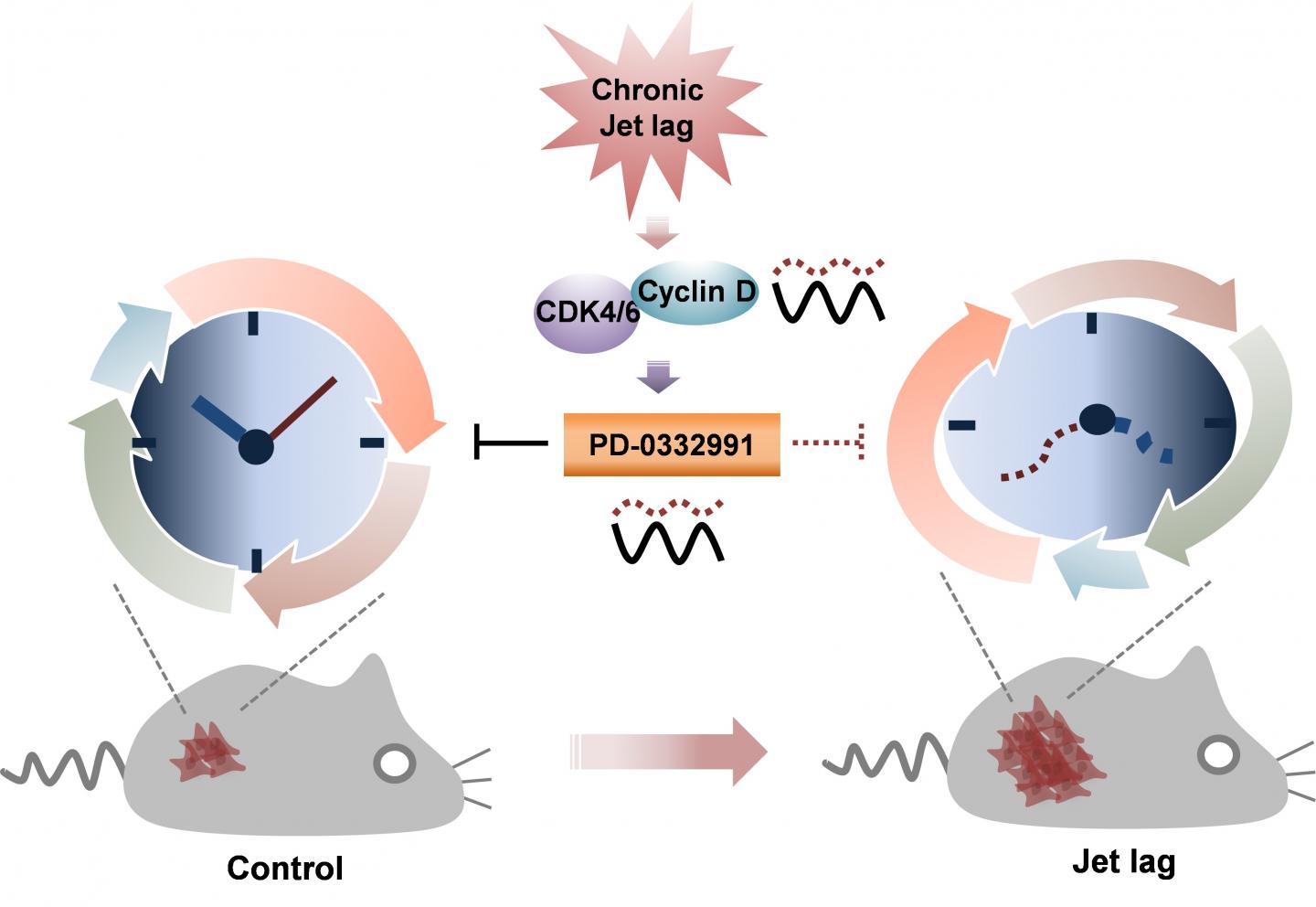
Disrupting normal circadian rhythms promotes tumor growth and suppresses the effects of a tumor-fighting drug, according to a new study publishing April 30 in the open-access journal PLOS Biology by Yool Lee, Amita Sehgal, and colleagues at the University of Pennsylvania. The results provide mechanistic support for “chronotherapy,” the delivery of cancer drugs timed to the endogenous circadian rhythm.

Circadian rhythms regulate many aspects of physiology from the organismic to the subcellular levels. Disruption of circadian rhythms, whether through jet travel, shift work, or sleep disturbances, is a known risk factor for several types of cancer. In animal models, hormonally induced circadian disruption promotes tumor growth, but the underlying mechanism or mechanisms have not been clear.

To uncover potential mechanisms, the authors used the hormone dexamethasone to chronically advance daily rhythms in cultured cells. They found that treatment altered expression of multiple genes, especially those involved in regulating the cell cycle. Circadian rhythm disruption increased cell proliferation, an effect that could be traced to increased expression of a cell-cycle control protein called cyclin D1. Cyclin D1, in turn, activated cyclin D-dependent kinase 4/6 (CDK4/6), a protein that switched the cell from growing larger to synthesizing new DNA, a step that ultimately leads to cell division.

Because tumor growth is linked so tightly to cell division, many cancer treatments seek to arrest progression through the cell cycle. The authors found that the tumor-fighting ability of one such drug, called PD-0332991, which inhibits CDK4/6 activity, varies with time-of-day such that treatment in the morning is more effective than treatment at night. Efficacy of PD-0332991 was reduced in both cells and mice when their circadian rhythms were disrupted.

“We suggest that chronic disruption of the normal circadian rhythm tips the balance between tumor-suppressive and tumor-progressive gene expression to favor tumor growth,” Sehgal said. “Better understanding the molecular effects of jet lag, shift work, and other sources of chronic disruption may lead to strategies to minimize the increased cancer risk associated with these behaviors, and to better treatment strategies, including timing delivery of cancer therapy for maximum benefit.”

###

Peer-reviewed / Experimental Study / Cells

In your coverage please use this URL to provide access to the freely available article in PLOS Biology: http://journals.plos.org/plosbiology/article?id=10.1371/journal.pbio.3000228

Citation: Lee Y, Lahens NF, Zhang S, Bedont J, Field JM, Sehgal A (2019) G1/S cell cycle regulators mediate effects of circadian dysregulation on tumor growth and provide targets for timed anticancer treatment. PLoS Biol 17(4): e3000228. https://doi.org/10.1371/journal.pbio.3000228

Funding: This work was supported by the National Institutes of Health (NIH) (R37-NS-048471) and Howard Hughes Medical Institute (HHMI) to A.S. The funders had no role in study design, data collection and analysis, decision to publish, or preparation of the manuscript.

Competing Interests: The authors have declared that no competing interests exist.

Media Contact
Amita Sehgal
[email protected]

Related Journal Article

http://dx.doi.org/10.1371/journal.pbio.3000228

Tags: BiochemistryBiologycancerCell BiologyCircadian RhythmMedicine/HealthneurobiologyNeurochemistryPhysiology
Share13Tweet8Share2ShareShareShare2

Related Posts

Cracking the Code: How Cancer Evades Antibody-Drug Conjugates and New Strategies to Overcome Resistance

June 25, 2026

MSU Scientists Reveal Mechanism Behind Ovarian Cancer’s Chemotherapy Resistance and Strategies to Overcome It

June 25, 2026

Rare Mixed Liver Cancer Underscores Diagnostic and Therapeutic Challenges

June 25, 2026

How Socioeconomic Factors Shape Lung Cancer Screening Experiences

June 25, 2026
Please login to join discussion

POPULAR NEWS

  • Saying Goodbye to PGY-6: Pediatric Fellowship Realities

    103 shares
    Share 41 Tweet 26
  • Multi-Hospital Study Reveals Long Covid Burden Is Twice as High as Current Estimates

    92 shares
    Share 36 Tweet 23
  • Detection of EDCs in Breast Milk and Infant Urine Up to Six Months Highlights Early Exposure Risks

    77 shares
    Share 31 Tweet 19
  • New Drug Candidate Developed at McMaster Shows Potential for Treating Brain Cancer

    58 shares
    Share 23 Tweet 15

About

We bring you the latest biotechnology news from best research centers and universities around the world. Check our website.

Follow us

Recent News

Tracking Lanthanide-Labeled Microplastics in Plants

POSTECH Researchers Slash Cost of Reconstituted Cell-Free Systems by 95%

AI and Physics Collaborate to Design Advanced Hydrogen Storage Materials

Subscribe to Blog via Email

Success! An email was just sent to confirm your subscription. Please find the email now and click 'Confirm' to start subscribing.

Join 82 other subscribers
  • Contact Us

Bioengineer.org © Copyright 2023 All Rights Reserved.

Welcome Back!

Login to your account below

Forgotten Password?

Retrieve your password

Please enter your username or email address to reset your password.

Log In
No Result
View All Result
  • Homepages
    • Home Page 1
    • Home Page 2
  • News
  • National
  • Business
  • Health
  • Lifestyle
  • Science

Bioengineer.org © Copyright 2023 All Rights Reserved.