• HOME
  • NEWS
  • EXPLORE
    • CAREER
      • Companies
      • Jobs
    • EVENTS
    • iGEM
      • News
      • Team
    • PHOTOS
    • VIDEO
    • WIKI
  • BLOG
  • COMMUNITY
    • FACEBOOK
    • INSTAGRAM
    • TWITTER
Thursday, August 13, 2026
BIOENGINEER.ORG
No Result
View All Result
  • Login
  • HOME
  • NEWS
  • EXPLORE
    • CAREER
      • Companies
      • Jobs
        • Lecturer
        • PhD Studentship
        • Postdoc
        • Research Assistant
    • EVENTS
    • iGEM
      • News
      • Team
    • PHOTOS
    • VIDEO
    • WIKI
  • BLOG
  • COMMUNITY
    • FACEBOOK
    • INSTAGRAM
    • TWITTER
  • HOME
  • NEWS
  • EXPLORE
    • CAREER
      • Companies
      • Jobs
        • Lecturer
        • PhD Studentship
        • Postdoc
        • Research Assistant
    • EVENTS
    • iGEM
      • News
      • Team
    • PHOTOS
    • VIDEO
    • WIKI
  • BLOG
  • COMMUNITY
    • FACEBOOK
    • INSTAGRAM
    • TWITTER
No Result
View All Result
Bioengineer.org
No Result
View All Result
Home NEWS Science News Health

Spying on cells eating habits could aid cancer diagnosis

Bioengineer by Bioengineer
April 8, 2019
in Health
Reading Time: 2 mins read
0
IMAGE
Share on FacebookShare on TwitterShare on LinkedinShare on RedditShare on Telegram

IMAGE

Credit: The University of Edinburgh

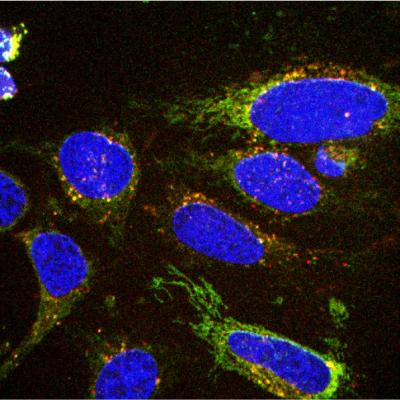
Scientists have developed a new imaging technology to visualise what cells eat, which could aid the diagnosis and treatment of diseases such as cancer.

The team has designed chemical probes that light up when they attach to specific molecules that cells eat, such as glucose.

Researchers used microscopes to watch cells eating glucose inside live zebrafish embryos, which are transparent and easy to observe. They found the technique also worked with human cells growing in the lab.

The team says their approach could easily be adapted to look at other molecules that are important for health and disease.

All cells rely on glucose and other molecules for their survival. If a cell’s eating habits change, it can be a warning sign of disease.

Researchers say the new technology could help detect tiny changes in cells’ eating habits inside the body’s tissues, making it easier to spot diseases sooner.

Doctors could also use the technology to monitor how patients are responding to treatment, by tracking the molecules that are eaten by healthy and diseased cells.

The study, published in the journal Angewandte Chemie, was funded by Medical Research Scotland, the Biotechnology and Biological Sciences Research Council and the European Research Council. The Royal Society and the Wellcome Trust also provided funding.

Dr Marc Vendrell, Senior Lecturer in Biomedical Imaging at the University of Edinburgh, said: “We have very few methods to measure what cells eat to produce energy, which is what we know as cell metabolism. Our technology allows us to detect multiple metabolites simultaneously and in live cells, by simply using microscopes.

“This is a very important advance to understand the metabolism of diseased cells and we hope it will help develop better therapies.”

###

Media Contact
Jen Middleton
[email protected]

Related Journal Article

http://dx.doi.org/10.1002/anie.201900465

Tags: BiochemistrycancerCell BiologyChemistry/Physics/Materials SciencesDiagnosticsMedicine/HealthMolecular Biology
Share12Tweet8Share2ShareShareShare2

Related Posts

AAT/SERPINA1 Pi*Z Variant Influences Gestation; AAT Prevents Preterm Birth in Mice

August 13, 2026

Drug-Resistant Rest Tremor Linked to Slower Parkinson’s Disease Progression

August 13, 2026

Turning AI Breakthroughs Into Public Health Action

August 13, 2026

Six-Year Ugandan Study Reveals How Sexual-Stage Antibodies Block Plasmodium falciparum Transmission

August 13, 2026
Please login to join discussion

POPULAR NEWS

  • AAT/SERPINA1 Pi*Z Variant Influences Gestation; AAT Prevents Preterm Birth in Mice

    29 shares
    Share 12 Tweet 7
  • High Capital Costs Limit Renewable Energy’s Global Climate Mitigation Impact

    29 shares
    Share 12 Tweet 7
  • Drug-Resistant Rest Tremor Linked to Slower Parkinson’s Disease Progression

    29 shares
    Share 12 Tweet 7
  • Survey reveals what people really think about generative AI

    29 shares
    Share 12 Tweet 7

About

We bring you the latest biotechnology news from best research centers and universities around the world. Check our website.

Follow us

Recent News

AAT/SERPINA1 Pi*Z Variant Influences Gestation; AAT Prevents Preterm Birth in Mice

High Capital Costs Limit Renewable Energy’s Global Climate Mitigation Impact

Drug-Resistant Rest Tremor Linked to Slower Parkinson’s Disease Progression

Subscribe to Blog via Email

Enter your email address to subscribe to this blog and receive notifications of new posts by email.

Join 86 other subscribers
  • Contact Us

Bioengineer.org © Copyright 2023 All Rights Reserved.

Welcome Back!

Login to your account below

Forgotten Password?

Retrieve your password

Please enter your username or email address to reset your password.

Log In
No Result
View All Result
  • Homepages
    • Home Page 1
    • Home Page 2
  • News
  • National
  • Business
  • Health
  • Lifestyle
  • Science

Bioengineer.org © Copyright 2023 All Rights Reserved.