• HOME
  • NEWS
  • EXPLORE
    • CAREER
      • Companies
      • Jobs
    • EVENTS
    • iGEM
      • News
      • Team
    • PHOTOS
    • VIDEO
    • WIKI
  • BLOG
  • COMMUNITY
    • FACEBOOK
    • INSTAGRAM
    • TWITTER
Wednesday, October 7, 2026
BIOENGINEER.ORG
No Result
View All Result
  • Login
  • HOME
  • NEWS
  • EXPLORE
    • CAREER
      • Companies
      • Jobs
        • Lecturer
        • PhD Studentship
        • Postdoc
        • Research Assistant
    • EVENTS
    • iGEM
      • News
      • Team
    • PHOTOS
    • VIDEO
    • WIKI
  • BLOG
  • COMMUNITY
    • FACEBOOK
    • INSTAGRAM
    • TWITTER
  • HOME
  • NEWS
  • EXPLORE
    • CAREER
      • Companies
      • Jobs
        • Lecturer
        • PhD Studentship
        • Postdoc
        • Research Assistant
    • EVENTS
    • iGEM
      • News
      • Team
    • PHOTOS
    • VIDEO
    • WIKI
  • BLOG
  • COMMUNITY
    • FACEBOOK
    • INSTAGRAM
    • TWITTER
No Result
View All Result
Bioengineer.org
No Result
View All Result
Home NEWS Science News Health

Spying on cells eating habits could aid cancer diagnosis

Bioengineer by Bioengineer
April 8, 2019
in Health
Reading Time: 2 mins read
0
IMAGE
Share on FacebookShare on TwitterShare on LinkedinShare on RedditShare on Telegram

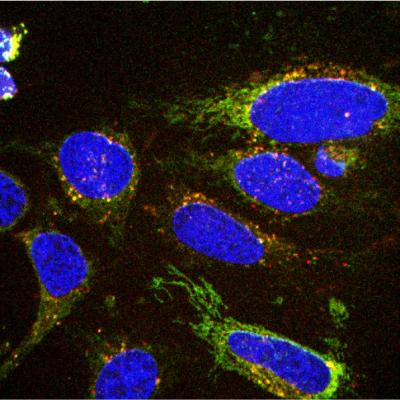
IMAGE

Credit: The University of Edinburgh

Scientists have developed a new imaging technology to visualise what cells eat, which could aid the diagnosis and treatment of diseases such as cancer.

The team has designed chemical probes that light up when they attach to specific molecules that cells eat, such as glucose.

Researchers used microscopes to watch cells eating glucose inside live zebrafish embryos, which are transparent and easy to observe. They found the technique also worked with human cells growing in the lab.

The team says their approach could easily be adapted to look at other molecules that are important for health and disease.

All cells rely on glucose and other molecules for their survival. If a cell’s eating habits change, it can be a warning sign of disease.

Researchers say the new technology could help detect tiny changes in cells’ eating habits inside the body’s tissues, making it easier to spot diseases sooner.

Doctors could also use the technology to monitor how patients are responding to treatment, by tracking the molecules that are eaten by healthy and diseased cells.

The study, published in the journal Angewandte Chemie, was funded by Medical Research Scotland, the Biotechnology and Biological Sciences Research Council and the European Research Council. The Royal Society and the Wellcome Trust also provided funding.

Dr Marc Vendrell, Senior Lecturer in Biomedical Imaging at the University of Edinburgh, said: “We have very few methods to measure what cells eat to produce energy, which is what we know as cell metabolism. Our technology allows us to detect multiple metabolites simultaneously and in live cells, by simply using microscopes.

“This is a very important advance to understand the metabolism of diseased cells and we hope it will help develop better therapies.”

###

Media Contact
Jen Middleton
[email protected]

Related Journal Article

http://dx.doi.org/10.1002/anie.201900465

Tags: BiochemistrycancerCell BiologyChemistry/Physics/Materials SciencesDiagnosticsMedicine/HealthMolecular Biology
Share12Tweet8Share2ShareShareShare2

Related Posts

Aging Brains Work Harder to Answer the Question: Who Am I?

Aging Brains Work Harder to Answer the Question: Who Am I?

October 7, 2026
How Gut Bacteria May Drive Insulin Resistance in Polycystic Ovary Syndrome

How Gut Bacteria May Drive Insulin Resistance in Polycystic Ovary Syndrome

October 7, 2026

When Doctors and Pharmacists Miscommunicate, Patients Pay the Price, Thai Study Finds

October 7, 2026

Scurvy Returns: A Modern Diagnostic Puzzle After Weight-Loss Surgery

October 7, 2026
Please login to join discussion

POPULAR NEWS

  • Alloys That Shrink Their Own Grains: New PIX Mechanism Refines Metals With Heat Alone

    Alloys That Shrink Their Own Grains: New PIX Mechanism Refines Metals With Heat Alone

    29 shares
    Share 12 Tweet 7
  • Endurance Exercise Reshapes the Liver in Males and Females Through Distinct Molecular Routes

    29 shares
    Share 12 Tweet 7
  • Single Transcription Factor PU.1 Rapidly Converts Fibroblasts into Macrophage-Lineage Cells

    29 shares
    Share 12 Tweet 7
  • New Scale Measures How Ready Nurse Educators Really Are for the AI Era

    29 shares
    Share 12 Tweet 7

About

We bring you the latest biotechnology news from best research centers and universities around the world. Check our website.

Follow us

Recent News

Alloys That Shrink Their Own Grains: New PIX Mechanism Refines Metals With Heat Alone

Endurance Exercise Reshapes the Liver in Males and Females Through Distinct Molecular Routes

Single Transcription Factor PU.1 Rapidly Converts Fibroblasts into Macrophage-Lineage Cells

Subscribe to Blog via Email

Success! An email was just sent to confirm your subscription. Please find the email now and click 'Confirm' to start subscribing.

Join 85 other subscribers
  • Contact Us

Bioengineer.org © Copyright 2023 All Rights Reserved.

Welcome Back!

Login to your account below

Forgotten Password?

Retrieve your password

Please enter your username or email address to reset your password.

Log In
No Result
View All Result
  • Homepages
    • Home Page 1
    • Home Page 2
  • News
  • National
  • Business
  • Health
  • Lifestyle
  • Science

Bioengineer.org © Copyright 2023 All Rights Reserved.