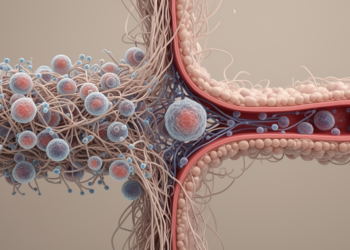
A new preclinical study finds that the regenerative cell therapy boosts motor neuron survival by repairing the blood-spinal cord barrier

Credit: © University of South Florida
TAMPA, Fla. (April 2, 2019) — Transplantation of human bone marrow-derived endothelial progenitor cells (EPCs) into mice mimicking symptoms of amyotrophic lateral sclerosis (ALS) helped more motor neurons survive and slowed disease progression by repairing damage to the blood-spinal cord barrier (BSCB), University of South Florida researchers report.
The new study, published March 27 in Scientific Reports, contributes to a growing body of work exploring cell therapy approaches to barrier repair in ALS and other neurodegenerative diseases.
The progressive degeneration of nerve cells that control muscle movement (motor neurons) eventually leads to total paralysis and death from ALS. Each day, an average of 15 Americans are diagnosed with the disease, according to the ALS Association.
Damage to the barrier between the blood circulatory system and the central nervous system has been recognized as a key factor in the development of ALS. A breach in this protective wall opens the brain and spinal cord to immune/inflammatory cells and other potentially harmful substances circulating in peripheral blood. The cascade of biochemical events leading to ALS includes alterations of endothelial cells lining the inner surface of tiny blood vessels near damaged spinal cord motor neurons.
This latest study by lead author Svitlana Garbuzova-Davis, PhD, and colleagues at the USF Health Morsani College of Medicine’s Center of Excellence for Aging & Brain Repair, builds upon a previous study showing that human bone marrow-derived stem cells improved motor functions and nervous system conditions in symptomatic ALS mice by advancing barrier repair. However, in that earlier USF study the beneficial effect was delayed until several weeks after cell transplant and some severely damaged capillaries were detected even after a high-dose treatment. So in this study, the researchers tested whether human EPCs – cells harvested from bone marrow but more genetically similar to vascular endothelial cells than undifferentiated stem cells – would provide even better BSCB restoration.
ALS mice were intravenously administered a dose of human bone-marrow derived EPCs. Four weeks after transplant, the results of the active cell treatment was compared against findings from two other groups of mice: ALS mice receiving a media (saline) treatment and untreated healthy mice.
The symptomatic ALS mice receiving EPC treatments demonstrated significantly improved motor function, increased motor neuron survival and slower disease progression than their symptomatic counterparts injected with media. The researchers suggest that these benefits leading to BSCB repair may have been promoted by widespread attachment of EPCs to capillaries in the spinal cord. To support this proposal, they point to evidence of substantially restored capillaries, less capillary leakage, and re-establishment of structural support cells (perivascular astrocytes) that play a role in helping form a protective barrier in the spinal cord and brain.
Further research is needed to clearly define the mechanisms of EPC barrier repair. But, the study authors conclude: “From a translational viewpoint, the initiation of cell treatment at the symptomatic disease stage offered robust restoration of BSCB integrity and shows promise as a future clinical therapy for ALS.”
###
The USF study was supported by a grant from the National Institute of Neurological Disorders and Stroke.
The University of South Florida, established in 1956 and located in Tampa, is a high-impact global research university dedicated to student success. The USF System includes three separately accredited institutions: USF, USF St. Petersburg and USF Sarasota-Manatee. Serving more than 50,000 students, the USF System has an annual budget of $1.8 billion and an annual economic impact of $4.4 billion. USF ranks in the top 25 nationally for research expenditures among public universities, according to the National Science Foundation. In 2018, the Florida Board of Governors designated USF as a Preeminent State Research University, placing USF in the most elite category among the state’s 12 public universities. USF is a member of the American Athletic Conference.
Media Contact
Anne DeLotto Baier
abaier@health.usf.edu
Original Source
https:/
Related Journal Article
http://dx.