Results show agreement between sleep measures reported by children and their parents
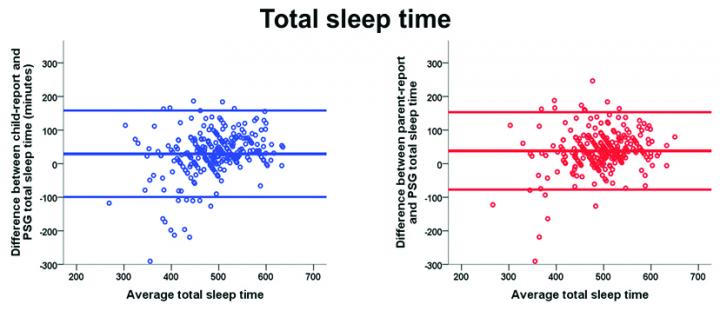
Credit: (American Academy of Sleep Medicine. Journal of Clinical Sleep Medicine volume 15, issue number 1)
DARIEN, IL – While sleep questionnaires are commonly completed by children and their parents, there has been a lack of data comparing the validity of these self-reported sleep parameters. A new study indicates that these sleep characteristics are relatively accurate compared to one another, and they vary only slightly from objective sleep measures.
Results show that when compared with objective sleep characteristics recorded during overnight polysomnography, there was strong agreement between both child report and parent report: Children overestimated their sleep duration by a median of 32 minutes, and parents overestimated their child’s sleep duration by 36 minutes. Similarly, children overestimated the time it took them to fall asleep – known as “sleep latency”- by four minutes, and parents overestimated their child’s sleep latency by two minutes.
According to the authors, similar variances have been found in previous studies that used actigraphy to estimate sleep parameters in comparison with overnight polysomnography. In prior research, adults also have been found to overestimate their own sleep duration.
“Simple sleep measures such as sleep duration have been shown to be important predictors of health in children and adults,” said Dr. Daniel Combs, lead author and assistant professor of pediatrics at the University of Arizona College of Medicine – Tucson and Banner – University Medical Center Tucson. “Our results suggest that while not perfect, parent or child report of sleep is a useful and very inexpensive tool to measure sleep in children.”
The study results are published in the Jan. 15 issue of the Journal of Clinical Sleep Medicine.
The study involved 285 children in the Tucson Children’s Assessment of Sleep Apnea community cohort study. They ranged in age from about 9 to 17 years, with a mean age of 13 years. Fifty-two percent of participants were boys, 68 percent were Caucasian, and 32 percent were Hispanic.
Objective measures were gathered using full polysomnography during one night of sleep at home. Children and their parents completed sleep questionnaires the following morning. Eighty-seven percent of parent questionnaires were filled out by mothers.
The authors noted that in cases with high disagreement between parent report and child report, the child report tended to be more accurate for sleep duration. In contrast, the parent report was more accurate for sleep latency.
The authors also performed a stratified analysis of children from 9 to 12 years of age, compared to children 13 to 17 years of age.
“We expected that for teenagers, parent report of sleep would be less accurate compared to parent report for younger children,” said Dr. Combs. “Surprisingly, there was no difference in parent versus child report about sleep in teenagers.”
###
The study was supported by funding from the National Institutes of Health, Patient-Centered Outcomes Research Institute, and American Academy of Sleep Medicine Foundation.
To request a copy of the study, “Mother Knows Best? Comparing Child Report and Parent Report of Sleep Parameters With Polysomnography,” or to arrange an interview with the study author or an AASM spokesperson, please contact Communications Coordinator Corinne Lederhouse at 630-737-9700, ext. 9366, or [email protected].
The monthly, peer-reviewed Journal of Clinical Sleep Medicine is the official publication of the American Academy of Sleep Medicine, a professional membership society that improves sleep health and promotes high quality, patient-centered care through advocacy, education, strategic research, and practice standards (aasm.org). The AASM encourages patients to talk to their doctor about sleep problems and visit SleepEducation.org for more information about sleep, including a searchable directory of AASM-accredited sleep centers.
Media Contact
Corinne Lederhouse
[email protected]
630-737-9700
Original Source
https:/
Related Journal Article
http://dx.