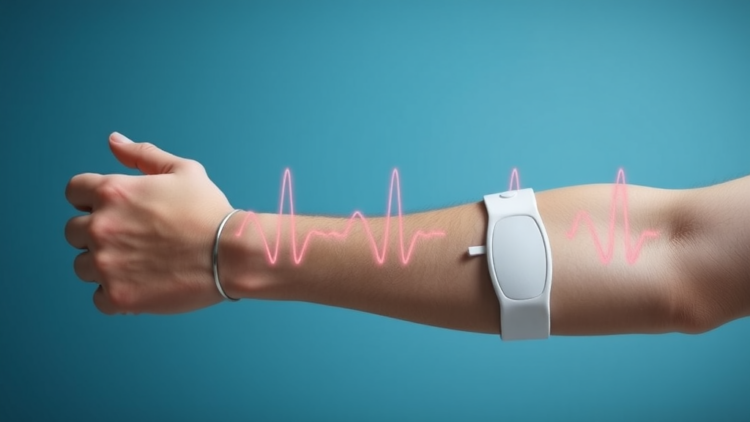
For nearly a century, the electrocardiogram has demanded an awkward ritual: ten electrodes, a tangle of wires, and a patient stripped to the waist and pinned to a bed. That ritual has kept the most diagnostically powerful cardiac test locked inside hospitals, even as smartwatches and adhesive patches have brought single-lead heart tracking to millions of wrists. Now a team of biomedical engineers in Taiwan reports a step toward closing that gap. In a study published in the Annals of Biomedical Engineering, researchers led by Kang-Ping Lin of Chung Yuan Christian University describe a wearable system that can extract a full 12-lead-equivalent electrocardiogram from electrodes arranged entirely around a person’s left upper arm, with no chest electrodes at all.
The concept, which the team calls LUA-ECG for left upper arm ECG, rests on a simple physiological observation. The electrical activity of the heart does not stop at the torso; it propagates through the body as volume-conducted fields that can be detected wherever conductive tissue meets an electrode. Clinicians have long known that arm-based recordings show recognizable cardiac waveforms, and commercial armband monitors have exploited this for basic rhythm detection. What has been missing is diagnostic depth. A single bipolar arm lead can tell you whether the heart is beating regularly, but the standard 12-lead ECG earns its clinical authority by viewing the heart’s electrical vector from twelve different angles, revealing the spatial signatures of infarction, hypertrophy, conduction block, and dangerous repolarization abnormalities.
The Taiwanese team’s answer is to multiply the viewing angles on the arm itself. Their prototype wraps a ring of electrodes around the circumference of the left upper arm, capturing 28 differential lead signals simultaneously. Because each pair of electrodes samples the cardiac field from a slightly different orientation around the limb, the ensemble of 28 signals encodes a rich, multi-directional picture of the heart’s electrical activity. From this pool, an algorithmic selection procedure identifies eight key differential leads whose waveforms best correspond to the eight independent components of the conventional 12-lead configuration, allowing the system to reconstruct the familiar clinical leads without any torso placement. The approach was refined with a matching strategy that optimizes the assignment between arm-derived signals and standard leads, drawing on established assignment-algorithm techniques from the engineering literature.
To test whether the reconstructed signals could stand up to clinical scrutiny, the researchers ran a two-phase validation in thirty healthy adults. In the first phase, each volunteer wore the arm-based system while a standard 12-lead ECG was recorded simultaneously, providing a beat-by-beat gold standard for comparison. In the second phase, the team quantified how faithfully the eight selected LUA-ECG signals reproduced the diagnostic features that cardiologists actually measure: the RR interval governing heart rate, the PR interval reflecting conduction through the atrioventricular node, the QRS duration marking the speed of ventricular depolarization, and the QT and corrected QT intervals that gauge the heart’s electrical recovery and flag risk of lethal arrhythmias when prolonged.
The results were strikingly consistent. Waveform correlations between the arm-derived signals and their standard counterparts ranged from 0.72 to 0.90 on average, indicating substantial to strong agreement in morphological shape across the reconstructed leads. More important for clinical use, the mean absolute errors in the timing measurements were tight: between 4.57 and 7.77 milliseconds for all five interval measurements, recorded at a sampling rate of 500 hertz. To put those numbers in context, cardiologists typically regard interval differences on the order of 10 to 20 milliseconds as measurement noise, and QTc prolongation thresholds that trigger drug-safety concern sit hundreds of milliseconds away from these error bars. An armband that keeps interval errors under eight milliseconds is operating well within the tolerance that matters for screening and long-term trend monitoring.
The significance of this precision becomes clear when you consider what current wearables actually deliver. Consumer smartwatches typically record a single lead, enough to detect atrial fibrillation but blind to the spatial patterns that localize a heart attack or reveal inherited conduction disease. Researchers have tried to bridge the deficit with artificial intelligence, training neural networks to reconstruct 12-lead waveforms from one, two, or three patch leads, with recent work using masked autoencoders and LSTM architectures. Those approaches show promise but inherit a fundamental limitation: information that was never recorded must be inferred, and the inferences can fail precisely in the abnormal hearts where diagnostic accuracy matters most. The LUA-ECG strategy takes a different path, capturing genuinely independent multi-orientation signals in hardware rather than hallucinating missing leads in software.
The left upper arm is also a deliberately practical choice of location. Unlike the chest, the arm is accessible, comfortable, and compatible with clothing, making it feasible for a device to be worn for days rather than minutes. The upper arm sits far enough from the powerful skeletal muscle of the forearm to reduce motion artifact, yet close enough to the torso that the cardiac field remains strong. Prior studies from other groups have mapped how bipolar lead quality varies around the mid-upper-arm circumference and have demonstrated that armband devices can sustain usable ECG recordings during daily life. The new work extends that foundation from single-lead rhythm monitoring to multi-lead morphology, which is the real dividing line between fitness gadgets and diagnostic instruments.
Long-duration monitoring is where the clinical payoff could be largest. The classic Holter monitor, introduced in the 1960s, still relies on chest electrodes and wires, and patient adherence degrades quickly over multi-day recordings. Intermittent arrhythmias, QT prolongation under psychotropic medication, and silent ischemic episodes all demand exactly the kind of continuous, unobtrusive capture that a comfortable armband enables. Because the LUA-ECG system reproduces the temporal intervals of the standard ECG with millisecond-level accuracy, it could in principle support not just rhythm surveillance but drug-safety monitoring for QTc prolongation, a use case where regulatory agencies already accept ambulatory ECG evidence. The researchers frame their system as a reliable approach for extended-duration monitoring applications, and the healthy-subject validation is the necessary first proof of concept.
Cautions remain, and the authors are appropriately measured. The study enrolled thirty healthy adults, whose clean signals and normal anatomy represent the easiest possible test case. Patients with myocardial infarction, bundle branch block, ventricular hypertrophy, or distorted torso geometry may shift the cardiac vector in ways that alter how standard leads map onto arm orientations, and the lead-selection algorithm will need validation in these populations before any clinical claim can be made. Motion artifact, sweat, electrode-skin impedance, and day-long wear stability, the perennial enemies of wearable ECG, were not the focus of this controlled recording session. The team also holds a pending U.S. patent on the physiological signal measuring method, suggesting a commercialization pathway, but regulatory clearance for diagnostic use would require substantially larger and more diverse trials.
Even with those caveats, the study marks a genuine engineering milestone: the demonstration that the informational content of the 12-lead ECG, long considered inseparable from the ten-electrode torso ritual, can be substantially recovered from a single band on one arm. The work was funded by Taiwan’s National Science and Technology Council and conducted with cardiologists at Cathay General Hospital in Taipei under institutional ethics approval. If subsequent studies in cardiac patients confirm what healthy volunteers have shown, the familiar image of the wired ECG patient could give way to something far simpler: a discreet armband, worn through ordinary life, quietly recording the heart from every angle a cardiologist would want to see.
Subject of Research: Wearable multi-electrode left upper arm system for 12-lead ECG measurement in healthy subjects
Article Title: Measurement of 12-Lead ECG Using Multi-Orientation Electrodes on the Left Upper Arm in Healthy Subjects
Article References: Wu, S.-Y., Lu, S.-H., Lin, W.-C., Lin, W.-C., Chen, M.-F., Tsai, C.-L., Ko, W.-C., & Lin, K.-P. (2026). Measurement of 12-Lead ECG Using Multi-Orientation Electrodes on the Left Upper Arm in Healthy Subjects. Annals of Biomedical Engineering. https://doi.org/10.1007/s10439-026-04390-5
Image Credits: AI Generated
DOI: 10.1007/s10439-026-04390-5
Keywords: wearable ECG, 12-lead electrocardiogram, left upper arm ECG, cardiac monitoring, biomedical engineering, arrhythmia detection, QT interval, Holter monitoring, electrodes, signal processing, cardiology, health technology
Cite Scienmag News
APA MLA Chicago
Ophelia Keating. (September 26, 2026). Arm-Band Electrodes Capture Full 12-Lead ECG Without Chest Wires. Scienmag. https://scienmag.com/arm-band-electrodes-capture-full-12-lead-ecg-without-chest-wires/
Ophelia Keating. “Arm-Band Electrodes Capture Full 12-Lead ECG Without Chest Wires.” Scienmag, 26 September 2026, https://scienmag.com/arm-band-electrodes-capture-full-12-lead-ecg-without-chest-wires/. Accessed 26 September 2026.
Ophelia Keating. “Arm-Band Electrodes Capture Full 12-Lead ECG Without Chest Wires.” Scienmag. September 26, 2026. https://scienmag.com/arm-band-electrodes-capture-full-12-lead-ecg-without-chest-wires/
Copy citation Download RIS
Tags: 12-lead electrocardiogramarm-band electrodes for full 12-lead ECGarm-based electrocardiogram for cardiac diagnosisarrhythmia detectionbiomedical engineeringbiomedical engineering advancements in portable ECGcardiac monitoringcardiologydevelopment of non-invasive 12-lead ECG solutionselectrodesfull diagnostic ECG from upper arm electrodeshealth technologyHolter monitoringinnovative cardiac monitoring wearable devicesleft upper arm ECGLUA-ECG wearable heart monitoring devicenon-chest electrode ECG technologyQT intervalSignal Processingtelemedicinevolume conduction principle in ECG signal acquisitionwearable 12-lead ECG system using arm electrodeswearable ECGwireless 12-lead ECG without chest wires