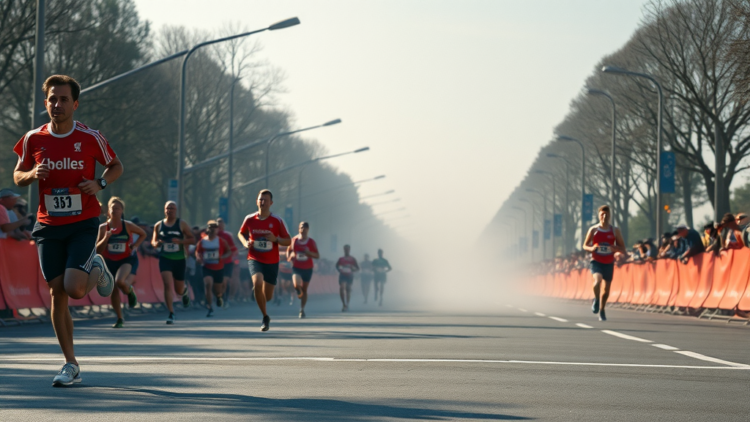
For recreational marathoners, the difference between a personal best and a personal disaster can come down to a few degrees on the thermometer. A new study of nearly 2,000 male runners, published in Physiological Reports, has now shown that air temperature does not simply slow everyone down by the same margin. Instead, heat fundamentally changes which runner characteristics matter most on race day, reshuffling the familiar predictors of marathon performance in ways that could reshape how amateur athletes train for a warming world.
The research team, led by Koshiro Inoue of Health Sciences University of Hokkaido, took advantage of a natural experiment hiding in the Japanese racing calendar. They surveyed finishers at the Tsukuba Marathon in November 2022 and 2023, and at the Hokkaido Marathon in August 2023. According to data from the Japan Meteorological Agency, the mean air temperatures during those races were 6.5, 20.6, and 28.2 degrees Celsius respectively, with estimated wet-bulb globe temperatures of 11.2, 22.2, and 31.5 degrees. In the classification scheme of earlier endurance research, those conditions correspond roughly to natural, moderate heat, and extreme heat environments, giving the scientists three distinct thermal snapshots of the same 42.195-kilometre distance.
In total, 1,938 male runners provided complete datasets, well above the minimum of 1,022 required by the team’s a priori power analysis. Each participant completed an online questionnaire before racing, reporting personal best marathon time over the preceding one to three years, age, years of running experience, height and weight, and detailed training habits over the previous three months, including weekly running distance, the longest single run, and weekly running frequency. Official net finish times were then retrieved from race websites. Crucially, the runners’ profiles differed between events: those who chose the hot Hokkaido race tended to have slower personal bests, higher body mass index, longer running careers, lower weekly mileage, and less frequent training than their counterparts at the cooler Tsukuba events, a pattern the researchers had to account for statistically.
The analytical centrepiece was a hierarchical multiple regression with interaction terms, a technique that allows scientists to ask not just whether a variable predicts finish time, but whether its predictive power changes across conditions. The baseline model, containing only the runner characteristics, explained about 71 percent of the variance in finish time. Adding the race event, which served as a proxy for temperature, boosted explained variance by a striking 10.7 percent, and the regression coefficients revealed a stepwise slowing from the coolest to the hottest race. Average finish times climbed from 223 minutes in the cool Tsukuba race of 2023, to 234 minutes in the milder 2022 edition, to 281 minutes in the August heat of Hokkaido.
But the headline finding lay in the third model, where temperature significantly moderated the relationships between finish time and four specific variables: personal best time, age, running experience, and body mass index. The associations between training volume, longest run, or training frequency and finish time, by contrast, remained stable across all three thermal conditions. In other words, heat selectively rewires the importance of who the runner is, while leaving the benefits of what the runner does largely intact.
Some of the individual interactions were genuinely counterintuitive. The link between personal best and finish time, strongly positive in both cool races, became significantly flatter in the extreme heat of Hokkaido. That pattern supports the minority view in the literature, advanced by economists Gasparetto and Nesseler, that faster runners suffer proportionally greater declines in hot conditions, perhaps because they run at higher intensities and push closer to their physiological limits, while slower runners, spending longer on the course, were already expected to fare worse. The new data suggest that under extreme heat, the usual hierarchy of ability is compressed, and a fast runner may lose more time to the mercury than a slower one.
Age told a more predictable but sobering story. Older runners were slower at every temperature, but the age-related penalty grew significantly steeper in the two warmer races. This aligns with physiological evidence that thermoregulation, particularly sweating and skin blood flow responses, declines with age, and with large-scale analyses of the New York City Marathon showing that heat amplifies age-related slowing in men between 30 and 64. Body mass index followed a similar trajectory: at the optimal cool temperature it bore no significant relationship to finish time, but its influence emerged and strengthened progressively as temperatures rose, consistent with the known advantages of smaller body size for heat dissipation during distance running and with epidemiological links between higher BMI and exertional heat illness risk.
Perhaps the most curious result concerned running experience. Years of training had no bearing on finish time in the cool race, was associated with slower times in the moderate heat of 2022, and, remarkably, predicted faster finishes in the extreme heat of Hokkaido. The authors suggest that long-accumulated adaptations and racing savvy may become decisive assets precisely when conditions are harshest, making veteran experience a potential key to surviving summer marathons. Meanwhile, the training variables behaved as conventional wisdom expects: greater weekly distance and higher training frequency were reliably associated with faster finishes, and, importantly, those benefits were conferred independently of temperature, implying that the performance payoff of training volume survives even as the thermometer climbs.
The study’s authors are careful about its limits. Participants were predominantly Japanese male recreational runners who volunteered for the survey, the hot condition rested on a single August race at one venue, and self-reported measures of height, weight, and training are known to carry small biases. Course differences between events cannot be fully excluded either. Still, the statistical framework was robust, the sample comfortably exceeded power requirements, and the central conclusion is hard to escape: temperature is not merely another variable in the marathon equation but a structural determinant that alters the weight of the other predictors.
The practical implications arrive at an opportune moment. Climate analyses suggest that opportunities to race in the optimal 3 to 11 degree Celsius range for recreational runners are shrinking, with the probability of ideal conditions at the Tokyo Marathon projected to fall over the coming decades. As more amateur runners face warmer start lines, the new findings point to concrete targets: body mass index, a modifiable factor, becomes a more meaningful lever in the heat, while experience can be deliberately banked. Age, irreversible, demands respect and adjusted expectations. For coaches and runners drafting training plans for the hot races of the future, the message is that the old prediction formulas, built in temperate conditions, may need a thermal correction.
Subject of Research: How air temperature modulates the physiological and training determinants of marathon finish time in male recreational runners
Article Title: Temperature‐driven modulation of factors influencing full‐Marathon time in male recreational runners
Article References: Inoue, K., Yamaguchi, A., Nabekura, Y., Ishihara, T., & Fukuie, T. (2026). Temperature‐driven modulation of factors influencing full‐Marathon time in male recreational runners. Physiological Reports, 14(17), Article e71096. https://doi.org/10.14814/phy2.71096
Image Credits: AI Generated
DOI: 10.14814/phy2.71096
Keywords: marathon, heat stress, thermoregulation, recreational runners, body mass index, running performance, aging athletes, training volume, wet-bulb globe temperature, climate change, exercise physiology, hierarchical regression
Cite Scienmag News
APA MLA Chicago
Ophelia Keating. (September 26, 2026). Heat Rewrites the Rules of Marathon Performance, Study of Nearly 2,000 Runners Finds. Scienmag. https://scienmag.com/heat-rewrites-the-rules-of-marathon-performance-study-of-nearly-2000-runners-finds/
Ophelia Keating. “Heat Rewrites the Rules of Marathon Performance, Study of Nearly 2,000 Runners Finds.” Scienmag, 26 September 2026, https://scienmag.com/heat-rewrites-the-rules-of-marathon-performance-study-of-nearly-2000-runners-finds/. Accessed 26 September 2026.
Ophelia Keating. “Heat Rewrites the Rules of Marathon Performance, Study of Nearly 2,000 Runners Finds.” Scienmag. September 26, 2026. https://scienmag.com/heat-rewrites-the-rules-of-marathon-performance-study-of-nearly-2000-runners-finds/
Copy citation Download RIS
Tags: aging athletesbody mass indexclimate changeeffects of heat on recreational runnersExercise Physiologyheat stressheat-related changes in runner characteristicshierarchical regressionimpact of air temperature on running outcomesinfluence of temperature on endurance performancemarathonmarathon performance in extreme heat conditionsmarathon performance under heat stressnatural experiments in marathon heatphysiological responses to heat during runningpredictors of marathon successrecreational runnersrunning performancetemperature-based training strategies for amateur athletesthermal conditions and marathon resultsthermoregulationtraining adaptations for hot weather runningtraining volumewet-bulb globe temperature