• HOME
  • NEWS
  • EXPLORE
    • CAREER
      • Companies
      • Jobs
    • EVENTS
    • iGEM
      • News
      • Team
    • PHOTOS
    • VIDEO
    • WIKI
  • BLOG
  • COMMUNITY
    • FACEBOOK
    • INSTAGRAM
    • TWITTER
Thursday, March 26, 2026
BIOENGINEER.ORG
No Result
View All Result
  • Login
  • HOME
  • NEWS
  • EXPLORE
    • CAREER
      • Companies
      • Jobs
        • Lecturer
        • PhD Studentship
        • Postdoc
        • Research Assistant
    • EVENTS
    • iGEM
      • News
      • Team
    • PHOTOS
    • VIDEO
    • WIKI
  • BLOG
  • COMMUNITY
    • FACEBOOK
    • INSTAGRAM
    • TWITTER
  • HOME
  • NEWS
  • EXPLORE
    • CAREER
      • Companies
      • Jobs
        • Lecturer
        • PhD Studentship
        • Postdoc
        • Research Assistant
    • EVENTS
    • iGEM
      • News
      • Team
    • PHOTOS
    • VIDEO
    • WIKI
  • BLOG
  • COMMUNITY
    • FACEBOOK
    • INSTAGRAM
    • TWITTER
No Result
View All Result
Bioengineer.org
No Result
View All Result
Home NEWS Science News Biology

First discovered fossil feather did not belong to iconic bird Archaeopteryx

Bioengineer by Bioengineer
February 4, 2019
in Biology
Reading Time: 2 mins read
0
IMAGE
Share on FacebookShare on TwitterShare on LinkedinShare on RedditShare on Telegram

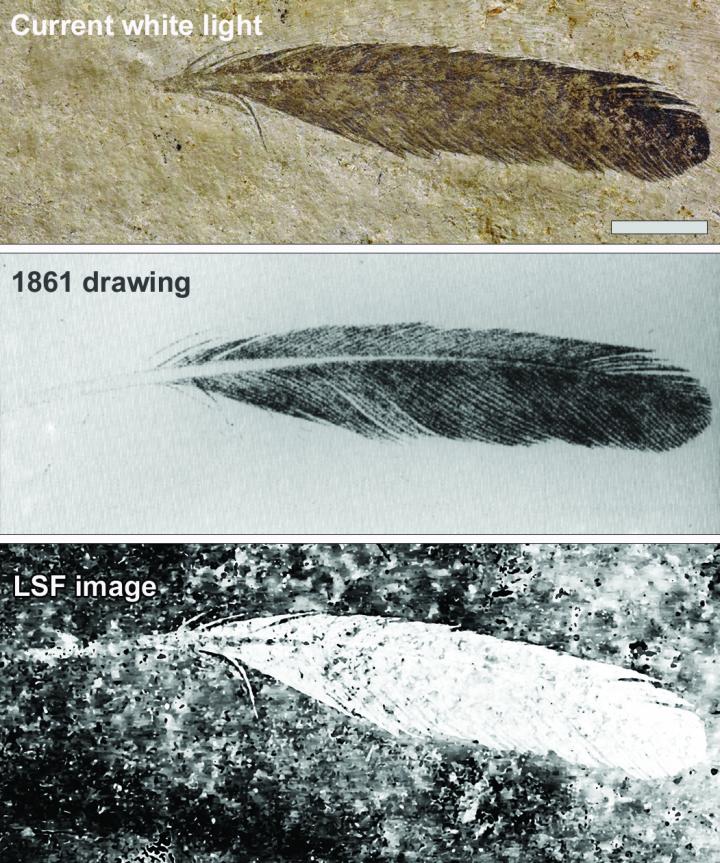
HKU imaging technology shows first discovered fossil feather did not belong to iconic bird Archaeopteryx
IMAGE

Credit: @The University of Hong Kong


A 150-year-old fossil feather mystery has been solved by an international research team including Dr Michael Pittman from the Department of Earth Sciences, The University of Hong Kong. Dr Pittman and his colleagues applied a novel imaging technique, Laser-Stimulated Fluorescence (LSF), revealing the missing quill of the first fossil feather ever discovered, dethroning an icon in the process.

This fossil feather was found in the Solnhofen area of southern Germany in 1861. The isolated feather was used to name the iconic fossil bird Archaeopteryx and was closely identified with its skeletons. Unlike the feather impressions preserved in some Archaeopteryx fossils, the isolated feather is preserved as a dark film. The detailed 1862 description of the feather mentions a rather long quill visible on the fossil, but this is unseen today. Even recent x-ray fluorescence and UV imaging studies did not end the debate of the “missing quill”. The original existence of this quill has therefore been debated and it was unclear if the single feather represented a primary, secondary, or primary covert feather.

The results of this study are described in the journal Scientific Reports, and underscore the potential and scientific importance of Laser-Stimulated Fluorescence, which is being developed by Thomas G Kaye of the Foundation for Scientific Advancement, USA and Dr Pittman. “My imaging work with Tom Kaye demonstrates that important discoveries remain to be made even in the most iconic and well-studied fossils,” says Dr Pittman.

With the help of the LSF images, the team finally solved the 150-year-old missing quill mystery. The now completely visible feather allowed detailed comparisons with the feather impressions of Archaeopteryx and with living birds. Before this LSF work, the feather was thought to represent a primary covert from Archaeopteryx, but this study shows that it differs from coverts of modern birds by lacking a distinct s-shaped centerline. The team also ruled out that the feather represented a primary, secondary, or tail feather of Archaeopteryx. Instead, the new data indicates that the isolated feather came from an unknown feathered dinosaur and that its attribution to Archaeopteryx was wrong. “It is amazing that this new technique allows us to resolve the 150-year-old mystery of the missing quill,” says Daniela Schwarz, co-author in the study and curator for the fossil reptiles and bird collection of the Museum für Naturkunde, Berlin. This discovery also demonstrates that the diversity of feathered dinosaurs was likely higher around the ancient Solnhofen Archipelago than previously thought. “The success of the LSF technique here is sure to lead to more discoveries and applications in other fields. But, you’ll have to wait and see what we find next!” added Tom Kaye, the study’s lead author.

###

The paper:
‘Detection of lost calamus challenges identity of isolated Archaeopteryx feather’ by Kaye, M Pittman, G Mayr, D Schwarz and X Xu in Scientific Reports.

Link to journal article: http://www.nature.com/articles/s41598-018-37343-7

Media Contact
Cindy Chan
[email protected]
852-391-75286

Tags: Earth ScienceEvolutionPaleontology
Share12Tweet8Share2ShareShareShare2

Related Posts

How to sway group opinions: Encourage opponents to stay undecided

How to sway group opinions: Encourage opponents to stay undecided

March 23, 2026
Deep Learning Model Maps How Individual Cells Shape Disease Outcomes

Deep Learning Model Maps How Individual Cells Shape Disease Outcomes

March 20, 2026

Removing only 15 female sharks annually could endanger the entire population, scientists warn

March 20, 2026

Scientists Urge Fragrance Industry to Transition from Sustainability Talk to Active Funding of Plant Conservation

March 20, 2026
Please login to join discussion

POPULAR NEWS

  • blank

    Revolutionary AI Model Enhances Precision in Detecting Food Contamination

    96 shares
    Share 38 Tweet 24
  • Imagine a Social Media Feed That Challenges Your Views Instead of Reinforcing Them

    1003 shares
    Share 397 Tweet 248
  • Uncovering Functions of Cavernous Malformation Proteins in Organoids

    54 shares
    Share 22 Tweet 14
  • Promising Outcomes from First Clinical Trials of Gene Regulation in Epilepsy

    51 shares
    Share 20 Tweet 13

About

We bring you the latest biotechnology news from best research centers and universities around the world. Check our website.

Follow us

Recent News

In-Sensor Cryptography Links Physical Process to Digital Identity

Can Psychosocial Factors Influence Cancer Risk?

Depression Factors in Elderly: Pre vs. Post-COVID Analysis

Subscribe to Blog via Email

Success! An email was just sent to confirm your subscription. Please find the email now and click 'Confirm' to start subscribing.

Join 78 other subscribers
  • Contact Us

Bioengineer.org © Copyright 2023 All Rights Reserved.

Welcome Back!

Login to your account below

Forgotten Password?

Retrieve your password

Please enter your username or email address to reset your password.

Log In
No Result
View All Result
  • Homepages
    • Home Page 1
    • Home Page 2
  • News
  • National
  • Business
  • Health
  • Lifestyle
  • Science

Bioengineer.org © Copyright 2023 All Rights Reserved.