• HOME
  • NEWS
  • EXPLORE
    • CAREER
      • Companies
      • Jobs
    • EVENTS
    • iGEM
      • News
      • Team
    • PHOTOS
    • VIDEO
    • WIKI
  • BLOG
  • COMMUNITY
    • FACEBOOK
    • INSTAGRAM
    • TWITTER
Sunday, December 21, 2025
BIOENGINEER.ORG
No Result
View All Result
  • Login
  • HOME
  • NEWS
  • EXPLORE
    • CAREER
      • Companies
      • Jobs
        • Lecturer
        • PhD Studentship
        • Postdoc
        • Research Assistant
    • EVENTS
    • iGEM
      • News
      • Team
    • PHOTOS
    • VIDEO
    • WIKI
  • BLOG
  • COMMUNITY
    • FACEBOOK
    • INSTAGRAM
    • TWITTER
  • HOME
  • NEWS
  • EXPLORE
    • CAREER
      • Companies
      • Jobs
        • Lecturer
        • PhD Studentship
        • Postdoc
        • Research Assistant
    • EVENTS
    • iGEM
      • News
      • Team
    • PHOTOS
    • VIDEO
    • WIKI
  • BLOG
  • COMMUNITY
    • FACEBOOK
    • INSTAGRAM
    • TWITTER
No Result
View All Result
Bioengineer.org
No Result
View All Result
Home NEWS Science News Biology

New family of fungi threatens a UNESCO-listed 8-century-old cathedral in Portugal

Bioengineer by Bioengineer
January 28, 2019
in Biology
Reading Time: 3 mins read
0
IMAGE
Share on FacebookShare on TwitterShare on LinkedinShare on RedditShare on Telegram

IMAGE

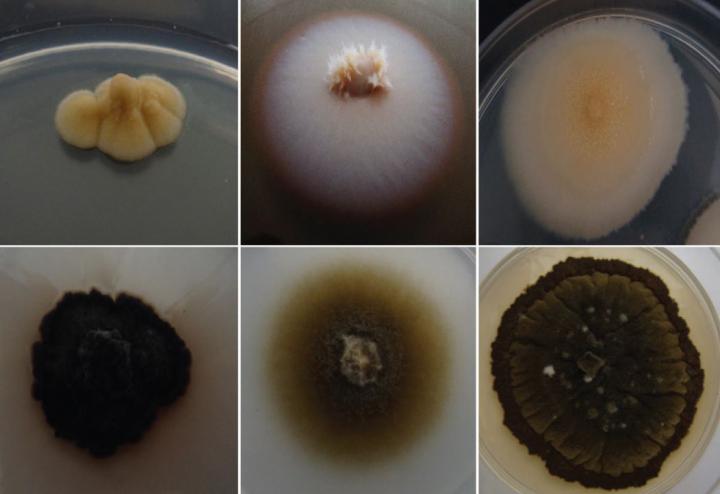
Credit: João Trovão


To be listed as UNESCO World Heritage requires special care and protection of valuable cultural monuments and pieces of Art from threats such as biodeterioration caused by microcolonial black fungi. The culprits lodge their branch-like structures (hyphae) deep into the stone forming fissures and cracks and also produce polysaccharides that trigger corrosion.

These fungi are well known for their unique resistance to hostile environmental conditions, including extreme temperatures, high solar and UV radiation, severe droughts and low abundance of nutrients. As a result, they survive in hot and cold deserts, saltpans, acidic and hydrocarbon-contaminated sites and exposed rocks surfaces. All of this makes them a particular challenge to conservationists and biologists who care for historic monuments.

During a multi-disciplinary scientific survey at the 8-century-old cathedral Sé Velha de Coimbra (Old Cathedral of Coimbra), which is the only Romanesque cathedral in Portugal to have survived relatively intact since the Reconquista times, scientists retrieved a peculiar slow-growing microcolonial black fungus.

What João Trovão of the University of Coimbra (Portugal) and his colleagues were looking at turned out to be a species of a whole new family (Aeminiaceae) in the order of the sooty mould fungi. The new species, its new genus and the novel family are described in the open-access journal MycoKeys.

To define the new group of fungi, the researchers first scraped off samples from a deteriorated limestone artwork in the “Santa Maria” chapel and then conducted an extensive and integrative analysis, based on morphological, physiological, ecological characters and DNA sequences.

As for the origin of the previously unknown fungus, the scientists hypothesise that the species had ‘arrived’ at the Old Cathedral of Coimbra with the limestone used during its construction. Coming from the unique nearby areas of Ançã and Portunhos, such limestone has been used on several of the “Our Ladies of the O” statues, as well as in the portal of the Royal Hospital in Santiago de Compostela (Spain). Currently, these fungi are considered endemic to the limestone quarries in the Iberian Peninsula.

“Regarding stone monuments exposed to the environment, microcolonial black fungi are considered one of the main culprits for the phenomenon of stone biodeterioration, being responsible for severe aesthetic, biochemical and biophysical alterations,” comment the scientists.

“It is, therefore, crucial to gather deeper knowledge regarding their biodiversity and their biological, ecological and physiological unique characteristics, in order to span our knowledge regarding these fungi and, at the same time, allow the development and improvement of tools to protect stone monuments from their deteriorative effects.”

###

Original source:

Trovão J, Tiago I, Soares F, Paiva DS, Mesquita N, Coelho C, Catarino L, Gil F, Portugal A (2019) Description of Aeminiaceae fam. nov., Aeminium gen. nov. and Aeminium ludgeri sp. nov. (Capnodiales), isolated from a biodeteriorated art-piece in the Old Cathedral of Coimbra, Portugal. MycoKeys 45: 57-73. https://doi.org/10.3897/mycokeys.45.31799

Media Contact
João Trovão
[email protected]

Related Journal Article

http://dx.doi.org/10.3897/mycokeys.45.31799

Tags: BiodiversityBiologyEcology/EnvironmentEvolutionMycologyPollution/Remediation
Share12Tweet8Share2ShareShareShare2

Related Posts

blank

GBLUP vs. WGBLUP: Genomic Selection in Beef Cattle

December 21, 2025
blank

Anopheles gambiae Habitat and Public Health in Osun

December 21, 2025

Genetic Insights into Aedes aegypti Expansion in California

December 21, 2025

Autophagy and HSP70 Drive Mytilus Thermal Stress Adaptation

December 20, 2025
Please login to join discussion

POPULAR NEWS

  • Nurses’ Views on Online Learning: Effects on Performance

    Nurses’ Views on Online Learning: Effects on Performance

    70 shares
    Share 28 Tweet 18
  • NSF funds machine-learning research at UNO and UNL to study energy requirements of walking in older adults

    71 shares
    Share 28 Tweet 18
  • Unraveling Levofloxacin’s Impact on Brain Function

    53 shares
    Share 21 Tweet 13
  • Exploring Audiology Accessibility in Johannesburg, South Africa

    51 shares
    Share 20 Tweet 13

About

We bring you the latest biotechnology news from best research centers and universities around the world. Check our website.

Follow us

Recent News

TMEM120A Regulates Fat Lipids via ER CoA Channel

Hidden Deforestation from Global Mining in 21st Century

Empowerment Model Boosts COPD Patients via Telenursing

Subscribe to Blog via Email

Enter your email address to subscribe to this blog and receive notifications of new posts by email.

Join 70 other subscribers
  • Contact Us

Bioengineer.org © Copyright 2023 All Rights Reserved.

Welcome Back!

Login to your account below

Forgotten Password?

Retrieve your password

Please enter your username or email address to reset your password.

Log In
No Result
View All Result
  • Homepages
    • Home Page 1
    • Home Page 2
  • News
  • National
  • Business
  • Health
  • Lifestyle
  • Science

Bioengineer.org © Copyright 2023 All Rights Reserved.