• HOME
  • NEWS
  • EXPLORE
    • CAREER
      • Companies
      • Jobs
    • EVENTS
    • iGEM
      • News
      • Team
    • PHOTOS
    • VIDEO
    • WIKI
  • BLOG
  • COMMUNITY
    • FACEBOOK
    • INSTAGRAM
    • TWITTER
Sunday, October 4, 2026
BIOENGINEER.ORG
No Result
View All Result
  • Login
  • HOME
  • NEWS
  • EXPLORE
    • CAREER
      • Companies
      • Jobs
        • Lecturer
        • PhD Studentship
        • Postdoc
        • Research Assistant
    • EVENTS
    • iGEM
      • News
      • Team
    • PHOTOS
    • VIDEO
    • WIKI
  • BLOG
  • COMMUNITY
    • FACEBOOK
    • INSTAGRAM
    • TWITTER
  • HOME
  • NEWS
  • EXPLORE
    • CAREER
      • Companies
      • Jobs
        • Lecturer
        • PhD Studentship
        • Postdoc
        • Research Assistant
    • EVENTS
    • iGEM
      • News
      • Team
    • PHOTOS
    • VIDEO
    • WIKI
  • BLOG
  • COMMUNITY
    • FACEBOOK
    • INSTAGRAM
    • TWITTER
No Result
View All Result
Bioengineer.org
No Result
View All Result
Home NEWS Science News Chemistry

3D printing lays the foundation for a new range of diagnostic tests

Bioengineer by Bioengineer
May 10, 2021
in Chemistry
Reading Time: 3 mins read
0
IMAGE
Share on FacebookShare on TwitterShare on LinkedinShare on RedditShare on Telegram

IMAGE

Credit: © Ameloot Group

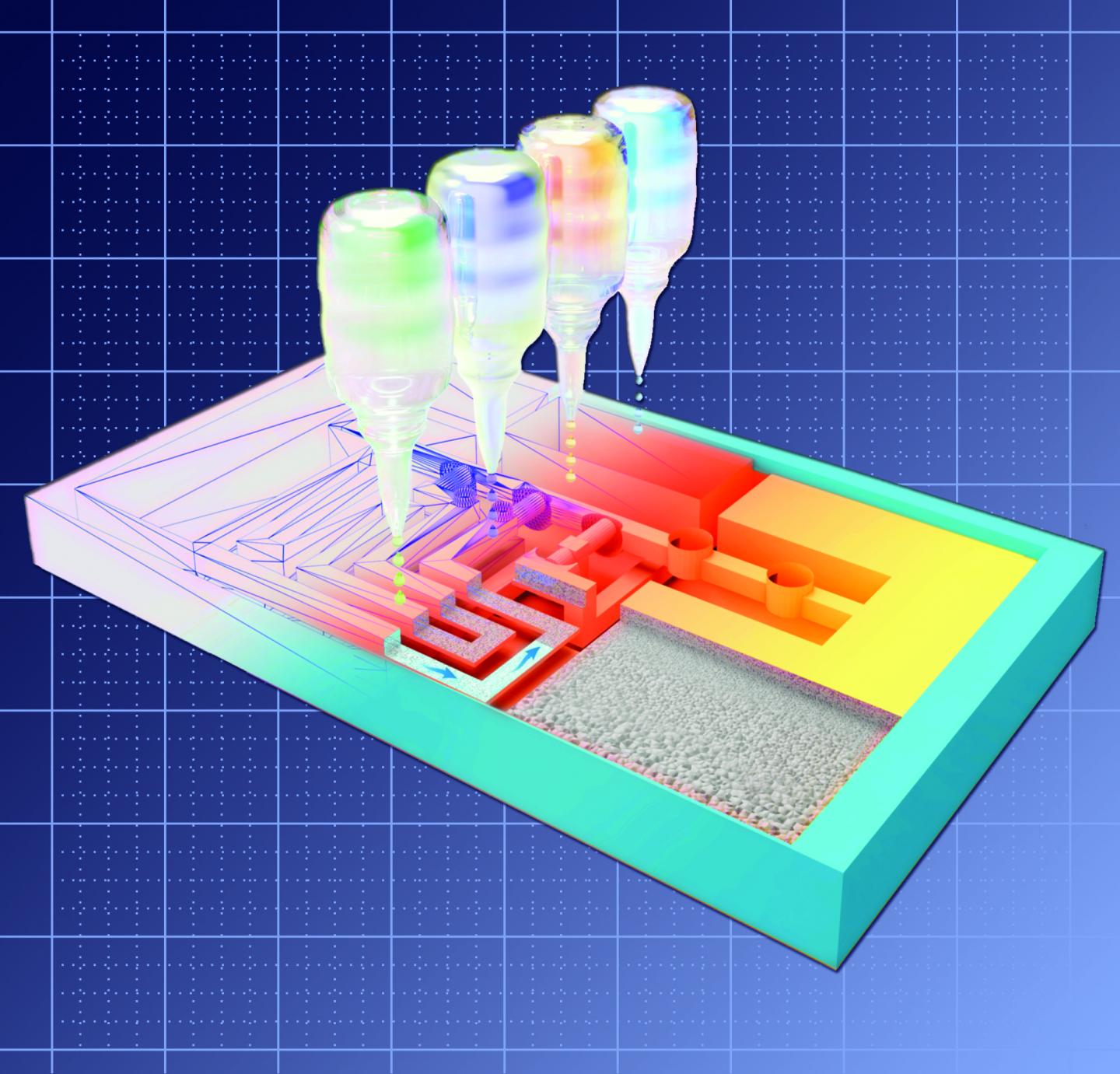
Researchers at KU Leuven (Belgium) have developed a 3D printing technique that extends the possibilities of lateral flow testing. These tests are widespread in the form of the classic pregnancy test and the COVID-19 self-tests. With the new printing technique, advanced diagnostic tests can be produced that are quick, cheap, and easy to use.

The COVID-19 pandemic has made everyone aware of the importance of rapid diagnosis. The sale of self-tests in pharmacies has been permitted in Belgium since the end of March. This self-test is a so-called lateral flow test. Using a wiper, a sample is taken through the nose. Next, it is dissolved in a solvent, and applied to the test kit. Absorbent material in the kit moves the sample downstream and brings it in contact with an antibody. If virus is present, a coloured line appears. The advantage of these tests is that they are cheap and do not require any specialised appliances.

Lateral flow tests are useful for simple tests that result in a yes-no answer, but not for tests that require a multi-step protocol. That is why bioengineers at KU Leuven set out to develop a new type of lateral flow test with more capabilities.

Precise prints

Using a 3D printer, the researchers fabricated a 3D version of a lateral flow test. The basis is a small block of porous polymer, in which ‘inks’ with specific properties are printed at precise locations. In this way, a network of channels and small ‘locks’ is printed that let the flow through or block it where and when necessary, without the need for moving parts. During the test, the sample is automatically guided through the different test steps. That way, even complex protocols can be followed.

The researchers evaluated their technique reproducing an ELISA test (Enzyme-Linked Immunosorbent Assay), which is used to detect immunoglobulin E (IgE). Ig E is measured to diagnose allergies. In the lab, this test requires several steps, with different rinses and a change in acidity. The research team was able to run this entire protocol using a printed test kit the size of a thick credit card.

Complexity is not a cost

“The great thing about 3D printing is that you can quickly adapt a test’s design to accommodate another protocol, for example, to detect a cancer biomarker. For the 3D printer it does not matter how complex the network of channels is”, says Dr. Cesar Parra. The 3D printing technique is also affordable and scalable. “In our lab, producing the Ig E prototype test costs about $ 1.50, but if we can scale it up, it would be less than $ 1,” says Dr. Parra. The technique not only offers opportunities for cheaper and faster diagnosis in developed countries, but also in countries where the medical infrastructure is less accessible and where there is a strong need for affordable diagnostic tests.

The research group is currently designing its own 3D printer, which will be more flexible than the commercial model used in the current study. “An optimised printer is kind of like a mobile mini factory which can quickly produce diagnostics. You could then create different types of tests by simply loading a different design file and ink. We want to continue our research on diagnostic challenges and applications with the help of partners”, concludes innovation manager Bart van Duffel.

Video: https://youtu.be/qRVa7X_LnV4

###

Media Contact
Bart van Duffel
[email protected]

Original Source

https://nieuws.kuleuven.be/en/content/2021/3d-printing-lays-the-foundation-for-a-new-range-of-diagnostic-tests

Related Journal Article

http://dx.doi.org/10.1002/adma.202008712

Tags: Biomedical/Environmental/Chemical EngineeringBiotechnologyChemistry/Physics/Materials SciencesDiagnosticsMaterialsMedicine/HealthTechnology/Engineering/Computer Science
Share12Tweet8Share2ShareShareShare2

Related Posts

New Coumarin Compounds Show Powerful Multitarget Potential Against Skin Aging

New Coumarin Compounds Show Powerful Multitarget Potential Against Skin Aging

October 4, 2026
Frog Egg Byproduct Inspires Smart Food Wrap That Changes Color as Food Spoils

Frog Egg Byproduct Inspires Smart Food Wrap That Changes Color as Food Spoils

October 4, 2026

Solvent Polarity Steers Double Proton Transfer in a Promising OLED Fluorophore

October 4, 2026

AI Digital Twins Could Transform Intensive Care in Landmark $38 Million Federal Project

October 4, 2026
Please login to join discussion

POPULAR NEWS

  • Alloys That Shrink Their Own Grains: New PIX Mechanism Refines Metals With Heat Alone

    Alloys That Shrink Their Own Grains: New PIX Mechanism Refines Metals With Heat Alone

    29 shares
    Share 12 Tweet 7
  • Endurance Exercise Reshapes the Liver in Males and Females Through Distinct Molecular Routes

    29 shares
    Share 12 Tweet 7
  • Single Transcription Factor PU.1 Rapidly Converts Fibroblasts into Macrophage-Lineage Cells

    29 shares
    Share 12 Tweet 7
  • New Scale Measures How Ready Nurse Educators Really Are for the AI Era

    29 shares
    Share 12 Tweet 7

About

We bring you the latest biotechnology news from best research centers and universities around the world. Check our website.

Follow us

Recent News

Alloys That Shrink Their Own Grains: New PIX Mechanism Refines Metals With Heat Alone

Endurance Exercise Reshapes the Liver in Males and Females Through Distinct Molecular Routes

Single Transcription Factor PU.1 Rapidly Converts Fibroblasts into Macrophage-Lineage Cells

Subscribe to Blog via Email

Success! An email was just sent to confirm your subscription. Please find the email now and click 'Confirm' to start subscribing.

Join 85 other subscribers
  • Contact Us

Bioengineer.org © Copyright 2023 All Rights Reserved.

Welcome Back!

Login to your account below

Forgotten Password?

Retrieve your password

Please enter your username or email address to reset your password.

Log In
No Result
View All Result
  • Homepages
    • Home Page 1
    • Home Page 2
  • News
  • National
  • Business
  • Health
  • Lifestyle
  • Science

Bioengineer.org © Copyright 2023 All Rights Reserved.