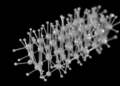
Near-infrared light is invisible to the human eye, yet it quietly powers some of the technologies shaping modern life. It is used in optical communications, biomedical monitoring, industrial inspection, intelligent sensing, and imaging systems that allow machines to perceive information beyond the visible spectrum. Now, researchers have developed a lead-free quantum-dot photodetector that combines unusually low electrical noise with high sensitivity, potentially advancing the next generation of affordable and environmentally safer near-infrared cameras.
The device is based on silver bismuth sulfide, or AgBiS₂, colloidal quantum dots. These nanoscale semiconductor particles have attracted attention because they absorb light efficiently across a broad spectral range and can be processed from solution, offering a potentially lower-cost alternative to conventional semiconductor fabrication. Unlike many high-performance infrared quantum dots based on lead or mercury, AgBiS₂ avoids the most serious toxicity concerns associated with heavy-metal materials. Yet its practical performance has been limited by a difficult interface problem inside the detector.
A photodetector works by converting incoming photons into mobile electrical charges. In an AgBiS₂ device, the photoactive quantum-dot layer must transfer electrons efficiently into an electron transport layer, which then carries them toward an electrode. If the energy levels at that boundary are poorly aligned, electrons can become trapped or recombine with holes before they are collected. The same defects can also allow unwanted current to flow in darkness. This dark current acts like electronic background noise, making it difficult to distinguish a weak optical signal from the detector’s own electrical activity.
To solve this problem, a research team led by Professors Bingkun Chen and Guohui Li introduced a bilayer electron transport structure made from zinc oxide and MXene. Rather than relying on a single transport material, the researchers used the two layers to engineer the interface between the quantum dots and the device’s charge-collecting components. Their design improves energy-level alignment, reduces interfacial defects, and creates a more favorable route for photogenerated electrons. The result is a detector designed to collect useful charges while blocking unnecessary current injection.
The performance numbers are striking. The optimized device achieved a dark-current density of just 6.1 × 10⁻⁸ amperes per square centimeter, reported as the lowest value so far for an AgBiS₂ colloidal quantum-dot photodetector. It responded to light from 375 to 1120 nanometers, spanning much of the visible spectrum and extending well into the near-infrared. At a wavelength of 980 nanometers, its specific detectivity reached 7.8 × 10¹⁰ Jones, a standard measure of how effectively a detector can identify weak radiation in the presence of noise.
The detector also delivered a linear dynamic range of 80 decibels. This value describes how wide a range of light intensities the device can measure while maintaining a predictable relationship between illumination and electrical output. A broad linear range is particularly important in imaging, where a single scene may contain both brightly illuminated and extremely dim regions. Compared with devices using traditional single-layer electron transport structures, the bilayer detector improved detectivity by approximately 3.5 to seven times, according to the research team.
The improvement is linked to the way the ZnO/MXene combination manages charge at the nanoscale. Zinc oxide provides an electron-transporting semiconductor interface, while the MXene layer helps modify the electronic environment and facilitate charge movement. Together, the layers reduce the barrier that electrons encounter as they leave the AgBiS₂ quantum dots. They also help passivate imperfections at the interface, limiting the pathways through which charges can disappear or unwanted carriers can enter. In practical terms, this means a stronger signal with less background interference.
To test whether the laboratory results could translate into imaging, the researchers integrated the photodetector with a 64 × 64 thin-film-transistor array. The resulting system produced clear and stable near-infrared images at 850 nanometers. This demonstration matters because an individual detector can show impressive sensitivity without necessarily functioning well in a large array. Uniformity, stability, and compatibility with electronic readout circuits are all essential for cameras and sensor platforms. The successful array experiment suggests that the architecture may be suitable for scalable imaging technologies rather than remaining a proof-of-concept material study.
The researchers describe the work as an interface-engineering strategy that could extend beyond AgBiS₂. By controlling energy alignment and defect-related losses at the boundary between quantum dots and transport layers, similar methods could help improve other lead-free optoelectronic devices. Potential applications include low-light imaging, wearable biomedical sensors, machine vision, environmental monitoring, and optical communication systems. The study, published in Nano Research on June 25, 2026, presents the ZnO/MXene bilayer as a route toward near-infrared sensors that combine high sensitivity, low dark current, solution-processable materials, and reduced reliance on toxic elements.
Subject of Research: Lead-free AgBiS₂ colloidal quantum-dot near-infrared photodetector using a ZnO/MXene bilayer electron transport layer
Article Title: ZnO/MXene bilayer electron transport layer enables ultra-low dark current AgBiS₂ quantum dot near-infrared photodetector for high-performance imaging
News Publication Date: 25 June 2026
Web References: https://doi.org/10.26599/NR.2026.94908699; Nano Research
References: Nano Research, DOI: 10.26599/NR.2026.94908699
Image Credits: Nano Research, Tsinghua University Press
Keywords
AgBiS₂ quantum dots, MXene, zinc oxide, near-infrared photodetector, quantum-dot imaging, lead-free optoelectronics, dark current, detectivity, thin-film-transistor array, nanotechnology
Tags: AgBiS₂ quantum dotsbroadband light absorptionenvironmentally friendly photodetectorslead-free infrared sensorslow-noise optical detectionMXene materialsNear-infrared photodetectorsQuantum Dot Technologyquantum-dot device fabricationsemiconductor interface engineeringultra-low dark currentZnO/MXene bilayer