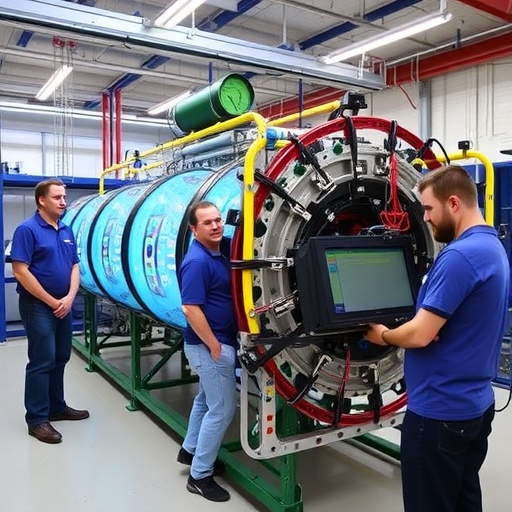
LAWRENCE, Kansas — A University of Kansas project aimed at upgrading one of the Large Hadron Collider’s most specialized detection systems has secured $1 million in funding from the U.S. Department of Energy’s Established Program to Stimulate Competitive Research, or DOE EPSCoR. Over the next four years, KU researchers will design and build two new calorimeters for the Compact Muon Solenoid experiment at CERN, creating instruments capable of surviving the extreme radiation and collision rates expected during the collider’s High-Luminosity era.
The detectors, known as High-Luminosity Zero Degree Calorimeters, or HL-ZDCs, will be assembled at KU’s Mechanical Prototyping Lab before being tested with high-energy particle beams at the Fermi National Accelerator Laboratory in Illinois. Once they pass calibration and performance checks, the instruments will be shipped to CERN, where they will be integrated into CMS ahead of the first heavy-ion data-taking period of the High-Luminosity Large Hadron Collider, currently scheduled for the middle of the 2030s.
The project is led by Michael Murray, a KU professor of physics and astronomy who also serves as the CMS HL-ZDC upgrade project leader, alongside KU Distinguished Professor Christophe Royon. KU postdoctoral researcher Georgios Krintiras will lead important parts of the detector’s data-reconstruction software. Together, the team will work across hardware design, materials engineering, electronics, simulation and data analysis, linking a Kansas laboratory to one of the largest international scientific collaborations ever assembled.
Zero Degree Calorimeters are positioned close to the LHC’s opposing particle beams, far from the central collision point of CMS. Their purpose is to capture energetic neutrons and photons that continue forward along the beamline after heavy-ion collisions. Because these particles escape at extremely small angles, they carry information that cannot be obtained from the central detector alone. By measuring their energy and distribution, physicists can reconstruct key features of collisions between lead nuclei, including how directly the nuclei struck one another.
That information is especially important in the study of quark-gluon plasma, a state of matter in which quarks and gluons are no longer confined inside protons and neutrons. Scientists believe this ultra-hot, dense form of matter existed during the first few millionths of a second after the birth of the universe. In modern experiments, it is recreated for fleeting moments when heavy atomic nuclei collide at nearly the speed of light. The pattern of forward-moving neutrons can help researchers distinguish nearly head-on collisions from glancing encounters and improve measurements of the plasma’s properties.
The upgraded calorimeters will also help identify ultraperipheral collisions. In these events, two nuclei pass close to one another without directly touching, yet their powerful electromagnetic fields interact. Such encounters can generate photons and other particles while preserving much of the nuclei’s forward motion. Separating these events from direct nuclear collisions is essential for studying electromagnetic interactions at unprecedented energies and for interpreting the complex signals recorded by CMS.
KU researchers are replacing the ZDCs that have served CMS through the first three major operating periods of the Large Hadron Collider. The High-Luminosity LHC will produce far more collisions, higher radiation levels and a denser stream of particles than the existing instruments were designed to withstand. The new detectors must therefore be narrower to fit into the restricted space around the beamline, faster to process signals arriving in rapid succession and more resistant to radiation damage.
The development effort will also give Kansas students direct experience with technologies used in frontier physics. Students will participate in precision manufacturing at KU, detector simulations, radiation-hard instrumentation, electronic readout systems and scientific software development. At Fermilab, they will work with specialists at the Test Beam Facility, where the completed calorimeters can be exposed to controlled particle beams. Training through Fermilab’s LHC Physics Center will further prepare them to analyze data once the upgraded collider begins operations.
“This project connects the full chain of experimental science,” Murray said. “Detectors assembled in Lawrence will be tested in a high-energy beam at Fermilab, installed at CERN and then used by an international collaboration to answer fundamental questions about matter.” The project is expected to deepen KU’s partnership with Fermilab while preserving advanced detector expertise and research infrastructure in Kansas. After installation, the two HL-ZDCs will provide CMS with a sharper view of the particles that flee along the beamline—turning some of the most difficult-to-detect remnants of nuclear collisions into clues about the universe’s earliest and most extreme state of matter.
Subject of Research: High-Luminosity Zero Degree Calorimeters for the Compact Muon Solenoid experiment at CERN’s Large Hadron Collider, with applications in heavy-ion physics, quark-gluon plasma research and ultraperipheral collisions.
Article Title: University of Kansas Wins $1 Million to Build Next-Generation Detectors for CERN’s High-Luminosity LHC
Web References: Compact Muon Solenoid; Large Hadron Collider; High-Luminosity LHC; KU Mechanical Prototyping Lab; Fermi National Accelerator Laboratory; Fermilab Test Beam Facility; Fermilab LHC Physics Center
References: University of Kansas project information; CERN information on the Compact Muon Solenoid and Large Hadron Collider; Fermi National Accelerator Laboratory information on detector testing and LHC research.
Image Credits: CERN
Keywords
Particle physics, particle accelerators, Large Hadron Collider, CERN, Compact Muon Solenoid, CMS, University of Kansas, zero degree calorimeter, high-luminosity LHC, quark-gluon plasma, heavy-ion collisions, subatomic particles, hadrons, detector technology, Fermilab
Tags: advanced radiation-resistant detector technologycollaboration between KUdesign and testing of calorimeters for Large Hadron ColliderDOE EPSCoR funding for particle physicsFermheavy-ion collision experimentsHigh-Luminosity Large Hadron Collider data collectionHigh-Luminosity Zero Degree Calorimeters (HL-ZDCs)KU-Fermilab collaboration on high-luminosity collider upgradesNext-generation CERN collider detector developmentparticle detector engineering and calibrationuniversity-led high-energy physics research