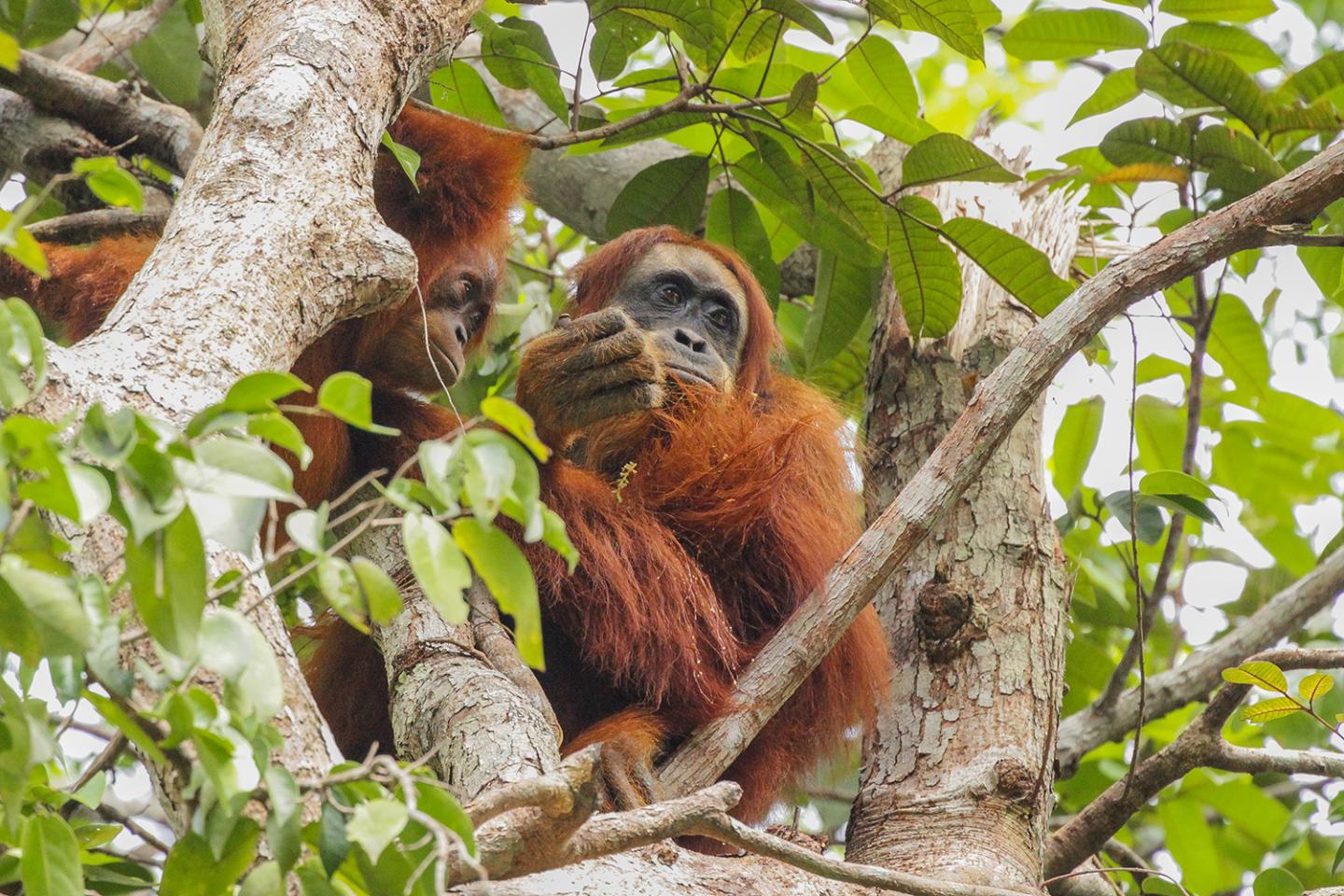
Credit: (Image: Julia Kunz)
Orangutans are closely related to humans. And yet, they are much less sociable than other species of great apes. Previous studies have showed that young orangutans mainly acquire their knowledge and skills from their mothers and other conspecifics. Social learning in orangutans occurs through peering, i.e. sustained observation of other members of the species at close range.
An international team led by the University of Zurich (UZH) has now studied peering behavior in young orangutans at two research stations on the islands of Sumatra and Borneo. The data was collected by researchers from the Department of Anthropology of UZH, the Max Planck Institute of Animal Behavior in Constance, the Universitas Nasional in Jakarta and Leipzig University, who observed more than 3,100 individual peering situations in 50 young animals over a period of around 13 years.
Sex-specific role models
The findings of the study reveal significant differences in the role models of young male and female orangutans. As they get older, young male orangutans increasingly prefer immigrant adult males or immigrant male and female juveniles as role models. In contrast, young females exhibit a consistently high interest in their mother’s behavior. When attending to non-mother role models, immature females prefer local adult females and local juveniles of both sexes.
Interestingly, these differences develop at a stage when the immature orangutans are still in constant association with their mothers. The mothers, in turn, show no differences in their patterns of association, which provides male and female immatures with the same opportunities for learning. “Young male and female orangutans simply use these opportunities differently,” explains last author Caroline Schuppli from the University of Zurich and the Max Planck Institute of Animal Behavior. “The differences in role models are also reflected in the immatures’ socially learned knowledge. Females thus develop feeding behaviors that are similar to those of their mothers, whereas males acquire a greater share of their knowledge from animals other than their mothers.”
Settling versus migrating
These differences stem from the acquisition of ecologically relevant knowledge as well as from sex-specific behavior. When male orangutans reach sexual maturity, they leave the area where they were born and migrate across different areas for several decades. Since food sources differ from one area to the next, acquiring a diverse set of knowledge is an advantage for males.
Female orangutans, on the other hand, remain in the area where they were born, and thus benefit from as deep a knowledge of the local area as possible. “We also suspect that young males learn sex-specific ecological behavior from adult males. Adult male orangutans are not only significantly larger than females, they also differ in their foraging and feeding behaviors,” says evolutionary biologist Schuppli.
Social learning crucial for human development
The findings highlight the importance of social learning for the development of immature orangutans. The fact that social learning is crucial in the development of the semi-solitary orangutans indicates that this is likely also the case for other great apes. It follows from this that the human capacity for social learning is a continuously evolved trait. The findings could also be relevant for developing sustainable strategies for wildlife conservation, especially when it comes to releasing orphaned orangutans raised by humans back into the wild.
###
Media Contact
Dr. Caroline Schuppli
[email protected]
Original Source
https:/
Related Journal Article
http://dx.