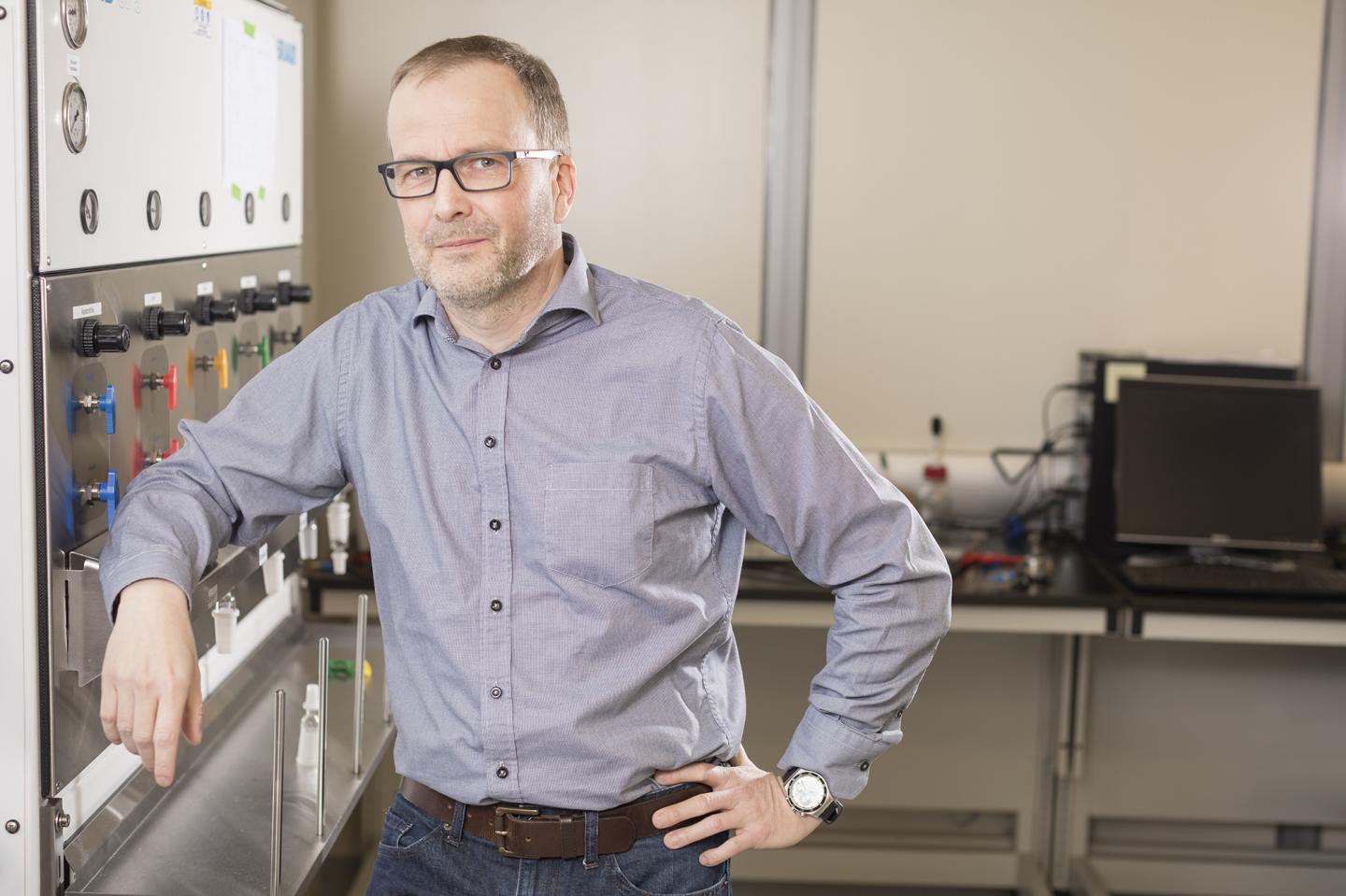
Credit: Paola Scattolon
York University researchers have discovered a way to make Lithium-powered batteries more environmentally friendly while retaining performance, stability and storage capacity.
Lithium-ion batteries use toxic, heavy metals which can impact the environment when they are extracted from the ground and are difficult to dispose of safely. Cobalt is one of those heavy metals, used in battery electrodes. Part of the problem is that lithium and cobalt are not abundantly available, and supplies are dwindling.
Using organic materials are the way forward and that has scientists like Professor Thomas Baumgartner of the Faculty of Science and his team busy developing and testing new molecules to find the right ones to replace the rare metals currently in use.
“Organic electrode materials are considered to be extremely promising materials for sustainable batteries with high power capabilities,” he says.
Their latest breakthrough is the creation of a new carbon-based organic molecule that can replace the cobalt now used in cathodes or positive electrodes in lithium-ion batteries. The new material addresses the shortcomings of the inorganic material while maintaining performance.
“Electrodes made with organic materials can make large-scale manufacturing, recycling or disposing of these elements more environmentally friendly,” says Baumgartner. “The goal is to create sustainable batteries that are stable and have equally as good if not better capacity.”
The research is published and featured on the cover of the March edition of the journal Batteries & Supercaps, a ChemPubSoc publication.
“With this particular class of molecules that we’ve made, the electroactive component is very suitable for batteries as it’s very good at storing electrical charges and has good long-term stability,” he says.
Baumgartner and his group previously reported on the electroactive component in a paper published in the journal Advanced Energy Materials.
“We have optimized this electroactive component and put it in a battery. It has a very good voltage, up to the 3.5 volts, which is really where current batteries are now,” he says. “It’s an important step forward in making fully organic and sustainable batteries.”
Baumgartner, along with postdoctoral researchers Colin Brides and Monika Stolar, have also demonstrated that this material is stable in long-term operation with the ability to charge and discharge for 500 cycles. One of the downsides of inorganic electrodes is that they generate significant heat when charging and require limited discharging rates for safety reasons. This new molecule addresses that shortcoming.
The next step, says Baumgartner, is to improve the capacity further. His team is currently developing the next generation of molecules that show promise in being able to increase current capacity.
###
York University champions new ways of thinking that drive teaching and research excellence. Our students receive the education they need to create big ideas that make an impact on the world. Meaningful and sometimes unexpected careers result from cross-disciplinary programming, innovative course design and diverse experiential learning opportunities. York students and graduates push limits, achieve goals and find solutions to the world’s most pressing social challenges, empowered by a strong community that opens minds. York U is an internationally recognized research university – our 11 faculties and 25 research centres have partnerships with 200+ leading universities worldwide. Located in Toronto, York is the third largest university in Canada, with a strong community of 53,000 students, 7,000 faculty and administrative staff, and more than 300,000 alumni. York U’s fully bilingual Glendon Campus is home to Southern Ontario’s Centre of Excellence for French Language and Bilingual Postsecondary Education.
Media Contact: Sandra McLean, York University Media Relations, 416-736-2100 ext. 2097 or 416-272-6317, [email protected]
Media Contact
Sandra McLean
[email protected]
416-736-2100 x22097
Original Source
https:/
Related Journal Article
http://dx.