


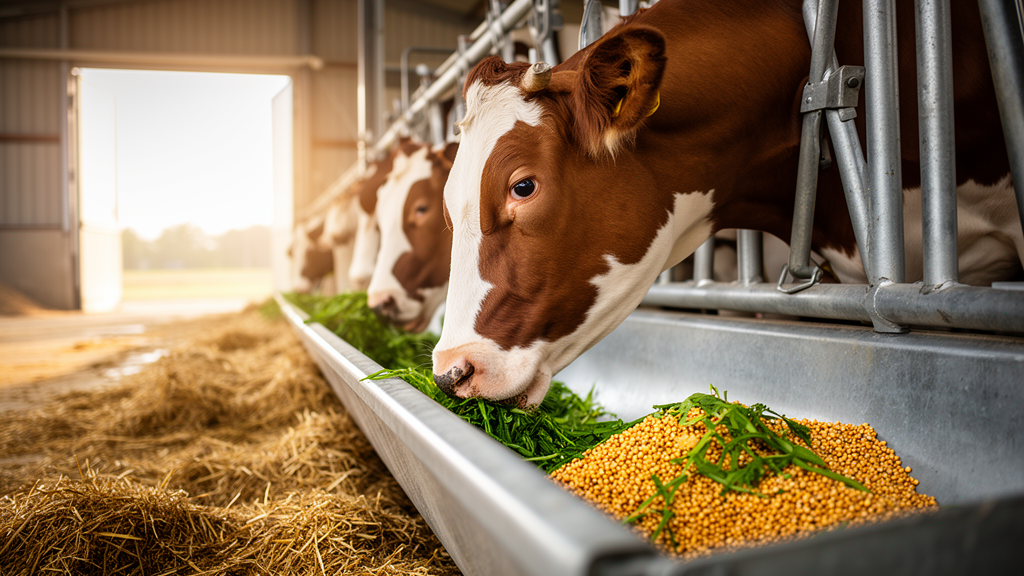
A network meta-analysis of 22 microecological intervention strategies has ranked Saccharomyces cerevisiae fermentation products first for increasing dry matter intake in cattle, placing them ahead of supplementation with live Saccharomyces cerevisiae alone. The study, published in BMC Veterinary Research on 21 October 2026, then combined network pharmacology, Mendelian randomization based on human genetic data, bovine transcriptomic analysis, molecular docking and exploratory two-step Mendelian randomization to sketch out a possible molecular mechanism linking the yeast-derived metabolites to feed intake regulation.
Dry matter intake is a key determinant of production efficiency in cattle, and although microbial interventions are widely studied and applied in animal nutrition, the authors noted that systematic comparisons of their effects on intake had remained limited. Their network meta-analysis was designed to fill that gap by evaluating multiple microecological preparations in a single framework. The analysis found that Saccharomyces cerevisiae fermentation products showed a larger estimated effect on dry matter intake than live Saccharomyces cerevisiae supplementation, and ranked highest among the 22 strategies evaluated, with dairy cows as the focus of the intake comparison.
To probe the mechanism behind this ranking, the team first turned to network pharmacology, which identified 75 candidate target genes. Subsequent Mendelian randomization analysis using human genetic data identified potential associations between 17 of these candidate genes and circulating ghrelin (GHRL) levels. Ghrelin is a hormone centrally involved in appetite regulation, making the GHRL pathway a plausible link between yeast-derived metabolites and feed intake, although the genetic evidence at this stage came entirely from human data.
The next step examined bovine colonic transcriptomic data. Because the available dataset came from calves supplemented with live Saccharomyces cerevisiae boulardii rather than the fermentation products themselves, the comparison was an indirect one. It showed an upward trend in HTR2B expression that was directionally consistent with the human Mendelian randomization result but did not reach statistical significance after false discovery rate correction, with a log fold change of 0.410, P = 0.032 and FDR = 0.081. The authors treated this as a suggestive, not a confirmed, signal.
Molecular docking analysis then tested how three candidate metabolites, adenosine, choline and thiamine, might interact with the HTR2B receptor. The predicted docking energies were −6.8 kcal/mol for adenosine, −3.4 kcal/mol for choline and −6.0 kcal/mol for thiamine, with the more negative values indicating stronger predicted binding. These computational results positioned adenosine, choline, thiamine and HTR2B as candidate components of a potential GHRL-related mechanism, but docking predictions alone do not establish binding or biological activity.
Colocalization analysis provided no evidence of a shared local genetic signal between HTR2B expression and circulating GHRL levels, weakening the case for a direct causal relationship at that locus. Finally, exploratory two-step Mendelian randomization suggested a small opposing indirect effect through Mollicutes, corresponding to an estimated shielding proportion of 8.63%, although the authors noted that this signal showed limited robustness.
The study’s conclusions are deliberately cautious. Because the Mendelian randomization evidence was derived from human genetic data, the proposed HTR2B–GHRL relationship should be considered a hypothesis-generating cross-species finding rather than a validated mechanism in cattle. The authors state that bovine experimental validation is required before these human genetic estimates can be extrapolated to cattle, and the transcriptomic support came from a boulardii supplementation dataset rather than from the fermentation products that ranked first in the meta-analysis.
Within those limits, the work offers a concrete lead: Saccharomyces cerevisiae fermentation products emerge as the most promising of 22 microecological strategies for increasing dry matter intake in dairy cows, and adenosine, choline, thiamine and the HTR2B receptor are now prioritized candidates for follow-up studies in cattle. The article was published as an open-access paper under a shared early-release note indicating that the version is subject to further edits before the final Version of Record.
Subject of Research: Network meta-analysis of yeast-derived microbial interventions and candidate molecular mechanisms regulating dry matter intake in cattle
Article Title: Saccharomyces cerevisiae-derived metabolites as putative regulators of feed intake in cattle
Article References: Bai, P., Song, J., Wang, S., Xu, X., Xu, Z., Li, C., Zhang, C., Wang, Y., Ning, J., Chen, H., Yang, L., & Liu, D. (2026). Saccharomyces cerevisiae-derived metabolites as putative regulators of feed intake in cattle. BMC Veterinary Research. https://doi.org/10.1186/s12917-026-06018-1
Image Credits: AI Generated
DOI: 10.1186/s12917-026-06018-1
Keywords: Saccharomyces cerevisiae, dry matter intake, dairy cows, network meta-analysis, Mendelian randomization, ghrelin, HTR2B, network pharmacology, molecular docking, cattle nutrition, microecological preparations, transcriptomics
News Source: William Thompson. (October 30, 2026). Yeast fermentation products rank first for boosting feed intake in cattle. Scienmag.



