• HOME
  • NEWS
  • EXPLORE
    • CAREER
      • Companies
      • Jobs
    • EVENTS
    • iGEM
      • News
      • Team
    • PHOTOS
    • VIDEO
    • WIKI
  • BLOG
  • COMMUNITY
    • FACEBOOK
    • INSTAGRAM
    • TWITTER
Sunday, August 9, 2026
BIOENGINEER.ORG
No Result
View All Result
  • Login
  • HOME
  • NEWS
  • EXPLORE
    • CAREER
      • Companies
      • Jobs
        • Lecturer
        • PhD Studentship
        • Postdoc
        • Research Assistant
    • EVENTS
    • iGEM
      • News
      • Team
    • PHOTOS
    • VIDEO
    • WIKI
  • BLOG
  • COMMUNITY
    • FACEBOOK
    • INSTAGRAM
    • TWITTER
  • HOME
  • NEWS
  • EXPLORE
    • CAREER
      • Companies
      • Jobs
        • Lecturer
        • PhD Studentship
        • Postdoc
        • Research Assistant
    • EVENTS
    • iGEM
      • News
      • Team
    • PHOTOS
    • VIDEO
    • WIKI
  • BLOG
  • COMMUNITY
    • FACEBOOK
    • INSTAGRAM
    • TWITTER
No Result
View All Result
Bioengineer.org
No Result
View All Result
Home NEWS Science News Chemistry

XenonPy.MDL — Comprehensive library of pre-trained models for materials properties

Bioengineer by Bioengineer
November 5, 2019
in Chemistry
Reading Time: 2 mins read
0
IMAGE
Share on FacebookShare on TwitterShare on LinkedinShare on RedditShare on Telegram

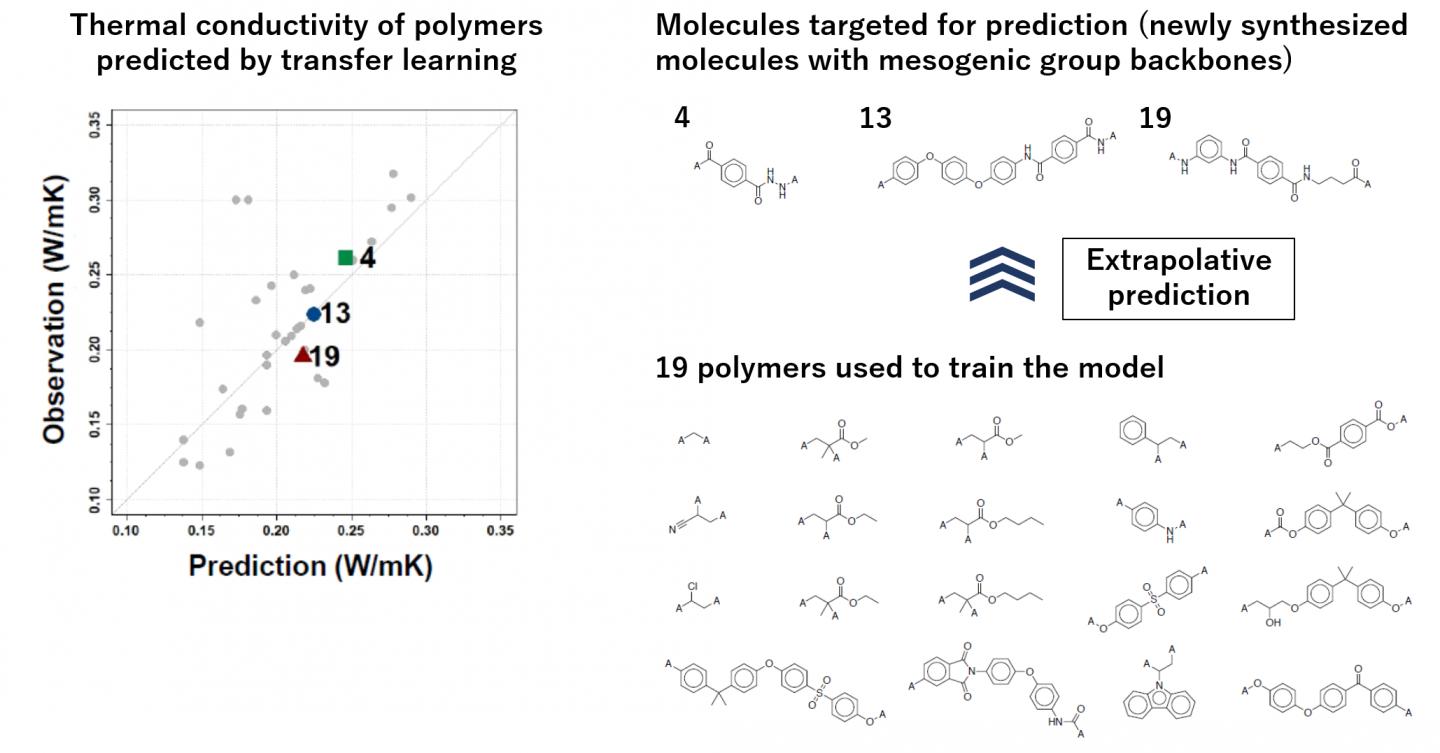
Transfer learning may serve as a solution to the scarcity of materials property data
IMAGE

Credit: Ryo Yoshida

A joint research group consisting of the Institute of Statistical Mathematics (ISM) and the National Institute for Materials Science (NIMS) has developed approximately 140,000 machine learning models capable of predicting 45 different types of physical properties in small molecules, polymers and inorganic materials. The joint group then made XenonPy.MDL – a pre-trained model library – publicly available.

XenonPy – an open source platform for materials informatics (MI) research – was jointly developed by NIMS and a team at the ISM Data Science Center for Creative Design and Manufacturing (Chang Liu (Project Assistant Professor), Yoh Noguchi (Project Researcher), Stephen Wu (Assistant Professor), Hironao Yamada (Project Researcher) and Ryo Yoshida (Center Director)).

XenonPy uses machine learning algorithms to perform various tasks of MI. Users of XenonPy can run the pre-trained models available in the XenonPy.MDL library via the application programming interface (API) and use them to construct a variety of materials design workflows. The joint group recently reported the release of XenonPy.MDL in a research article published in ACS Central Science, a journal of the American Chemical Society.

In addition, as described in the article, the group succeeded in demonstrating the great potential of transfer learning to overcome the problem of limited amounts of materials data in various tasks of MI (i.e., predicting the physical properties of small molecules, polymers and inorganic crystalline materials using exceedingly limited materials data).

###

This research project was supported in part by the JST “Materials Research by Information Integration” Initiative (MI2I) and was conducted at NIMS between FY2015 and FY2019.

Media Contact
URA Station Planning Unit
[email protected]

Related Journal Article

http://dx.doi.org/10.1021/acscentsci.9b00804

Tags: Algorithms/ModelsCalculations/Problem-SolvingMaterialsMathematics/Statistics
Share13Tweet8Share2ShareShareShare2

Related Posts

Hebrew University Congratulates Haim Sompolinsky on Receiving 2026 Dirac Medal

Hebrew University Congratulates Haim Sompolinsky on Receiving 2026 Dirac Medal

August 8, 2026
New brain model reveals how regional chemistry shapes large-scale neural activity

New brain model reveals how regional chemistry shapes large-scale neural activity

August 8, 2026

Topological coupler breaks bandwidth tradeoff in broadband coupled resonator waveguides

August 8, 2026

Radical Chemistry Selectively Cleaves Strong Bonds While Preserving Weaker Ones

August 7, 2026
Please login to join discussion

POPULAR NEWS

  • Short-Term Animal-Product Restriction Rapidly Alters Human Proteogenomic Profiles

    29 shares
    Share 12 Tweet 7
  • UVA-Induced Hyperploidization Causes Fibrosis in Post-Mitotic Fuchs Dystrophy Corneal Cells

    29 shares
    Share 12 Tweet 7
  • Study Explores PDLIM2 as Prognostic Biomarker and Treatment Target in Lung Adenocarcinoma

    29 shares
    Share 12 Tweet 7
  • Healthy Vaccinee Effect Shapes Evaluation of Updated COVID-19 Vaccines in Older Adults

    29 shares
    Share 12 Tweet 7

About

We bring you the latest biotechnology news from best research centers and universities around the world. Check our website.

Follow us

Recent News

Short-Term Animal-Product Restriction Rapidly Alters Human Proteogenomic Profiles

UVA-Induced Hyperploidization Causes Fibrosis in Post-Mitotic Fuchs Dystrophy Corneal Cells

Study Explores PDLIM2 as Prognostic Biomarker and Treatment Target in Lung Adenocarcinoma

Subscribe to Blog via Email

Enter your email address to subscribe to this blog and receive notifications of new posts by email.

Join 86 other subscribers
  • Contact Us

Bioengineer.org © Copyright 2023 All Rights Reserved.

Welcome Back!

Login to your account below

Forgotten Password?

Retrieve your password

Please enter your username or email address to reset your password.

Log In
No Result
View All Result
  • Homepages
    • Home Page 1
    • Home Page 2
  • News
  • National
  • Business
  • Health
  • Lifestyle
  • Science

Bioengineer.org © Copyright 2023 All Rights Reserved.