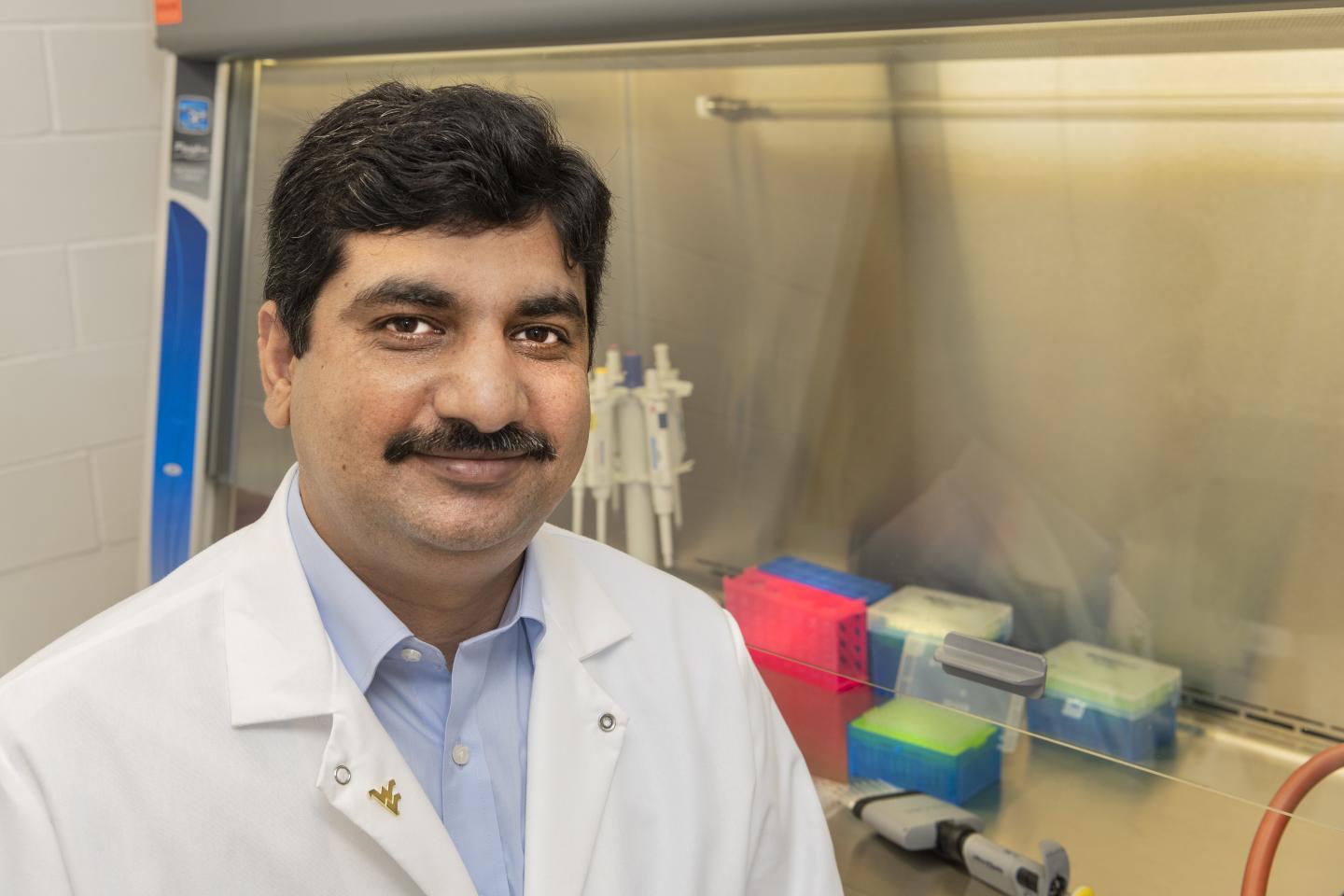
Credit: Greg Ellis/West Virginia University
Each time we breathe in, we’re not inhaling just one component that seeps into our lungs. It’s a medley of gasses and particles – both natural and human-made – that can unleash unknown consequences on respiratory health.
One knowledge gap to understanding the effects of inhaling outdoor air pollution, according to Salik Hussain, assistant professor of physiology and pharmacology at the West Virginia University School of Medicine, is that the scientific community has largely focused on studying only individual toxicants, such as particles or gases.
In reality, Hussain said, “we inhale a mixture of everything.”
Through the aid of a five-year, $3 million grant from the National Institutes of Health, Hussain will delve into the impact of inhalation co-exposure, namely from particles and ozone, on lung tissue regeneration.
“If we look at how environmental particles or gasses are studied at this moment, they are studied as individual components 99 percent of the time,” said Hussain, who runs the Hussain Lab, which researches pulmonary and systemic health effects of inhalation exposure. He’s also a member of the WVU Center for Inhalation Toxicology.
“Developing and studying the co-exposure scenario in a standardized, controlled fashion, such as a laboratory setting,” Hussain said, “will enable a better mechanistic understanding of how environmental exposures result in adverse outcomes.”
His aim is twofold: To steer policy and decision-making pertaining to mixed environmental pollutants, and to improve health and well-being in susceptible populations.
Specifically, he plans to identify adverse outcomes of carbon black (a surrogate of the carbon core of ultrafine particles) and ground level ozone (the most reactive gas component of air pollution) inhalation, and study mechanisms leading to lung injury and impairment of lung regeneration.
In real world/co-exposure situations, unanticipated outcomes can occur such as ultrafine air pollution particles carrying other pollutants into areas of lungs usually not affected by those pollutants.
Gaseous components can modify the surfaces of particles to make them more reactive, Hussain said. This can lead to either aggravation or heightened susceptibility to more severe clinical outcomes such as acute lung injury, a serious pulmonary condition with up to 40 percent mortality that kills nearly 200,000 Americans each year.
With this funding, Hussain plans to study how air pollution inhalation leads to changes in susceptibility to develop ALI and impact the ability of the lungs to regenerate after ALI. He will be studying mechanistic pathways of lung stem/progenitor cells reprogramming after inhalation of the toxicants.
According to the World Health Organization, more than four million deaths are linked to outdoor environmental pollution each year.
“Environmental health is not a developing country’s problem,” Hussain said. “It is also a developed country’s problem. My work has a translational angle, where the goal is to improve the health of the communities and people across the world.”
The NIH grant awarded to Hussain is part of one of the National Institute of Environmental Health Sciences signature programs, the highly-competitive Outstanding New Environmental Scientist Award, designated to cultivate the next leaders in environmental health sciences.
Hussain holds a secondary appointment in the department of Microbiology, Immunology and Cell Biology.
###
Media Contact
Jake Stump, Director of Research Communications
[email protected]
Original Source
https:/