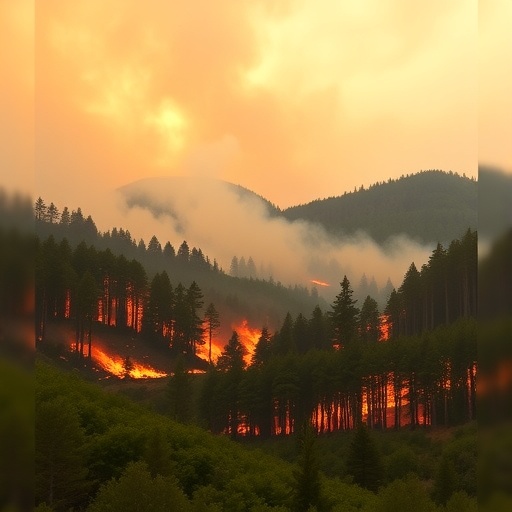
A groundbreaking artificial intelligence system developed by engineers at West Virginia University promises to revolutionize wildfire monitoring and response. This new framework empowers satellites to not only detect wildfires but also autonomously adjust their orbits for continuous, focused surveillance as fires spread rapidly across terrain.
Traditional wildfire monitoring technologies like drones and ground-based sensors are constrained by limited coverage areas and infrastructure requirements. Satellites, however, offer global reach and can scan vast territories within days, making them ideal for tracking unpredictable wildfires. The WVU team, led by aerospace engineering doctoral candidate Brycen Pearl and professor Hang Woon Lee, devised the WildFire-applicable Intelligent and Responsive Ensemble for Detection and Scheduling (WildFIRE-DS). This AI-driven system analyzes satellite imagery in near-real time, verifies wildfire detection using statistical methods, and dynamically retasks satellites to optimize their observation schedules.
Wildfires are notoriously challenging to monitor because of their speed—sometimes surging at 15 to 20 miles per hour—and complex interactions with environmental factors like wind patterns, vegetation density, and topography. Pearl explains that fires can even create localized weather phenomena, such as fire-induced thunderstorms, further complicating predictions. The WildFIRE-DS system incorporates these complexities by leveraging sensors aboard satellites that collect data on surface temperature, vegetation, and atmospheric conditions—critical variables influencing fire behavior.
Unlike existing satellite constellations like FireSat and OroraTech’s Wildfire Constellation, which use AI primarily for image interpretation, WVU’s technology adds a crucial layer: the ability for satellites to autonomously reposition themselves to improve coverage over evolving fire zones. This maneuverability ensures more frequent revisits of critical areas, enabling faster updates and more effective ground response coordination.
The urgency for such innovation was underscored by catastrophic events like California’s 2025 Palisades fire, which devastated tens of thousands of acres and caused billions in losses. Rapid detection and communication remain vital to limiting wildfire damage, a goal supported by complementary technologies such as ALERTCalifornia’s AI-powered camera network. By extending these concepts into space with enhanced AI and satellite constellations, WildFIRE-DS aims to give firefighting teams the precious head start needed to save lives and property.
Professor Lee emphasizes that while advances in ground sensors and drones continue to improve firefighting capabilities, satellites equipped with AI offer unparalleled global surveillance without dependence on local infrastructure. With AI-enabled satellites autonomously adjusting their monitoring schedules, wildfire containment efforts stand to become more proactive and efficient, potentially transforming disaster management on a planetary scale.
This pioneering work was funded by the NASA West Virginia Established Program to Stimulate Competitive Research and is detailed in the Journal of Aerospace Information Systems.
Article Title: Automating the Wildfire Detection and Scheduling Pipeline with Maneuverable Earth Observation Satellites
News Publication Date: 19-Jun-2026
Web References: http://dx.doi.org/10.2514/1.I011883
Image Credits: WVU Photo/Brian Persinger
Keywords
Wildfires, Satellite Monitoring, Artificial Intelligence, Aerospace Engineering, Earth Observation, Smoke Detection, Fire Behavior, Remote Sensing, Maneuverable Satellites
Tags: AI-driven wildfire detectionautonomous satellite orbit adjustmentdynamic satellite schedulingenvironmental sensors for wildfire detectionglobal wildfire surveillance systemsmachine learning in wildfire predictionreal-time wildfire imagery analysissatellite-based wildfire tracking technologywildfire monitoring challengeswildfire response and managementWildfire satellite monitoringwildfire-induced weather phenomena