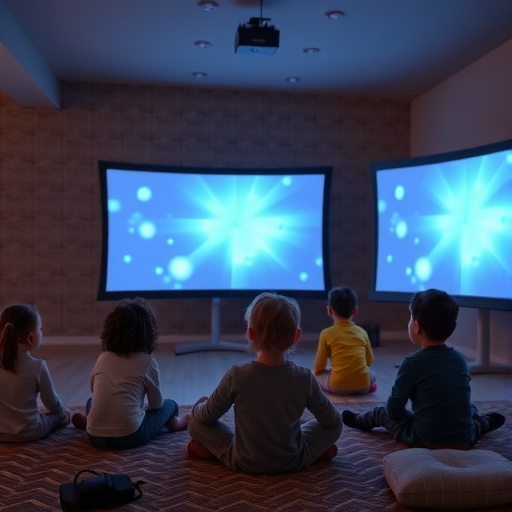
A recent study from The Ohio State University reveals complex links between parents using digital screens to soothe their young children’s emotional distress and the development of critical cognitive skills. This research, published in the Journal of Communication, challenges simplistic assumptions about screen time and child development by highlighting individual variability shaped by parental mental health and child behavior patterns.
Focusing on executive functions—key cognitive abilities such as cognitive flexibility and inhibitory control—the study examined data from Project M.E.D.I.A., a longitudinal survey conducted by Brigham Young University tracking children between 2½ and 7½ years of age. Cognitive flexibility enables young children to adapt to changing situations and perspectives, while inhibitory control helps them suppress impulsive reactions, both foundational to effective learning and social interaction.
Lead researcher Jane Shawcroft explains that media emotion regulation—the use of technology by parents to calm upset children—interacts with these executive functions in a dynamic feedback loop. For most children, this relationship is bidirectional: a child’s difficulty in self-regulation prompts increased screen use by parents, which in turn influences the child’s cognitive development, perpetuating a cyclical pattern over time.
However, the study uncovered two distinct outlier groups. In roughly 6% of cases, the expected relationship between media emotion regulation and the cognitive skills diverged in ways the researchers could not fully explain, prompting further data collection. Another 7% of children showed a one-way effect: screen use shaped cognitive skill development, but children’s cognitive abilities did not influence parental screen use decisions. Notably, parents in this subgroup reported higher rates of depression, implicating mental health as a critical factor influencing how families utilize technology for emotion regulation.
These findings emphasize that parental mental health deeply affects technology use in childcare, positioning screen time as a coping mechanism when resources are scarce. Shawcroft stresses that framing parental screen use as a moral failing overlooks the underlying struggle and that societal support for parental well-being is essential. Expanding access to alternative emotion regulation tools—such as outdoor play spaces and mindfulness practices—may mitigate overreliance on screens.
The study reframes the conversation about children, technology, and parenting, advocating for broader community engagement rather than placing responsibility solely on parents. Enhancing parental mental health and creating supportive environments could foster healthier developmental trajectories and more balanced media relationships in young children.
As digital media becomes increasingly entwined with early childhood experiences, this nuanced research underscores the need for tailored interventions and compassionate societal frameworks to navigate the evolving landscape of parenting in the digital age.
Subject of Research: People
Article Title: Media emotion regulation and executive functions: individual differences in temporal ordering among young children
News Publication Date: 9-Jul-2026
Web References: https://doi.org/10.1093/joc/jqag009
Keywords
Cognitive development, Executive functions, Media emotion regulation, Parenting, Child development, Mental health, Screen time, Cognitive flexibility, Inhibitory control
Tags: bidirectional effects of media use and child self-regulationChild emotional regulation and screen timecognitive flexibility and inhibitory control developmentimpact of screen time on early childhood learningindividual variability in response to screen-based calminginfluence of parental mental health on children’s cognitive skillslong-term effects of media emotion regulation on child growthlongitudinal studies on child development and screen exposureoutlier groups in child development related toparental mental health and digital media userisks and benefits of using screens to soothe children