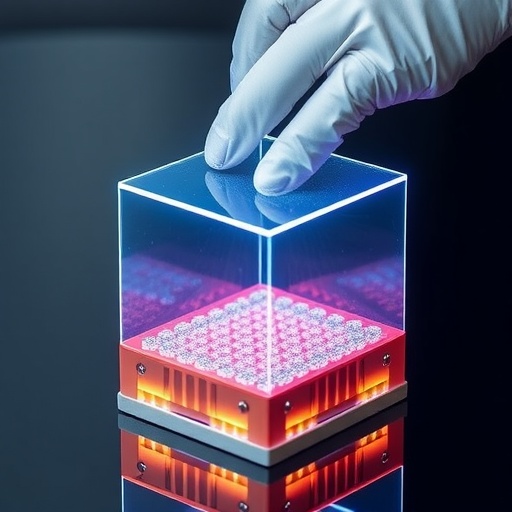
A groundbreaking development from the University of Illinois Urbana-Champaign engineers promises to revolutionize carbon dioxide capture by mimicking the mechanisms used in battery charging and discharging. This innovation offers a fresh approach to addressing the growing challenge of excess atmospheric CO2, distinct from traditional heat-based carbon capture techniques.
The collaborative research, conducted alongside Toyota Research Institute of North America, centers on direct air capture (DAC) technology designed to extract CO2 directly from the surrounding air, rather than at concentrated emission points like power plants. The new device leverages electricity and water-based electrochemical reactions within a specialized electrochemical cell, circumventing the need for thermal energy typically required for CO2 absorption and release.
At the heart of this novel system lies a pair of potassium-stabilized manganese dioxide electrodes working in tandem within a cation-compensated cell. By cycling the pH level of a saltwater solution electrochemically, the device first increases alkalinity to absorb CO2 efficiently from ambient air. Subsequently, it lowers the alkalinity to release concentrated and purified CO2 gas, which can then be sequestered or repurposed, all without reliance on high-temperature processes.
This electrochemical approach is distinguished by the use of proton-intercalation electrodes, which enable operation within an alkaline environment where CO2 solubility is significantly enhanced. This is a critical factor in making DAC practical and energy-efficient, addressing the challenge of capturing CO2 present at low concentrations in the atmosphere.
The research team adopted a thermodynamic framework analogous to classical power plant cycles, but instead of conventional pressure-volume dynamics, they analyzed the cycle through changes in dissolved inorganic carbon and potassium ion concentrations. This innovative mapping pinpointed energy losses within the process and guided optimizations to improve cycle efficiency and reduce power consumption.
While early laboratory results demonstrate promising potential, challenges remain for real-world deployment. One major hurdle is the inter-stream mixing of two liquid flows within the device, which can diminish both efficiency and CO2 capture rates. The researchers are actively exploring ways to minimize this mixing, which could yield significant gains in energy use and overall productivity.
Supported by grants from Toyota, the University of Illinois’s Campus Research Board, and its Grainger College of Engineering, this research represents a pioneering step towards scalable electrochemical direct air capture. It opens avenues for novel materials and process engineering to tackle the persistent legacy of atmospheric carbon that conventional emission reductions alone cannot resolve.
Beyond its immediate environmental implications, this work also underscores the synergy between electrochemistry and process design in developing low-energy, high-efficiency carbon capture solutions. Through the combination of innovative electrode materials and refined thermodynamic cycling, this technology could become a vital tool in the global effort to mitigate climate change.
Subject of Research: Electrochemical direct air capture of carbon dioxide
Article Title: Toward a low-energy direct-air capture cycle by reversible proton-intercalation-mediated alkalization
News Publication Date: 27-Jun-2026
Web References: https://pubs.acs.org/doi/10.1021/acs.est.6c04593
Image Credits: Photo by Michelle Hassel
Keywords
Direct air capture, CO2 removal, electrochemical cell, potassium-stabilized manganese dioxide electrodes, proton intercalation, alkalization cycle, climate mitigation, low-energy carbon capture, thermodynamic cycle
Tags: battery-inspired carbon capture devicesclimate change mitigation through electrochemical devicesdirect air carbon captureelectrochemical cell for ambient CO2 extractionelectrochemical CO2 removal technologyinnovative approaches to reducing atmospheric greenhouse gaseslow-energy carbon capture methodspH cycling for CO2 separationpotassium manganese dioxide electrodessaltwater electrolysis for CO2 sequestrationsustainable direct air capture solutionswater-based electrochemical CO2 absorption