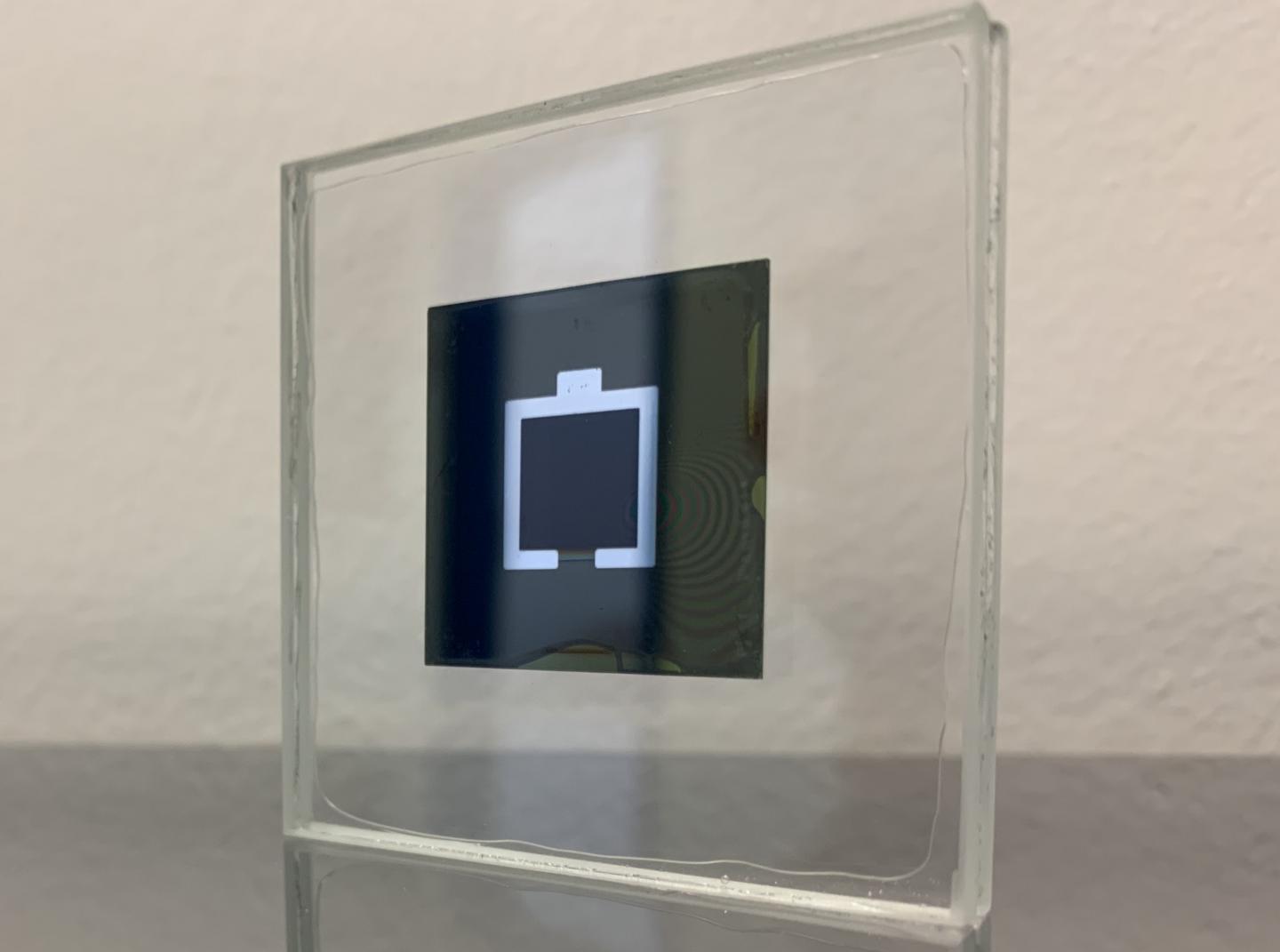
Credit: Eike Köhnen/HZB
While silicon converts mostly the red portions of sunlight into electricity, perovskite compounds primarily utilise the blue portions of the spectrum. A tandem solar cell made of stacked silicon and perovskite thus achieves significantly higher efficiency than each individual cell on its own.
Prof. Bernd Stannowski from the HZB Institute PVcomB and Prof. Steve Albrecht, who heads a Helmholtz Young Investigator Group (YIG) at HZB, have already jointly set new records for monolithic tandem solar cells on several occasions. At the end of 2018, the team presented a tandem solar cell made of silicon with a metal-halide perovskite that achieved an efficiency of 25.5 per cent. Then Oxford Photovoltaics Ltd. announced a value of 28 per cent.
Now the HZB team can report the next record. The value of 29.15 per cent has been certified by the Fraunhofer Institute for Solar Energy Systems (ISE) on Friday, Jan. 24th and now appears in the charts of the National Renewable Energy Lab (NREL), USA. The NREL chart has been tracking the rising efficiency levels for nearly all types of solar cell since 1976. Perovskite compounds have only been included since 2013 – and the efficiency of this class of material has increased more than in any other material since then.
“We developed a special electrode contact layer for this cell in collaboration with the group of Prof. Vytautas Getautis (Kaunas University of Technology), and also improved intermediate layers”, explain Eike Köhnen and Amran Al-Ashouri, doctoral students in Albrecht’s group. The new electrode contact layer also permitted improvement of the perovskite compound’s composition in the HZB HySPRINT laboratory. This compound is now more stable when illuminated in the tandem solar cell and improves the balance of electrical currents contributed by the top and bottom cells. The silicon bottom cell comes from Stannowski’s group and features a special silicon-oxide top layer for optically coupling the top and bottom cells.
All processes used to realise this one-square-centimeter cell are also suitable in principle for large surface areas. Scaling up with the help of vacuum deposition processes is very promising, as initial tests have already shown.
The realistic practical efficiency limit for tandem cells made of silicon and perovskite is about 35 per cent. Next, the HZB team wants to break the 30 per cent efficiency barrier. Albrecht explains that initial ideas for this are already under discussion.
###
More Information:
Steve Albrecht heads the junior research group Perovskite Tandem Solar Cells and is a junior professor at the TU Berlin. He is researching the organic-inorganic material perovskite, which is one of the biggest surprises in solar cell research: In just six years, the efficiency of perovskite solar cells has quintupled. In addition, perovskite layers can be produced from solution and in future can be printed cost-effectively on large areas.
Albrecht’s team, in cooperation with other groups from HZB, has already set several world records for tandem solar cells made of perovskite in combination with inorganic semiconductors. In September 2019, they presented a tandem solar cell made of CIGS and perovskite that achieves a certified efficiency of 23.26 percent, which is still the current world record for this material combination. They also developed an industry relevant perovskit/PERC solar cell in 2019 with a PV industry partner.
Media Contact
Antonia Roetger
[email protected]
Original Source
https:/