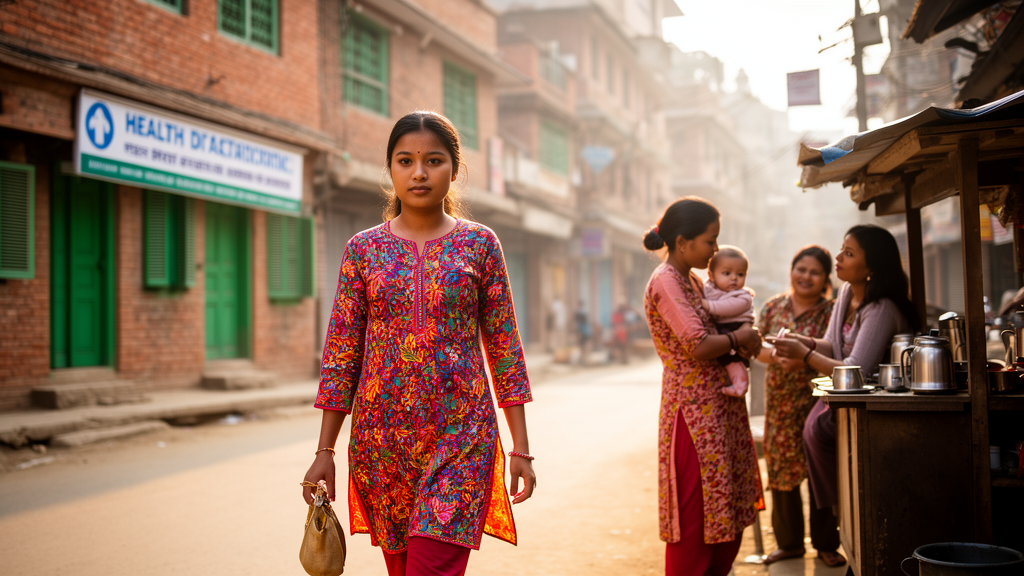
Women in Nepal who scored highly on a measure of social independence were more likely to complete the full continuum of maternal and newborn health care, from pregnancy through the postpartum period, according to a cross-sectional study published in BMC Public Health. The association was strongest in urban areas and was not statistically significant in rural settings, a contrast the authors say points to the limits of individual empowerment where health systems and geography constrain access.
The research team, led by Anil Sigdel with colleagues including Dinesh Neupane and Karun Kishor Karki, analyzed data from the 2022 Nepal Demographic and Health Survey. Their sample included 1,876 married women aged 15 to 49 years who had children under two years of age. To quantify empowerment, the researchers used the survey-based Women’s emPowERment (SWPER) index, a validated tool that summarizes women’s standing across three domains: attitudes towards violence, social independence, and household decision-making.
The outcomes examined spanned the maternal and newborn health service cascade. These were four or more antenatal care visits, delivery in a health facility, postnatal care within 48 hours for both mother and newborn, and completion of the full continuum of care. The team used multivariable logistic regression to estimate prevalence odds ratios for the association between each empowerment domain and service utilization, with analyses stratified by place of residence.
The distribution of empowerment scores differed markedly by domain. Overall, 81.7 percent of women were classified as highly empowered in attitudes towards violence, with 83.4 percent in urban areas versus 78.6 percent in rural areas. Only 36.1 percent showed high social independence, and here the urban-rural gap was wider: 39.7 percent of urban women versus 29.2 percent of rural women. High household decision-making was the least common classification at 32.6 percent overall, and in this domain rural women slightly outpaced urban women, at 33.7 percent versus 32.1 percent.
The central finding concerned social independence. Women with high social independence had higher odds of completing the maternal and newborn health continuum of care compared with those with low independence, with a prevalence odds ratio of 1.61 (95 percent confidence interval 1.10 to 2.36). When the analysis was split by residence, the association remained significant in urban areas, with a prevalence odds ratio of 1.70 (95 percent confidence interval 1.01 to 2.84), but not in rural areas, where the estimate was 1.52 (95 percent confidence interval 0.87 to 2.65) and included the null value.
Other results were more mixed and, in some cases, ran in an unexpected direction. Household decision-making was not significantly associated with most maternal and newborn health services. However, among rural women, those with high decision-making status were significantly less likely to attend four or more antenatal care visits, with a prevalence odds ratio of 0.44 (95 percent confidence interval 0.23 to 0.85). Similarly, in rural settings, women with high empowerment regarding attitudes towards violence were less likely to deliver in a health facility than those with low empowerment in that domain, with a prevalence odds ratio of 0.21 (95 percent confidence interval 0.06 to 0.66).
The authors conclude that higher social independence is associated with greater utilization of maternal and newborn health services, particularly in urban settings, whereas in rural Nepal empowerment alone appears insufficient to overcome health system and geographic barriers to accessing services. They recommend that public health interventions move beyond individual empowerment and adopt cross-sectoral strategies that simultaneously address structural constraints and improve service accessibility in remote regions.
As a cross-sectional analysis of a single survey round, the study captures associations at one point in time and cannot establish causal relationships between empowerment and service use. The findings are specific to married women in Nepal with children under two years, and the wide confidence intervals on several estimates, particularly in the rural strata, reflect the precision limits of the sample. The article was published as an open-access research paper on 26 September 2026, and the version shared ahead of final publication remains subject to further editorial edits before the version of record is finalized.
Subject of Research: The association between women's empowerment measured by the SWPER index and utilization of maternal and newborn health services in Nepal
Article Title: Measuring the association between women’s empowerment using SWPER index and utilization of maternal and newborn health services from pregnancy to postpartum in Nepal
Article References: Sigdel, A., Bhattarai, A. H., Neupane, D., Bista, A., Khatri, R. B., Dulieu, N., & Karki, K. K. (2026). Measuring the association between women’s empowerment using SWPER index and utilization of maternal and newborn health services from pregnancy to postpartum in Nepal. BMC Public Health. https://doi.org/10.1186/s12889-026-29691-1
Image Credits: AI Generated
DOI: 10.1186/s12889-026-29691-1
Keywords: women's empowerment, SWPER index, Nepal, maternal health, newborn health, continuum of care, antenatal care, postnatal care, DHS survey, urban-rural disparities, health service utilization, Measuring
News Source: Harold Sullivan. (October 28, 2026). Women’s Social Independence Tied to Better Maternal Care Use in Urban Nepal. Scienmag.