In the hyper-arid agricultural expanses of Northwest China, three decades of intensive drip irrigation have expanded without triggering the widespread crop yield collapse that critics long predicted from secondary soil salinization. A perspective published in npj Sustainable Agriculture by researchers including Yaning Chen, Zhenhua Wang, Feihu Yin, Chenggang Zhu, and Chuanxiu Liu demonstrates how this stability is maintained through an integrated regulatory system rather than drip technology operating in isolation. Focusing on the quintessential inland drainage basin of the Tarim River in the Xinjiang Uygur Autonomous Region, where annual precipitation falls below one hundred millimeters while annual potential evaporation exceeds twenty-five hundred millimeters, the authors examine the underlying mechanisms governing soil water and salt transport. Under these severe atmospheric conditions, upward capillary migration routinely drives mineral salts into the topsoil. While mulched drip irrigation has expanded across more than seventy million mu, or approximately four point six seven million hectares, in Xinjiang as of 2024 to curb evaporative losses and sustain crops like cotton, its long-term viability depends strictly on seasonal flood leaching and engineered drainage networks.
Drip irrigation functions by delivering water directly into the crop root zone as point or line sources, generating an ellipsoidal wetting bulb that fundamentally alters the spatial distribution of soil salinity across the field profile. In the primary root zone, specifically within the top forty centimeters of the soil layer directly beneath emitters, irrigation water consistently exerts an active salt-leaching effect. This process establishes a localized desalinization zone that provides a favorable, low-salinity micro-environment essential for seed germination and early seedling development. However, the depth of water infiltration beneath drip systems is inherently constrained, typically penetrating to only fifty to eighty centimeters, which is substantially shallower than conventional flood irrigation. Because the downward water flux does not propel dissolved solutes into deep geological strata or regional groundwater tables, the displaced salts inevitably accumulate around the peripheral wetting front and within deeper sub-plow layers, creating a pronounced spatial interleaving of desalinated root zones and highly concentrated peripheral salt bands.
The spatial heterogeneity of this salinity profile is intensified by intense evaporative demand acting on exposed ground surfaces between mulched crop rows. Under mulched drip irrigation systems, plastic film effectively suppresses evaporation directly over the primary root zones, but bare inter-film strips and exposed inter-plant spaces become the primary conduits through which soil vapor discharges into the dry atmosphere. Consequently, continuous capillary pull transports dissolved solutes upward, producing heavy salt encrustation and persistent surface gathering along the borders of cultivated strips. Long-term monitoring studies across continuous cultivation chronosequences reveal that soil salinity follows a characteristic parabolic trajectory of initial desalinization followed by subsequent salt resurgence rather than a simple, linear progression. During approximately the first six years of continuous drip management under typical regional field conditions, irrigation-induced leaching steadily decreases plow-layer salinity. Over longer horizons, however, the progressive expansion of salt pools at the wetting boundaries gradually erodes this initial desalinization capacity, re-establishing chronic salinization risks across the wider profile.
Quantitative field evaluations documented in the review highlight both the temporal lags and vertical contrasts that define multi-year drip irrigation. In investigated field profiles, the average desalinization rate within the top one hundred centimeters reached eighty-four point eight nine percent after eight years of continuous drip irrigation, yet researchers simultaneously detected a relatively stable salt accumulation layer situated between sixty and one hundred and fifty centimeters below the surface. In parallel longitudinal observations of the cultivated plow layer, soil salinity dropped marginally from three point one zero grams per kilogram to three point zero zero grams per kilogram after three years of drip management, but subsequently rebounded to four point eight one grams per kilogram after twelve years of continuous practice. The authors outline three distinct drivers behind this multi-year accumulation: strong capillary rise from shallow, saline water tables in plain areas; the influx of dissolved salts leached by mountainous headwater rivers traversing Tertiary saline formations; and the deliberate practice of tailoring drip quotas strictly to crop transpiration needs rather than leaching requirements.
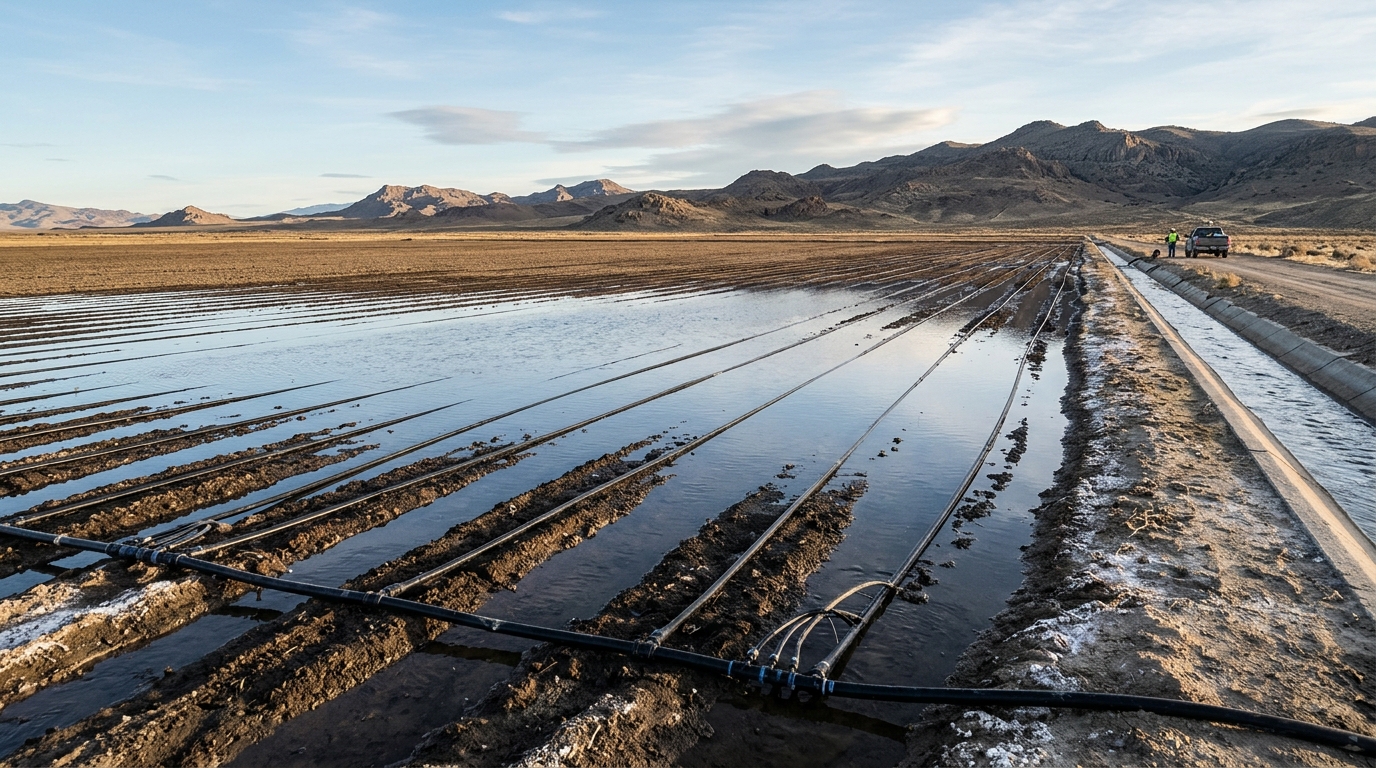
Because growing-season drip quotas are calibrated solely to fulfill crop water demands under severe resource constraints, the volume applied remains fundamentally incapable of achieving full-profile solute evacuation, making net multi-year salt buildup inevitable unless balanced by off-season interventions. The paper resolves this water-salt paradox by demonstrating that regional crop productivity has been sustained through the systematic integration of autumn and winter flush irrigation, traditionally termed winter irrigation for salt suppression or autumn flushing for salt leaching. Applied after the autumn harvest, this practice employs non-growing-season river water to dissolve solutes accumulated within the plow layer and push them into deeper subsoil horizons. Field experiments across salinized cotton fields in northern Xinjiang show that winter irrigation quotas ranging between three thousand and forty-two hundred cubic meters per hectare decrease total salt content in the zero-to-one-hundred-centimeter profile by thirty point eight nine to forty-six point three seven percent before spring plowing.
The salt-suppression efficacy of autumn and winter irrigation operates through three interconnected hydrological and physical mechanisms: deep hydraulic leaching, water-table regulation, and thermodynamic inhibition during winter freeze-thaw cycles. Within the Tarim irrigation districts, field studies determine that the optimal winter irrigation quota averages approximately thirty-five hundred cubic meters per hectare, representing approximately forty-seven to sixty-three percent of the cumulative irrigation volume applied during the preceding growing season depending on baseline soil salinity. This post-harvest inundation effectively leaches the zero-to-sixty-centimeter layer, achieving an effective flushing depth of sixty centimeters that consistently outperforms spring irrigation.
Beyond straightforward hydraulic flushing, winter irrigation fundamentally reshapes seasonal soil moisture and shallow groundwater dynamics, which must be paired with functional engineering drainage to ensure permanent salt removal. Infiltration during the late autumn and early winter temporarily recharges shallow aquifers beneath the fields. As severe winter freezing sets in, water is drawn upward from deep subsoil layers and the underlying water table toward the advancing freezing front, contributing to a temporary seasonal decline in groundwater levels while rendering conventional drainage infrastructure temporarily inactive. When soil thaws in early spring and hydraulic connectivity resumes, functional networks of open surface ditches, subsurface drainage pipes, and vertical pumping wells become essential to capture and evacuate the mobilized, solute-laden drainage water from the basin. The perspective emphasizes that without engineered drainage pathways to export flushed brine out of irrigation districts, winter irrigation alone cannot prevent water tables from rebounding and depositing salts back into the plow layer.
The third dimension of the salt-suppression mechanism involves thermodynamic modifications to the soil during severe winter cold, which alters the physical mechanics of freeze-thaw solute transport. In the arid interior of Northwest China, winter irrigation delays the onset of both seasonal soil freezing and subsequent spring thawing, thereby shortening the overall duration of the annual freeze-thaw cycle. This temporal truncation reduces the persistence of capillary conduits that normally siphon deep groundwater and dissolved mineral solutes upward toward the freezing soil surface. By weakening the thermodynamic driving forces that pull moisture toward freezing boundaries throughout the winter-to-spring transition, post-harvest irrigation suppresses topsoil salt crusting before spring planting. This integrated hydro-thermal response distinguishes winter irrigation from standard seasonal watering, ensuring that leached solutes remain positioned where emerging spring drainage flows can systematically purge them from the root environment.
The selection and institutional persistence of autumn and winter irrigation in the Tarim River Basin are deeply rooted in regional hydrogeological conditions and engineering water management constraints. Southern Xinjiang contains one hundred and eighty-seven reservoirs, among which one hundred and forty-three are shallow plain reservoirs representing seventy-six point seven two percent of the total facility count. Because the cumulative available storage capacity of these reservoirs accounts for less than sixteen percent of the basin’s total annual runoff, surface facilities cannot capture and store abundant late-season water for the following summer. Following the cessation of agricultural irrigation in late summer, stable river baseflow fed by glacial meltwater from the Tianshan, Kunlun, and Karakoram mountains, mid-mountain rainfall, and bedrock fissures continues flowing through regional river channels. Diverting this surplus autumn and winter baseflow onto agricultural fields converts otherwise unmanageable water that would evaporate in downstream desert reaches into a vital tool for leaching salts while storing water underground to support spring planting.
The authors conclude that sustaining agricultural productivity under long-term drip irrigation in global drylands depends entirely on maintaining a dual-stage balance between growing-season water savings and off-season solute evacuation. Similar seasonal flushing practices support irrigated production in northern China’s Hetao Irrigation District, the Mediterranean basin, the southwestern United States, and Australia’s Murray-Darling Basin, confirming that water-saving field methods cannot function indefinitely as standalone solutions without basin-level salt export. Looking ahead, the researchers outline three essential scientific priorities: optimizing post-harvest leaching quotas to minimize water consumption while maximizing salt removal across heterogeneous soils; deploying automated soil sensors, telemetry, and decision-support systems to integrate real-time water-salt monitoring with drainage controls; and establishing comparative international frameworks to evaluate how this integrated Chinese management model can be adapted to other arid agricultural regions confronting escalating water scarcity.
Subject of Research: Soil salinity dynamics and water-salt balance mechanisms under long-term drip irrigation in arid regions
Article Title: Mechanisms sustaining stable crop yields under long-term drip irrigation in arid regions
Article References: Chen, Y., Wang, Z., Yin, F., Zhu, C., & Liu, C. (2026). Mechanisms sustaining stable crop yields under long-term drip irrigation in arid regions. npj Sustainable Agriculture, 4(1), Article 90. https://doi.org/10.1038/s44264-026-00198-x
Image Credits: AI Generated
DOI: 10.1038/s44264-026-00198-x
Keywords: Drip Irrigation, Soil Salinization, Autumn-Winter Irrigation, Tarim River Basin, Water-Salt Balance, Agricultural Drainage, Arid Agriculture, Cotton Production, Mechanisms, sustaining, stable, crop
News Source: Alan Morgan. (November 6, 2026). Winter Flooding and Drainage Sustain Arid Cropland Under Long-Term Drip Irrigation. Scienmag.