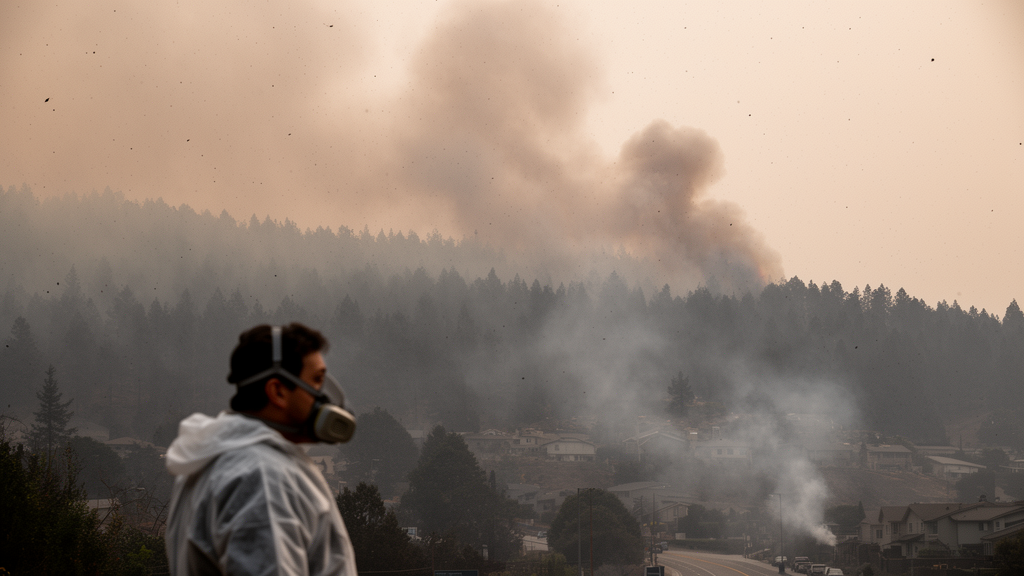
Two large observational studies led by researchers at the Icahn School of Medicine at Mount Sinai found that wildfire-related fine particulate matter was associated with more severe health effects than comparable concentrations of PM2.5 from non-wildfire sources. A retrospective, registry-based cohort study of 414,016 adults aged 65 or older with lung cancer found that wildfire-related PM2.5 was linked to a substantially greater mortality risk per unit of long-term exposure than non-wildfire PM2.5. A separate analysis of hospitalization records across 20 U.S. states found stronger associations between wildfire PM2.5 and cardiovascular and pulmonary admissions than for comparable concentrations of pollution from other sources. The results, published in The Lancet Oncology and Nature Communications, do not establish that wildfire smoke caused the additional deaths and hospitalizations, but they indicate that the source of PM2.5 may matter when assessing its health effects.
Wildfire-related PM2.5 is a mixture of microscopic airborne particles that can penetrate deep into the lungs and enter the bloodstream. The Mount Sinai team separated estimated exposures to wildfire-related and non-wildfire PM2.5 so their health associations could be compared at equivalent concentrations. The investigations examined long-term exposure rather than the acute effects of a single smoky day. One study assessed survival after a lung cancer diagnosis, while the other examined hospitalization rates for a broad range of heart and lung conditions over more than a decade. Together, the studies address different outcomes and populations, and their results do not show that all particles contribute equally to health risks.
For the lung cancer analysis, published in The Lancet Oncology on September 15, 2026, researchers used the SEER-Medicare database to identify 414,016 adults aged 65 or older diagnosed with lung cancer. Estimates of total ambient PM2.5 were developed by the research team, while wildfire-specific PM2.5 estimates were based on work published by researchers at Stanford University. These geographic exposure estimates were linked to the places where participants lived. Both wildfire-related and non-wildfire PM2.5 were associated with increased mortality risk following diagnosis. When investigators compared equivalent increases in exposure, however, wildfire-related PM2.5 showed a substantially larger association with mortality, suggesting that an overall PM2.5 measure may not capture the full health relevance of the particles’ source.
The study estimated that wildfire-related PM2.5 accounted for only about 4% of total PM2.5 exposure in the study population, yet it was associated with about 17% of mortality related to total PM2.5 exposure. These are model-based apportionments rather than direct counts, but they illustrate the disproportionate contribution attributed to wildfire smoke in the analysis. The researchers also estimated that hundreds of annual deaths among study participants were attributable to wildfire-related PM2.5 exposure. Higher numbers of smoky days and longer periods of smoke exposure were associated with poorer survival. Because the study was retrospective and observational, its findings cannot fully separate the toxicity of wildfire particles from other factors associated with residence, health status, access to care or differences in the underlying composition of the pollution.
Senior author Yaguang Wei, an assistant professor of environmental medicine at Mount Sinai, said the findings provide evidence that the source of air pollution matters, not only its amount. He said wildfire-related PM2.5 appeared more harmful than equivalent levels of pollution from other sources. The researchers said future work will seek to identify the specific chemical components responsible for the differences and the biological mechanisms through which wildfire particles may affect cancer survival, cardiovascular health and respiratory disease. The release also noted that wildfire smoke increasingly affects communities beyond traditionally fire-prone regions, exposing large numbers of people in the United States to elevated levels of air pollution and making the exposure a nationwide public-health challenge.
The second study, published in Nature Communications on September 17, 2026, examined hospitalization records for residents of 20 U.S. states between 2006 and 2019. Investigators linked the records to advanced models estimating long-term exposure to wildfire-related and non-wildfire PM2.5. The dataset included more than 57 million cardiovascular hospitalizations and nearly 33 million hospitalizations for pulmonary disease. The outcomes covered heart failure, ischemic heart disease, hypertension, asthma, pneumonia, chronic obstructive pulmonary disease and other respiratory illnesses. At equivalent concentrations, wildfire-related PM2.5 was consistently associated with larger increases in hospitalization risk than PM2.5 from non-wildfire sources. The analysis therefore extended the source-specific pattern observed in the lung cancer cohort to a much broader population and a wider range of cardiopulmonary outcomes.
First author Min Zhang, a postdoctoral fellow in Mount Sinai’s Department of Environmental Medicine, said the large-scale comparison provided an unusual opportunity to examine the health effects of wildfire smoke alongside other sources of air pollution. The analysis found associations across both the lungs and cardiovascular system, with the apparent effects of wildfire PM2.5 stronger than those of similar amounts of pollution from traffic, industry and other sources. As with the cancer study, the work demonstrates population-level associations rather than proving that any particular wildfire-related exposure directly caused an admission. Its estimates depend on exposure models and on the completeness and accuracy of hospitalization records across the included states and years.
The hospitalization analysis identified groups in which the associations were particularly strong: racial and ethnic minority populations, residents of metropolitan areas, and people living in communities with lower educational attainment and higher levels of socioeconomic deprivation. The results show where the observed associations were most pronounced; they do not establish that wildfire smoke was the only pollution-related risk faced by these groups or explain the cause of the differences between subgroups. Wei said the findings may have implications for clinicians and patients, noting that monitoring air quality and limiting exposure during smoke events may be especially important for people with lung cancer or chronic heart and lung diseases. The researchers also called for further work to identify vulnerable patients and develop practical strategies for reducing exposure.
Both studies were conducted by investigators from the Icahn School of Medicine at Mount Sinai, Harvard T.H. Chan School of Public Health, Stony Brook University and New York University. The Nature Communications work was supported by the National Institute of Environmental Health Sciences. Wei described the papers as an important step toward identifying who may be most vulnerable to wildfire smoke and understanding how increasing wildfire activity could affect public health. The findings support treating wildfire PM2.5 as a distinct exposure rather than assuming that pollution from different sources has equivalent effects at the same concentration. The extent to which exposure reduction can improve outcomes, and which biological mechanisms account for the additional risk, will require further research before the observational associations can be translated into effective prevention strategies or clinical guidance.
Subject of Research: Long-term health effects of wildfire-related fine particulate air pollution in the United States
Article Title: Wildfire smoke may be more harmful than other air pollution, two Mount Sinai studies find
Article References: Wildfire smoke may be more harmful than other air pollution, two Mount Sinai studies find. Original publication (Bibliographic details unavailable.)
Image Credits: AI Generated
DOI: Not provided
Keywords: wildfire smoke, PM2.5, air pollution, lung cancer, mortality, cardiovascular disease, respiratory disease, hospitalization risk, environmental health, Wildfire, smoke, harmful
News Source: Russell Cooper. (October 26, 2026). Wildfire PM2.5 linked to greater risks than other air pollution. Scienmag.